Spain grid investment rises to €17 billion through 2030
Spain grid investment will rise above €17 billion by 2030 as the government responds to higher electricity connection demand.
Atlas Newsdesk ·
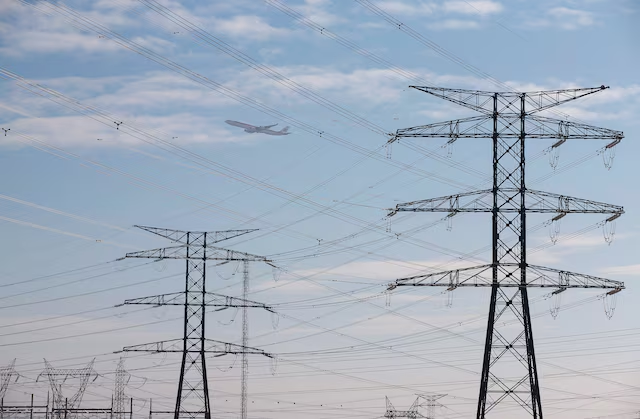
Spain grid investment will rise to more than €17 billion through 2030, a 30% increase aimed at meeting electrification demand.
The new total is equivalent to $19.6 billion at the exchange rate cited by the government, compared with the lower level initially planned. Energy Minister Sara Aagesen announced the decision Wednesday and linked the increase to requests from power users, generators and storage developers.
Aagesen cites record grid spending
Aagesen described the program as “the largest investment in grids in the history of this country.” The statement places transmission capacity at the center of Spain’s energy policy, where renewable power additions have increased the need for wires, substations and connection points.
The ministry said the plan is designed to support Spain’s 2023-2030 National Energy and Climate Plan. That framework sets the government’s energy transition targets for the decade, and the grid budget is intended to help carry more electricity from renewable projects to homes and industrial consumers.
Connection requests reshape the plan
A public consultation showed that general electricity demand made up 41% of the proposals received, the largest share reported by the ministry. Power generation projects accounted for 40%, while energy storage represented 19%, giving demand and supply-side proposals almost equal weight in the planning process.
The demand side includes industry, housing and large electricity users such as data centers, according to Aagesen. Those users require reliable high-capacity links, which can shift grid planning from simply connecting new generation to managing localized consumption growth.
Spain has expanded renewable energy capacity quickly, creating pressure on the transmission network to move output from wind and solar projects to consumption centers. Without sufficient grid capacity, new projects can face connection delays, curtailment risk or higher balancing needs.
Capacity auctions are due next
Aagesen said Spain will soon publish rules for an auction-based capacity market for the electricity system. The mechanism would be open to generation companies, storage operators and some customers, according to the minister.
Participants would receive compensation for being available to supply electricity to the grid or reduce consumption during peak-demand periods or system stress events. The design would give policymakers a second tool alongside network investment: paying for availability when the system needs flexibility.
For renewable developers, the larger grid envelope may improve the path to connection if permitting, procurement and construction keep pace. For storage firms, the planned capacity market could create revenue tied to system reliability rather than energy sales alone.
Three paths for the power system
If connection demand from data centers, housing and industry remains strong, the higher grid budget could help Spain absorb more electricity use without forcing a larger share of projects into waiting queues. The macro effect would be a cleaner electrification path; for large power users, the mechanism would reduce connection bottlenecks; for the sector, it would increase the value of grid-ready sites.
If renewable generation requests dominate the pipeline instead, transmission upgrades would mainly determine how much new wind and solar capacity can be delivered to market. That would support Spain’s climate-plan targets, help developers convert permits into operating assets and intensify competition among power producers seeking viable grid access.
If auction rules are delayed or compensation proves too low, the capacity market may attract less flexible supply and demand response than the government expects. The open question is whether Spain can align grid spending, connection approvals and capacity payments quickly enough to match the demand profile identified in the consultation.