Hong Kong five-year plan adds 196,000 homes and gold push
John Lee’s Hong Kong five-year plan promises 196,000 public housing units while expanding finance, gold trading and mainland-linked technology projects.
Atlas Newsdesk ·
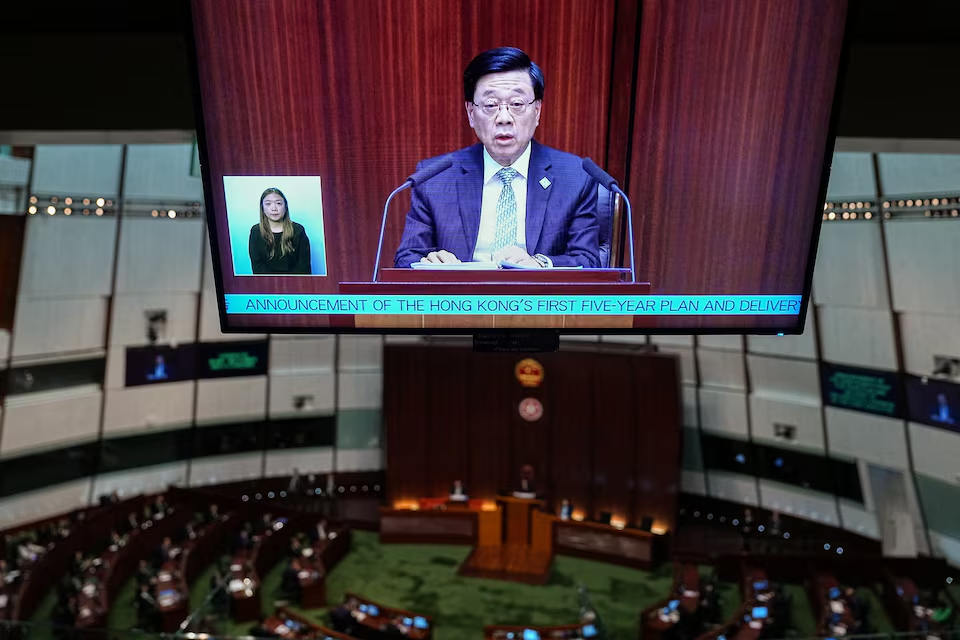
Hong Kong five-year plan promises 196,000 public housing units within five years as John Lee seeks to ease housing pressure and defend the city’s finance role.
Lee unveiled the city’s first such plan on Wednesday after two months of consultations with lawmakers and residents, setting priorities across housing, jobs, education, health, finance and technology. The program follows Beijing’s national five-year plan approved in March for the years to 2030, giving Hong Kong a local road map aligned with mainland policy.
196,000 units set housing marker
The housing pledge is the plan’s clearest domestic test. Lee said supply over the next decade would be split 40% for public rentals, 30% for subsidized flats and 30% for private homes, with the first 196,000 public units due within five years.
Hong Kong’s land scarcity has long kept ownership beyond the reach of many younger households in a city of 7.5 million residents. Lee said the government would encourage upward mobility and improve the housing ladder, tying social policy to a market where property has been a key source of public revenue through land sales.
The plan lands as Lee’s administration faces pressure after the Wang Fuk Court fire in Tai Po last November killed 168 people and left thousands without homes. The disaster added a near-term housing emergency to a shortage that officials have been trying to relieve through new towns, subsidized flats and faster public construction.
Northern Metropolis carries jobs promise
The Northern Metropolis remains the largest physical bet in the plan. First announced in 2021, the 30,000-hectare, or 116-square-mile, area near the mainland China border is intended to house about 2.5 million people once fully developed.
Authorities have said the project would create about 650,000 jobs and include three university campus sites, making it both a housing release valve and a new business district. Lee said completion would support living, work and travel while adding to Hong Kong’s competitiveness.
The location gives the project a second function: linking Hong Kong more tightly with mainland technology supply chains and China’s Greater Bay Area. Lee described Hong Kong as a “super connector” and said the city would accelerate alignment with national technology strategies.
The priority sectors named by Lee include artificial intelligence, robotics, microelectronics, new energy, advanced manufacturing, new materials, healthcare and lifestyle services. If the Northern Metropolis attracts those employers, the city gains a broader jobs base; if delivery slips, the housing shortage and talent-retention problem remain harder to ease.
Gold clearing joins finance agenda
The financial measures seek to defend Hong Kong’s role as an offshore renminbi, trade and capital-markets center. Lee said the city would launch its first central clearing and settlement system for gold in the first quarter of 2027, adding commodities infrastructure to its finance agenda.
The Hong Kong Monetary Authority plans to implement central bank digital currency settlement by the end of this year, according to Lee. The securities regulator and HKEX will also promote dual primary and secondary listings by overseas companies, including issuers from Southeast Asia and countries involved in China’s Belt and Road program.
The plan also targets maritime services, trade, green and sustainable finance, digital assets, and international legal and dispute resolution services. Those areas point to a strategy of keeping Hong Kong relevant to cross-border capital even as mainland integration becomes a larger part of its economic model.
Birth payments extend policy reach
Lee paired the development program with measures aimed at the city’s low fertility rate. The government will extend a HK$20,000 baby bonus for firstborn children for three more years and raise payments to HK$30,000 for second and third children during the period.
The package also includes child allowances, tax deductions and more childcare centers, according to Lee. The mechanism is fiscal rather than demographic: payments may lower the immediate cost of childbirth, but housing prices, wages and childcare capacity will shape whether families change plans.
If housing targets hold, the five-year plan could support construction, household formation and domestic demand while preserving Hong Kong’s finance base. If funding, land delivery or cross-border coordination slows, the city’s companies face a thinner local demand recovery and the wider property, construction and professional-services sectors carry more of the adjustment.
The macro path depends on whether Hong Kong can combine mainland-linked technology projects with its older role in capital markets and trade. For Lee’s government, the measurable tests are the five-year public housing timetable, the 2027 gold clearing launch, the digital-currency deadline and the pace at which Northern Metropolis jobs move from plan to payroll.