Sonny Rollins Leaves Behind a Radical Standard for Jazz Improvisation
Sonny Rollins, the influential tenor saxophonist whose relentless improvisation and landmark recordings helped shape modern jazz, has died at 95.
Ayla Demirhan ·
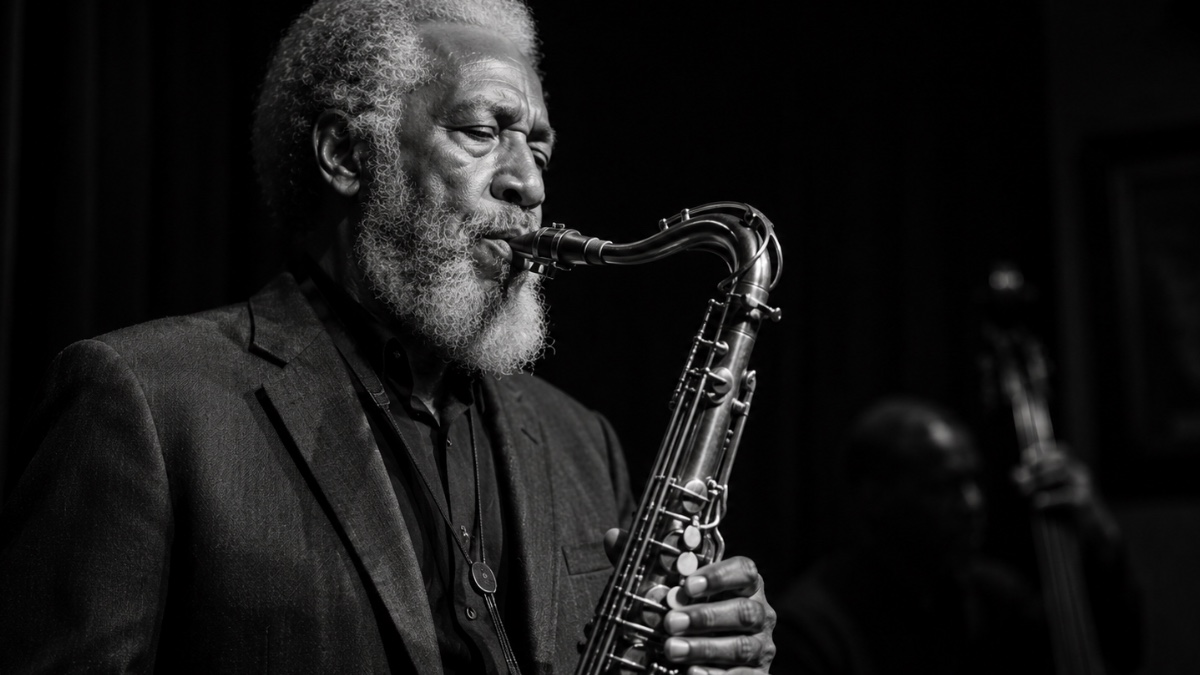
Sonny Rollins spent two years practicing alone on New York’s Williamsburg Bridge after concluding that fame had arrived before artistic satisfaction. By then, he had already recorded “Saxophone Colossus,” the 1956 album that established him as one of jazz’s defining young voices. Yet success did little to quiet his dissatisfaction with his own playing. Rollins later said he withdrew to the bridge because he knew he had not yet reached the level he wanted from himself.
The bridge sessions became part of jazz mythology. Rollins would spend as many as 14 or 15 hours there, returning night after night to refine his tone, phrasing, and improvisation away from audiences and critics. What began as a practical decision — avoiding disturbing a pregnant neighbor — evolved into one of the most famous self-imposed artistic exiles in modern music. The result was “The Bridge,” the 1962 album that marked his return and revealed a deeper, more searching style of improvisation.
Harlem’s Music-Filled Streets
Born Walter Theodore Rollins on Sept. 7, 1930, he grew up in Harlem during a period when jazz was woven into the neighborhood’s daily life. His brother and sister studied music, while figures like Fats Waller and Coleman Hawkins lived nearby. Rollins later recalled walking past the Cotton Club and Savoy Ballroom on his way to school, absorbing the sounds and rhythms that defined New York jazz culture.
That environment gave Rollins both technical grounding and artistic ambition. He idolized Hawkins while also studying the innovations of Charlie Parker, whose bebop revolution transformed jazz during Rollins’ adolescence. Pianist Thelonious Monk became an early mentor, helping sharpen Rollins’ harmonic instincts and unconventional approach to melody. Even among gifted contemporaries, Rollins stood out for his willingness to stretch songs into extended improvisational explorations.
“Oleo” and the Miles Davis Years
By the late 1940s and early 1950s, Rollins was already playing alongside major jazz figures including Bud Powell, Art Blakey, and Miles Davis. His compositions quickly entered the core jazz repertoire. Pieces such as “Oleo” and “Airegin,” written during his collaborations with Davis, became enduring standards studied by generations of musicians.
Rollins approached composition differently from many bebop writers of his era. His melodies often sounded conversational, almost playful, before opening into technically demanding structures underneath. That balance between accessibility and complexity helped make his work influential beyond jazz specialists. His improvisations could move from humor to aggression to lyricism within a single solo, giving performances an unpredictable quality that audiences and fellow musicians found magnetic.
His 1956 album “Saxophone Colossus” became the clearest expression of that style. The record included “St. Thomas,” the calypso-inspired piece that reflected his family’s roots in the U.S. Virgin Islands. At a time when many jazz recordings focused heavily on harmonic complexity, Rollins brought Caribbean rhythm and melodic looseness into mainstream modern jazz without sacrificing sophistication.
The Art of Endless Improvisation
Rollins earned a reputation as perhaps the greatest improviser of his generation because of the sheer unpredictability of his solos. Unlike musicians who carefully mapped performances in advance, he often entered concerts with no detailed plan. He once explained that he would step on stage with only the structure of the piece in mind, leaving everything else to instinct and spontaneity.
That philosophy made every performance feel unfinished in the best sense — open, exploratory, and alive. Rollins treated improvisation not as decoration but as the center of musical expression itself. His solos could run for extraordinary lengths, twisting familiar melodies into new shapes through repetition, pauses, rhythmic disruptions, and sudden bursts of energy.
Critics often compared him to John Coltrane and Wayne Shorter, though Rollins occupied a distinct place in jazz history. Coltrane pushed improvisation toward spiritual intensity and harmonic abstraction. Shorter emphasized compositional architecture and mood. Rollins, by contrast, approached improvisation almost like public thinking: conversational, humorous, argumentative, and deeply human.
He also expanded the role of the tenor saxophone by using it rhythmically as much as melodically. His playing frequently implied percussion and bass movement simultaneously, giving small ensembles unusual momentum and fullness. That innovation helped redefine what front-line jazz instruments could accomplish within a group setting.
“Alfie” and Crossing Into Film
Rollins’ ambitions extended beyond traditional jazz albums. In 1966, he recorded music for the film “Alfie,” creating one of the decade’s most memorable jazz soundtracks. His compositions captured the swagger, uncertainty, and emotional restlessness of the Michael Caine film with unusual precision. Critics later compared the achievement to Miles Davis’ celebrated soundtrack work for Louis Malle’s “Elevator to the Gallows.”
The same year, Rollins released “East Broadway Run Down,” another example of his increasingly adventurous approach during the 1960s. As jazz splintered into modal, avant-garde, and fusion movements, Rollins refused to settle into a single category. He remained rooted in melody while still experimenting structurally and rhythmically.
That refusal to repeat himself became central to his identity. Even after becoming one of jazz’s most celebrated musicians, Rollins continued disappearing periodically from public life to rethink his playing. Those sabbaticals, unusual for a major performer, reflected his belief that artistic growth required withdrawal as much as exposure.
Jail Cells, Heroin, and Reinvention
Rollins’ life could easily have taken another path. In 1950, he was arrested for armed robbery and spent 10 months in jail. He later described prison as brutal but formative, saying music helped him avoid much of the violence around him.
Two years later, he was arrested again for violating parole through heroin use. Like many jazz musicians of his generation, Rollins struggled with addiction during the bebop era, when drugs circulated heavily through nightclub culture. Unlike many peers, however, he survived long enough to reinvent himself physically and spiritually.
He replaced destructive habits with yoga, exercise, and disciplined routines that became unusual within jazz circles at the time. Another sabbatical beginning in 1969 took him to India and Japan, including a period spent in a monastery. Those experiences deepened the meditative quality that increasingly appeared in both his music and public reflections.
The Last Giant Standing
Rollins recorded more than 60 albums as a leader and collaborated across genres, including performances with the Rolling Stones on their 1981 album “Tattoo You.” Yet he remained skeptical of much rock music, later describing it as derivative of Black blues traditions.
Over time, Rollins came to represent one of the final living links to the formative era of modern jazz shaped by Parker, Monk, Davis, and Coltrane. As many contemporaries died, his survival carried symbolic weight inside the music world. He understood that role clearly.
A respiratory illness forced him to stop performing, and he retired in 2014 after receiving multiple Grammy Awards and a Lifetime Achievement Award from the Recording Academy.
Still, Rollins resisted treating legacy as nostalgia. In a 2011 interview with PBS, he reflected on being “the last guy” from his era while insisting the music itself outlived the people who created it. That belief defined his career: jazz as a living conversation rather than a museum piece.
Rollins died at his home in Woodstock, New York, according to a statement from his publicist. He was 95.