Over 3,300 No Kings Rallies Sweep All 50 States Against Trump Administration Policies
No Kings protests on March 28, 2026 spanned all 50 US states with 3,300+ events, plus solidarity rallies in major European cities.
Lauren Collins ·
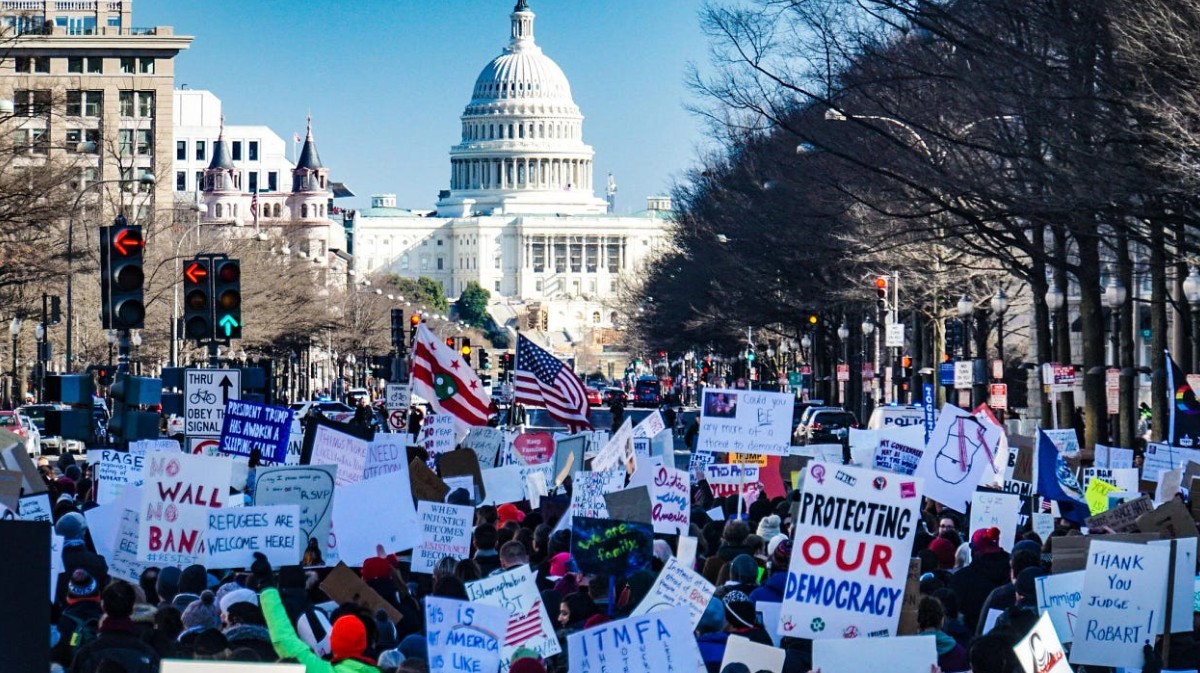
Demonstrators staged a nationwide wave of “No Kings” protests on Saturday, March 28, 2026, with events also held in several overseas cities. Organizers said the rallies were aimed at opposing policies implemented by the Trump administration.
The mobilization marked the third round of “No Kings” actions, with more than 3,300 events scheduled across all 50 US states. Large crowds were reported in major population centers including New York, Los Angeles, and Washington, DC.
Scale, locations, and organizers
Alongside the US events, solidarity gatherings were held in international cities including Rome, Paris, and Berlin. The source material does not provide attendance totals, and it is unclear how participation compared across locations.
Indivisible, described as a progressive nonprofit, was among the groups involved in organizing the demonstrations. Organizers said their outreach was designed to extend beyond major metropolitan areas, projecting that about two-thirds of participants would be in non-urban communities.
Timing amid security and immigration actions
The protests took place roughly one month after the start of a joint US-Israel military operation against Iran. The source does not detail the operation’s scope or objectives, but the timing places the demonstrations in a period of heightened geopolitical focus.
A central gathering was held in Minnesota’s Minneapolis–St. Paul area, where participants commemorated Alex Pretti and Renee Nicole Good. The two US citizens died in January during “Operation Metro Surge,” a federal immigration crackdown that began in December and ended in February.
Operation Metro Surge and legal disputes
Operation Metro Surge involved more than 3,000 federal immigration agents, according to the source. The operation drew accusations of excessive force in deportation raids and prompted dozens of lawsuits before it concluded.
The source does not specify which entities made the excessive-force allegations, the status of the lawsuits, or whether any courts have ruled on the claims. Those gaps limit what can be concluded about the legal and operational outcomes of the crackdown.
Speakers, symbolism, and the midterm backdrop
Events included speeches by public figures such as Senator Bernie Sanders, as well as musical performances by Bruce Springsteen and Joan Baez. In Washington, DC, demonstrators gathered at prominent sites including the Lincoln Memorial, displaying signs and effigies critical of the Trump administration.
The protests unfolded during campaigning for November’s US midterm elections, with Republicans seeking to retain majorities in both chambers of Congress. While the immediate market impact is not stated in the source, the scale and geographic spread of the demonstrations underscore a politically active environment that can shape policy expectations and, in turn, investor attention to regulatory and fiscal trajectories.
Implications
For the United States, the protests highlight heightened political mobilization ahead of the November midterms, a period when policy direction can become less predictable. The overlap with immigration enforcement disputes and ongoing litigation may keep domestic governance and civil-rights debates prominent.
Sectors sensitive to regulatory and enforcement priorities—such as employers reliant on migrant labor and firms exposed to compliance costs—may face a more uncertain policy environment, though no new measures are confirmed in the source. The legal disputes tied to Operation Metro Surge also point to continued operational and reputational scrutiny for federal enforcement activities.
Global investors often track US political stability and election dynamics because they can affect fiscal policy, regulation, and risk sentiment. The timing soon after a US-Israel operation against Iran adds a geopolitical layer that can influence broader market attention to security risk, alliances, and potential spillovers into energy and trade routes, even though the source cites no direct market moves.