Oil prices drop as Gulf supply routes show signs of relief
Oil prices fell to two-week lows as Iran signaled a possible Hormuz reopening and Saudi Arabia prepared to resume Yanbu exports.
Atlas Newsdesk ·
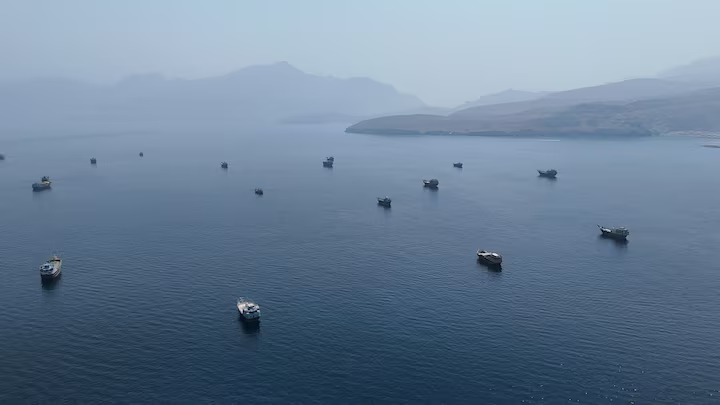
Oil prices fell more than 2% to two-week lows Tuesday as Iran and Saudi Arabia signaled potential relief for Gulf and Red Sea supply routes.
Hormuz signal resets risk
Brent crude futures for November fell $2.11, or 2.1%, to $98.23 a barrel at 1151 GMT, touching the lowest level since September 8. The US WTI October contract, which expires Tuesday, dropped $2.48, or 2.59%, to $93.30 a barrel.
The more active WTI November contract slid $2.36, or 2.55%, to $90.01 a barrel, also its lowest since September 8. The decline followed an Iranian signal that one of the world’s main energy chokepoints could reopen on a defined timetable.
A senior Iranian official said Iran could reopen the Strait of Hormuz within seven days if the US eases military pressure and lifts its blockade on Iranian ports. The official said Iran’s delegation at the UN General Assembly in New York had full authority to restart diplomacy with the US.
The Strait of Hormuz handled about one-fifth of global oil and liquefied natural gas supplies before the current military escalation began in late February. That share explains why even a conditional Iranian timetable can change pricing across crude, refined products and shipping risk.
Yanbu restart shifts Aramco flows
Saudi Arabia has restarted operations at its East-West Pipeline and could resume exports from Yanbu later Tuesday, according to three people briefed on the matter. Drone attacks forced the pipeline to shut on September 13, stopping crude loadings at the Red Sea port.
Saudi Aramco had increased exports through the Strait of Hormuz after the Yanbu disruption. Around 14 million barrels of Aramco crude were loaded on seven supertankers inside the Gulf on Sunday, tanker-tracking data showed.
The potential Yanbu restart matters for Aramco because the Red Sea route gives the company an outlet outside the Gulf. If Yanbu flows normalize, Aramco can rebalance loadings away from Hormuz and reduce the operational strain created by the pipeline shutdown.
Hamad Hussain, senior climate and commodities economist at Capital Economics, said the Iranian comments suggested diplomacy efforts could be making progress. He added, “There may also be other obstacles, such as the issue of tolls and fees, to overcome before a lasting solution can be achieved.”
Diesel squeeze limits relief
Ole Hansen, head of commodity strategy at Saxo Bank, said he did not see much further downside for oil prices until supplies increased through the Strait of Hormuz. He pointed in particular to refined products, where shortages remain most acute.
Diesel prices in Europe and the US have reached record highs after conflicts in Iran and Ukraine reduced exports from major producers, including Russia, Saudi Arabia and the United Arab Emirates. That refined-fuel squeeze means lower crude futures may not quickly translate into relief for consumers or industrial users.
President Trump’s meetings with world leaders at the UN General Assembly this week add a diplomatic channel to a market still pricing military risk in the Middle East and a 4.5-year war in Ukraine. For global inflation, the immediate question is whether crude and diesel supply improves enough to ease fuel costs before winter demand rises.
If Iran reopens Hormuz and Yanbu exports resume, the global macro effect would be a lower energy-risk premium, Aramco would gain more route flexibility, and refiners would have a clearer path to feedstock. If talks stall or pipeline security weakens, prices could remain supported through shipping constraints, Aramco would keep relying more heavily on Gulf loadings, and the wider industry would face tighter refined-product balances.