AI supply chains draw Wall Street into China listings boom
US banks and Chinese investors are still funding both sides of AI supply chains, leaving the Trump-Xi talks framed by finance as much as technology.
Atlas Newsdesk ·
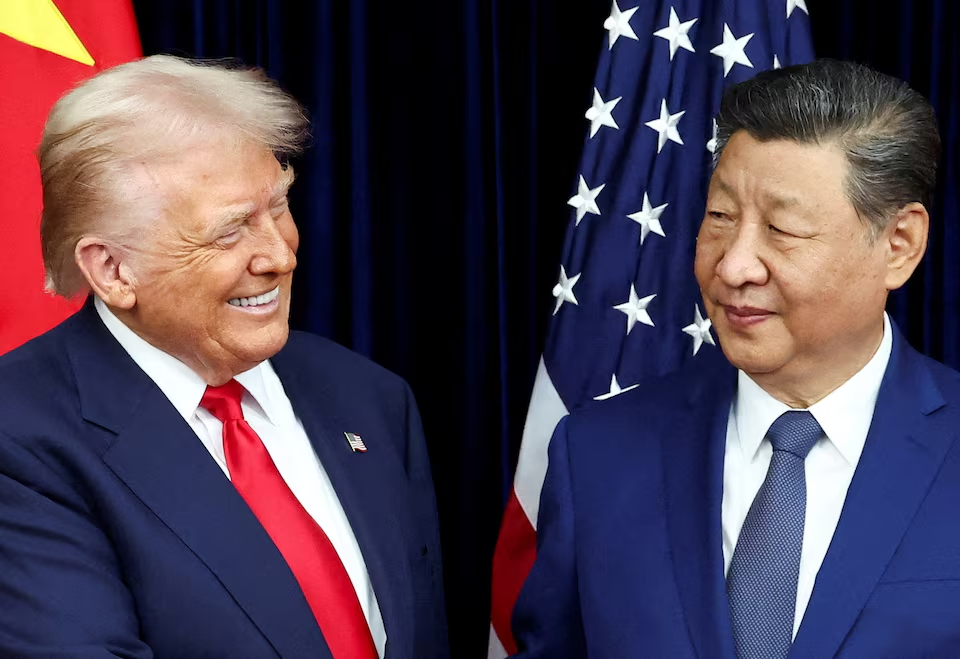
AI supply chains remain financially intertwined as US banks helped raise $17.2 billion for Chinese high-tech issuers this year.
LSEG data put Wall Street banks on 19 Chinese high-tech equity capital market transactions in the year to date, equal to nearly 30% of the sector's issuance. US data also showed the value of US shares held by Hong Kong residents and mainland Chinese rose 23% from a year earlier to more than $750 billion.
Banks bridge China listings
The flows show how capital has moved through openings left by policy even as Washington and Beijing try to reduce each side's dependence on the other for advanced technology. The public disclosures place financial firms inside an AI rivalry that analysts have compared with the Cold War space race.
One of the largest transactions was Zhongji Innolight's $6.8 billion Hong Kong listing, where Goldman Sachs, Morgan Stanley and Citigroup were among the joint global coordinators. The company makes optical components, a part of the hardware chain supporting data-center buildouts and AI computing demand.
US rules restrict supplies of advanced chips and chip-making equipment to China, and Washington also limits some US investment in sensitive Chinese AI-related sectors. The restrictions contain an exemption for publicly traded securities, leaving room for banks to advise on listings and follow-on sales.
Chinese funds favor US chips
Chinese capital has also continued to reach US technology markets through regulated and offshore channels. US stocks, with technology shares a favored segment, account for almost half of the 1 trillion yuan, or about $150 billion, managed by China's outbound mutual funds under quotas set by the country's foreign-exchange regulator.
Sinolink Securities data showed Chinese holdings rose this year in US chip-related names including Micron Technology, AMD, Sandisk, Lam Research and Applied Materials. S&P Global Market Intelligence said US AI funding rounds involving investors based in China or Hong Kong increased from about $436 million in 2023 to roughly $8.9 billion through mid-September.
The offshore fund channel is harder to measure than public shareholdings. Thilo Hanemann, a partner at Rhodium Group, said wealthy Chinese investors still back US technology companies through offshore vehicles, but added that "there is very limited visibility into these fund structures and thus the magnitude of exposure."
Trump-Xi agenda tests capital flows
President Trump and Xi Jinping are due to meet in Washington this week, with AI expected to feature in the discussions. US Treasury Secretary Scott Bessent said he and Chinese Vice Premier He Lifeng discussed creating a US-China AI dialogue, including a notification system for shared goals and threats.
Investors are treating the financial links as both a buffer and a vulnerability. Fred Hu, founder and chairman of Primavera Capital Group, said, "US and Chinese businesses and investors continue to maintain connectivity and invest in each other despite highly volatile geopolitical conditions."
The strains are close to the surface. At least one US lawmaker has criticized JPMorgan Chase and Bank of America for underwriting the Hong Kong listing of Contemporary Amperex Technology Co., a Chinese battery maker the US government has said has ties to China's military.
JPMorgan said it was operating within legal and risk controls. "We recognize the challenges posed by geopolitics. As global and Chinese companies continue to engage and compete across markets, we operate within applicable legal, regulatory, and risk-management frameworks," the bank said.
If the Trump-Xi talks preserve dialogue without new curbs, the macro effect would be to keep cross-border technology capital moving despite strategic rivalry. For Zhongji Innolight and other listed Chinese hardware firms, that path would support access to global investors; for the wider AI sector, it would keep financing channels partly shared while supply chains remain politically divided.
If restrictions tighten instead, the same links could unwind through lower issuance, narrower investor pools and higher compliance costs. Xile He, co-founder and CEO of San Francisco AI start-up BrentX, said, "There probably won't be a single winner in the U.S.-China AI race," adding, "From an investor perspective, I think betting entirely on one side is a big risk."