ICE Deploys to Houston Airports Amid TSA Delays
ICE agents assisted TSA at Houston airports on March 23, 2026, as IAH security waits hit four hours amid shutdown staffing strain.
Cuneyd Erdogan ·
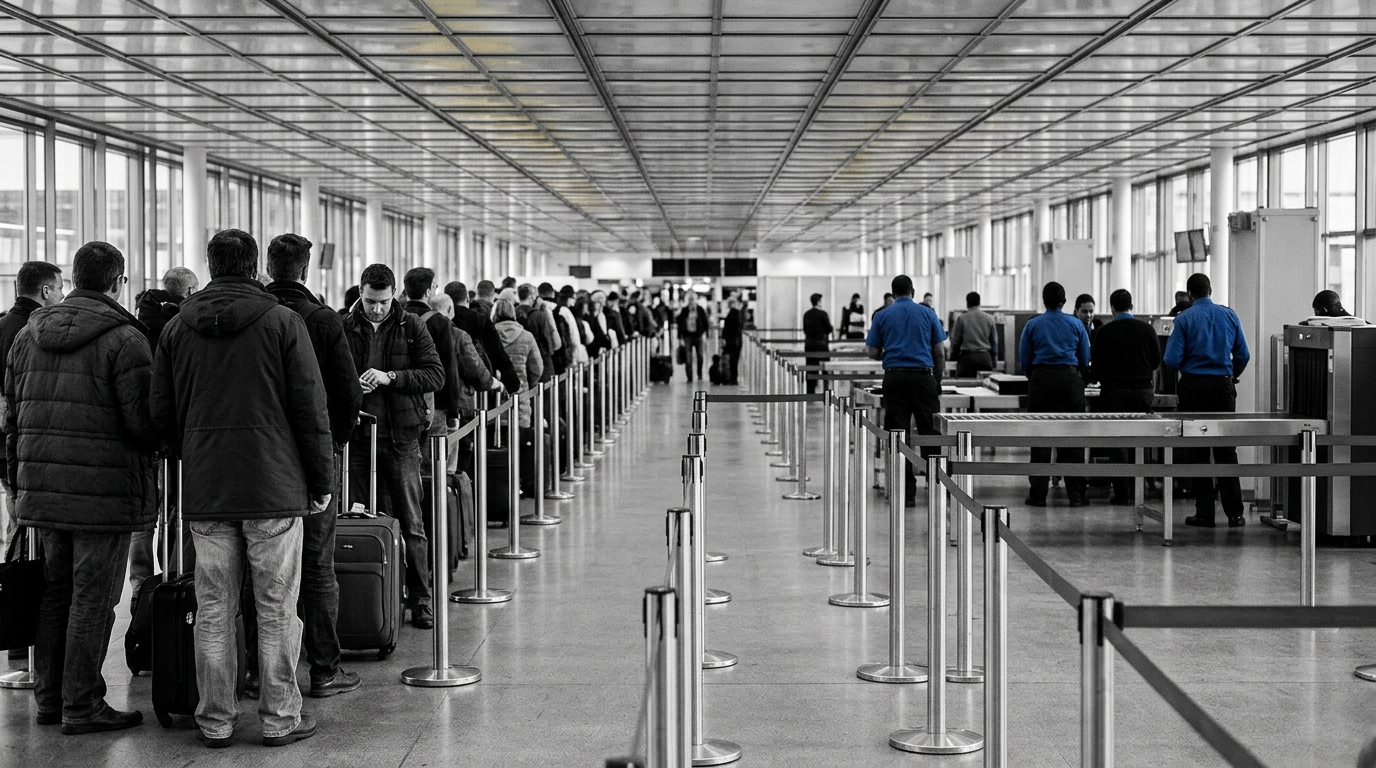
Federal immigration officers were deployed to Houston’s two commercial airports on Monday, March 23, 2026, as security screening delays surged at George Bush Intercontinental Airport (IAH). The move came after a weekend announcement by President Donald Trump that ICE personnel would be used to support TSA operations during a funding disruption.
At IAH, wait times at Terminal E reached about four hours, a situation linked in the source material to reduced staffing tied to a partial U.S. government shutdown. By contrast, screening lines at William P. Hobby Airport (HOU) were reported at roughly 10 minutes through the morning.
What changed at Houston’s airports
ICE officers were observed inside IAH, including at Terminal A, where a Houston Airport System staff member directed them to watch the security queues. The source material also describes at least three ICE agents positioned on the upper level of Terminal E near the final entry point to the security checkpoint.
Houston airport officials confirmed that ICE agents would help with TSA-related functions as part of the federal response to the shutdown. The Department of Homeland Security (DHS), which oversees the TSA, has been operating without full funding for more than a month, the source says.
Why TSA staffing is under pressure
The source attributes the staffing shortfall to a congressional impasse over immigration enforcement policy that has left DHS without full appropriations. In that context, the reported four-hour wait at IAH’s Terminal E highlights how quickly passenger processing can deteriorate when checkpoint staffing falls below demand.
The operational picture in Houston was uneven: IAH faced severe congestion at one terminal while Hobby’s lines remained comparatively stable. The source does not specify whether the difference was driven by passenger volumes, staffing allocations, terminal configuration, or airline schedules.
Market and policy relevance
Extended screening delays can disrupt airline schedules and increase missed connections, affecting carriers, airport operators, and travelers. For businesses, unpredictable airport processing times can raise costs tied to employee travel and complicate time-sensitive trips, particularly in a major U.S. energy and logistics hub like Houston.
Politically, the deployment underscores how a funding lapse can push agencies to reassign personnel across missions. The source material frames the ICE presence as support for TSA functions, but it does not detail the specific tasks ICE agents performed, the duration of the deployment, or whether similar measures were implemented at other U.S. airports.
Risks and unknowns
Key uncertainties remain based on the available information: how many ICE officers were assigned, whether they had specialized screening training, and how quickly the staffing gap at TSA checkpoints can be closed while DHS lacks full funding. The source also does not provide updated wait-time trends beyond the morning snapshot.
For now, Houston’s experience illustrates how federal budget disruptions can translate into immediate operational strain at critical transport nodes, with knock-on effects for commerce and mobility.