

Kenya confirms four Ebola cases, taking total to seven
Three of the latest confirmed patients are health workers who treated Kenya’s first Ebola patient, the Health Ministry said.
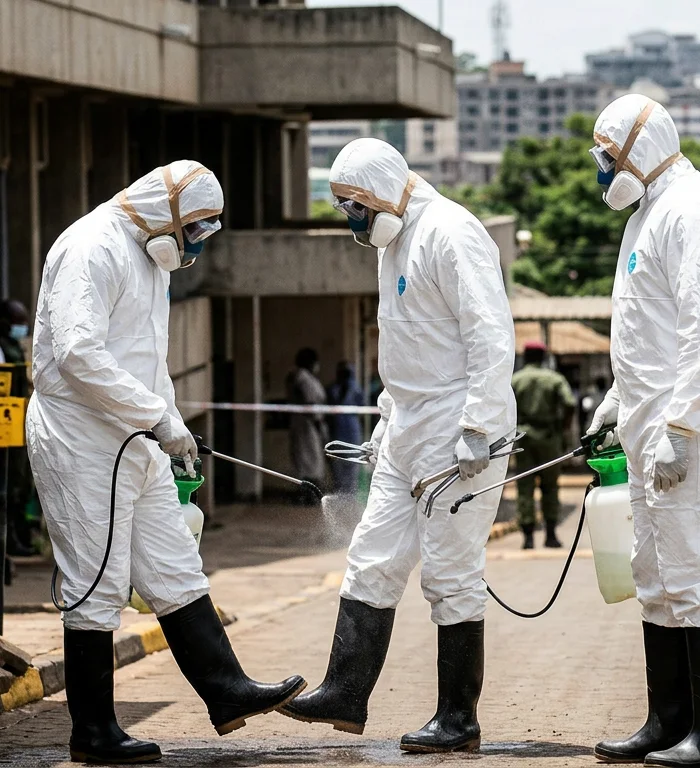
Kenya’s Ministry of Health said four more patients tested positive for Ebola Bundibugyo on Saturday, October 17, lifting the country’s confirmed outbreak tally to seven, according to an Al Jazeera/AP news article.
The cases matter because three of the four newly confirmed infections were health workers who treated Kenya’s first patient, the ministry said in an X statement cited by the article; a day earlier, Kenya had reported three cases.
The fourth new patient is a relative of the first patient, who died from Ebola, the ministry said. That relative had been under quarantine since October 6.
Kenya’s case identified on Friday was a “primary contact and a close relative of the first and second cases”, the Health Ministry said, according to the article.
The Kenyan infections are linked to an Ebola epidemic in the Democratic Republic of the Congo, where more than 9,000 cases and more than 4,300 deaths have been recorded since the outbreak was officially detected in May, the article said.
Kenya’s first patient died on October 5 after being ill in the Democratic Republic of the Congo for one month and travelling to Nairobi on October 3. The latest infections are the first known cases of transmission inside Kenya, according to the article.
The Health Ministry said 128 of the first patient’s 130 contacts, or 98.5%, had been placed in quarantine. The article said that exceeds the global benchmark of 85% needed to break transmission chains.
The ministry said it had traced and quarantined almost all contacts of the first patient and had no evidence of wider community spread. Kenya has also strengthened screening and set up a hotline for people who suspect contact with an Ebola patient, the article said.
The response still faces scrutiny. The article said some observers have questioned how the first patient bypassed health screening after returning to Kenya and came into contact with a large number of people.
Ebola spreads through direct contact with bodily fluids from an infected person or contaminated materials such as bedding and clothing. The dominant strain in this outbreak is Bundibugyo, for which the article said there are currently no vaccines or treatments, though research is under way and some vaccines are in early human testing.
Source: news article, Al Jazeera and AP, October 17, 2026
More stories
- French police arrest more than 1,800 after cost-of-living protests
- Godongwana faces 80% debt test in budget update
- Georgia faces surrogacy scrutiny after 1,100 births in 2023
- Iran parliament backs Akhlaghi as defence minister in 237-15 vote
- Belgium seeks EU sanctions after West Bank attack on diplomats
- Macron vows prosecutions after 400 arrests at France protests
- Javier Milei backs Flavio Bolsonaro in Brazil's run-off
- Wolfspeed faces dilution risk in $1.5bn Pentagon loan
Latest news
- Borrowers face debt squeeze as reform timetable stretches
- Soy-derived LPC70 curbs salt-linked behavior changes in mice
- Meat-derived Neu5Gc tracks with 63% higher diabetes risk
- El Gouna selects 5 filmmakers for third Rising Stars cohort
- Vanillin shows wound-care potential in early research
- Menin restoration improves older-mouse memory in 30 days
- Feijóo targets Catalonia’s 48 seats with Albiol housing pledge