Iran sanctions widen as US readies bank penalties this week
Treasury Secretary Scott Bessent said Iran sanctions will likely hit banks this week as Tehran threatens Gulf oil exports and Brent rises.
Lauren Collins ·
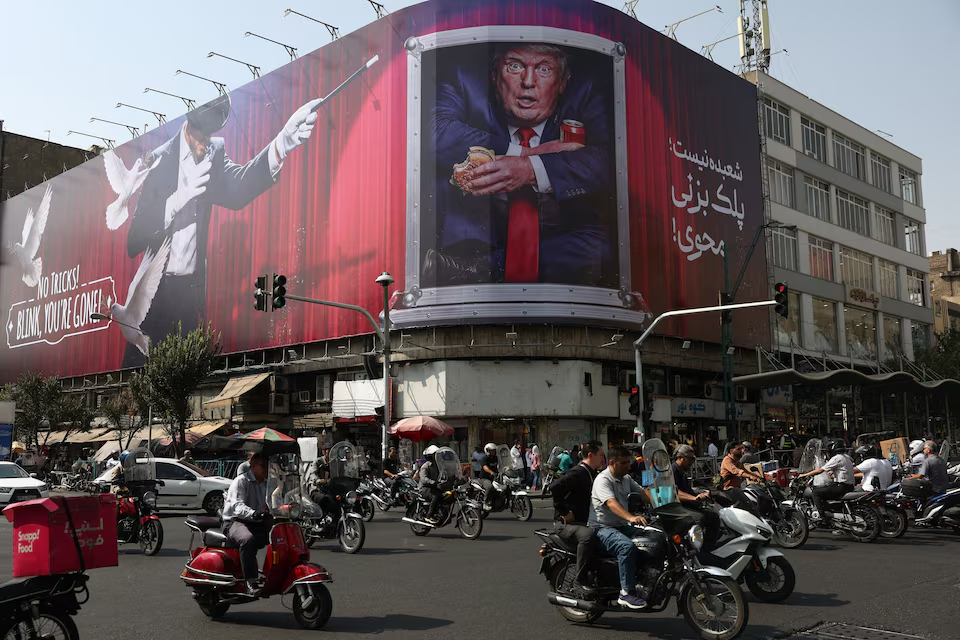
Iran sanctions are set to widen this week as Treasury Secretary Scott Bessent prepares two bank measures, with oil markets focused on Hormuz.
Bessent said Tuesday at a Group of 20 finance leaders meeting in Asheville, North Carolina, that Washington would probably announce a bank sanction this week and another the following week. He said the US was consulting allies and examining airline leasing companies and other entities that do business with the Islamic Revolutionary Guard Corps.
Bessent names banks and leases
The Treasury secretary described the measures as part of a broader effort to cut off Iran’s leadership from financing after six months of conflict. “We have zero tolerance. We are going to economically asphyxiate this regime,” Bessent said.
His comments extend a sanctions campaign that has long targeted Iran’s oil revenue and access to weapons components. Bessent also warned that countries continuing business with Iran could face US penalties, widening the pressure from Iranian entities to their overseas counterparties.
President Trump has threatened to hit Iran “hard” in response to renewed Iranian strikes, while also telling reporters Monday that the latest exchange did not mean a return to full-scale war. The White House position leaves sanctions as the immediate tool, even as both sides have tied further military steps to the other’s next move.
Hormuz risk lifts Brent
Brent futures rose more than 2% on Tuesday after the first direct US-Iran attacks since July and reports of tanker strikes near the Strait of Hormuz. The waterway is a central route for Gulf crude exports, and Iran has effectively closed it to shipping, according to the source material.
Two supertankers carrying Saudi oil were struck by unknown projectiles within minutes of each other late Monday while outbound through the strait, according to data from shipping intelligence and tracking firms Marisks and Kpler. The incidents added a physical supply risk to a confrontation that had increasingly shifted toward sanctions, blockades and financial pressure.
“The tit-for-tat missile exchanges between the U.S. and Iran bring validation to those who believe that even if not a ‘forever war’, this conflict will run and run,” said John Evans, an analyst at PVM. His assessment points to the market’s central concern: a conflict that stops short of declared war can still keep insurance, freight and crude prices under strain.
Tehran holds to Gulf threat
Iranian parliament speaker Mohammad Baqer Qalibaf said Tehran would block Gulf oil exports if its own crude sales were stopped, according to Iranian media. “If the enemy wants us not to export oil from the Persian Gulf, no one will be able to export oil,” Qalibaf was quoted as saying.
Iranian President Masoud Pezeshkian said Tehran would respond immediately if Washington returned to commitments under a June memorandum intended to halt the fighting. The agreement followed fighting that began with US and Israeli strikes on February 28 and opened a 60-day negotiating period that passed without a broader settlement.
Foreign Ministry spokesman Esmaeil Baghaei told a Tehran press conference that Washington was “addicted to making excessive demands and has mistaken negotiations for dictating terms.” He said Iran would use its capabilities “whether on the battlefield or through our diplomatic apparatus,” language that keeps both military and negotiating channels active.
Rial pressure tests reserves
Central bank governor Abdolnaser Hemmati said Iran had sufficient foreign currency reserves and was ready to inject up to $2 billion into the foreign exchange market to calm volatility. The statement followed pressure on the rial, which crossed 2 million to the dollar in August, and annual inflation of 66% in July.
If US bank sanctions restrict settlement channels, the direct effect would fall on Iran’s access to hard currency, while global markets would price a higher risk premium into energy and shipping. Airline leasing companies, banks, tanker operators and refiners would face tighter compliance checks if Washington follows through on secondary sanctions.
If the June memorandum becomes the basis for renewed talks instead, pressure on oil freight and Brent could ease through lower disruption risk rather than new supply. The main open questions are whether tanker traffic through Hormuz remains impaired, whether US allies enforce the next sanctions round, and whether either side treats the next strike as requiring a military answer.