

Investors weigh France debt as school protests intensify
France faces mounting budget pressure as higher borrowing costs, school protests and an approaching presidential election complicate fiscal decisions with…
France faces mounting budget pressure with its 10-year bond yield at 4.85%, against less than 4% two months earlier, testing European markets.
The increase exceeds 85 basis points, although yields have retreated from nearly 5% earlier this month. French stocks have also weakened: the CAC-40 Index has lost roughly 10% over two months.
The strain extends beyond French assets. Italian and Greek sovereign spreads have widened in recent weeks, while the euro has weakened against every other G10 currency this month; those movements alone do not establish that France caused them.
France retains access to borrowing
France continues to raise money in debt markets, an important distinction from Greece during its earlier crisis. Michel Sapin, who previously served as French finance minister, said France still had fiscal flexibility, although that room had narrowed.
Sapin identified economic weakness, budget difficulties and the approaching presidential contest as overlapping pressures. “Political uncertainty fuels and amplifies genuine concerns,” he said.
The fiscal impasse follows years of competing demands on public finances. Emmanuel Macron initially pursued business tax reductions and labor reforms, before concessions following the Yellow Vest demonstrations and support during the pandemic and inflation shock added spending commitments.
Parliamentary divisions following the 2024 legislative election have complicated efforts to change course. Prime Minister Sébastien Lecornu faces resistance to budget restraint after attempts at fiscal correction ended the tenures of his two immediate predecessors.
School demands meet deficit targets
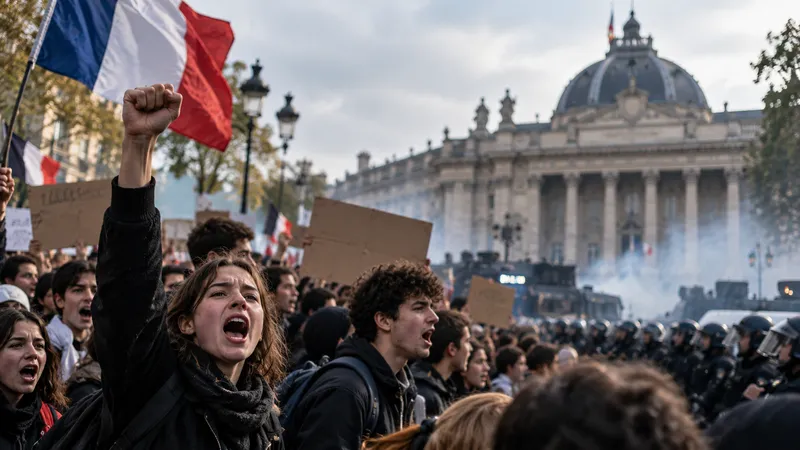
Student demonstrators are seeking €10 billion ($11.2 billion) for education, citing crowded classrooms and deteriorating buildings. They contrast those conditions with higher military spending and restrictions on other budgets.
The government has promised additional teachers for schools facing staffing shortages, while organizers have called another demonstration for Tuesday. These demands confront a government proposing spending restraint to reach a deficit of 5% of output in 2027, a target it is expected to miss this year.
Marine Le Pen has proposed a lower deficit target of 3.7% for next year, compared with the government's 5% objective. Her proposal puts the scale and feasibility of fiscal adjustment at the center of a presidential campaign in which Macron cannot seek another term.
Pacific Investment Management Co. said last week that it was maintaining a “major underweight” allocation to French sovereign debt. Separately, Macquarie Group rates strategist Thierry Wizman described social unrest and the bond selloff as mutually reinforcing through political polarization.
ECB draws a crisis distinction
European Central Bank policymakers have said emergency intervention is unnecessary for now. Bundesbank Executive Board member Michael Theurer said there was no systemic sovereign crisis, while warning that risks had increased.
If France secures a workable budget and borrowing costs ease, lower financing pressure would give the government more flexibility over spending. That scenario would also reduce one source of uncertainty for European banks holding French debt and investors assessing euro-area assets.
If political disagreement persists and yields rise further, refinancing at higher rates would progressively increase the interest burden, intensifying competition between debt payments and public services. Further spread widening elsewhere would present a broader risk to European financing conditions, although such an outcome is not established.
The next tests are the government's ability to assemble support for its budget, the scale of renewed demonstrations and whether pressure spreads beyond French securities. Emergency central-bank support remains a possibility rather than an announced response.
More stories
- Kyiv says Russia keeps hitting energy sites despite Trump-backed ceasefire push
- Riyadh airport faces 60% flight cancellations after strikes
- Saudi Arabia reports interceptions after airport deaths
- Alvarez keeps Oct. 31 Riyadh title fight on schedule
- Australia warns travelers after King Khalid airport strikes
- Ukraine says Russia hits Kyiv plant after Trump ceasefire claim
- AU launches Africa Credit Rating Agency ahead of license
- GCC Chief Says Schengen Waiver Is Close Before Riyadh Summit
Latest news
- Qingfa Hesheng says Chinese rice seeds hold 90% Pakistan share
- Arrvel adds 4-by-6 Bluetooth label printer
- Trial data put CBL-514's visceral fat findings in context
- IMF warns AI threatens jobs and government tax revenues
- Söder presses CDU after AfD speaker wins 48 votes
- Hood Warfare 2 rides $5 Steam launch into viral clips