Germany rebuild hands Jurgen Klopp four-year mandate deal
Jurgen Klopp opened his Germany tenure by warning media over family privacy as a four-year rebuild begins after a World Cup loss to Paraguay.
Atlas Newsdesk ·
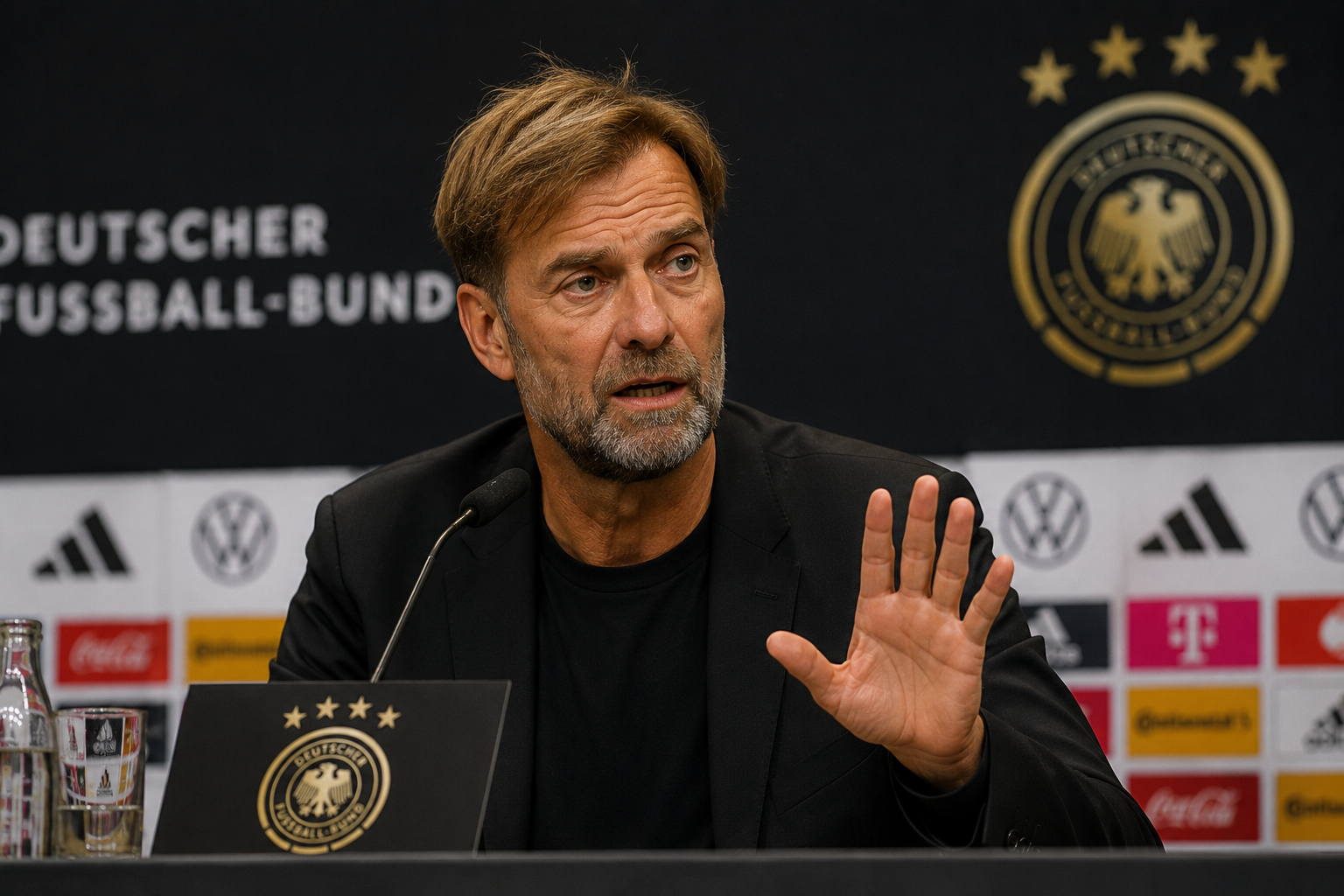
Jurgen Klopp began his Germany tenure with a warning over family privacy. His four-year deal shifts attention to a national rebuild.
Klopp, 59, was appointed on Friday to replace Julian Nagelsmann, who resigned this month after Germany lost to Paraguay in the World Cup last 32. The schedule opens on 24 September, when Germany face the Netherlands in the Nations League.
Klopp draws a privacy line
The first press conference was meant to introduce a new football project, but Klopp used it to set personal limits. He told reporters: "If you behave badly and don't leave my family in peace then I'll be gone, I'll just turn away."
Klopp said he understood that national coaches in other countries can face harsher scrutiny, but he made clear that the Germany role would not come at any cost. "I love this job but I am always ready to call it quits if need be," he said.
The warning matters because Germany’s national team post carries a public profile beyond club management. A national coach becomes a political and cultural figure as much as a sporting one, especially after a World Cup failure that has placed the program under sharper examination.
A four-year Germany brief
Klopp’s contract runs to the 2030 World Cup, which is due to be staged by Spain, Portugal and Morocco. That gives him a full tournament cycle to reshape Germany after Nagelsmann’s exit and the Paraguay defeat.
He framed the job as the final summit of his coaching career, not a stepping stone back into club football. "Jurgen Klopp is not going to have any 'career' after the national team," he said, adding: "This is the pinnacle, the absolutely high point of my footballing career as coach. I will give everything I have got."
The appointment also marks Klopp’s first coaching role since he left Liverpool in the summer of 2024 after saying he had run out of energy. His return shifts him from the daily rhythm of club football to the compressed demands of international management, where training time is limited and public judgment often lands after a handful of matches.
Klopp said he had once considered the Germany post almost unimaginable, but the idea became more realistic over time. He said "the time is right" for a comeback and described the past few days as feeling "almost like a movie."
Netherlands match sets first test
The Netherlands fixture gives Klopp an immediate measure of Germany’s competitive level under new leadership. A Nations League group-stage match will not define the four-year project, but it can shape the early mood around his authority, selection choices and tactical direction.
Germany’s players are the first group affected because a new coach can reset roles quickly. Established internationals may face renewed pressure, while fringe players could see an opening if Klopp prioritizes intensity, pressing structure and squad energy over reputation.
The wider coaching market will . Klopp’s switch from elite club football to a national job may strengthen the appeal of international posts for top managers who want lower fixture volume but still want a major stage.
Three paths for Germany
If Klopp’s privacy boundary is respected and early results hold, Germany can buy time for a deeper rebuild. That would support the national team’s commercial appeal, stabilize Klopp’s position and encourage other federations to pursue high-profile club coaches for long-cycle projects.
If media intrusion becomes the story, the mechanism changes. Attention would move from squad development to Klopp’s tolerance for the role, creating uncertainty for Germany and raising questions across football about whether national jobs can still offer a less consuming alternative to clubs.
If the Netherlands match exposes familiar weaknesses, the rebuild starts under pressure before it has structure. The main uncertainty is how quickly Klopp can translate his club methods into international football, where limited camps, player availability and tournament timing leave less room for gradual correction.