Gallium plant at Alcoa wins $174 million US financing deal
The US Department of War said it would commit $174 million to Alcoa for a gallium plant, targeting supply beyond China.
Jason Kwon ·
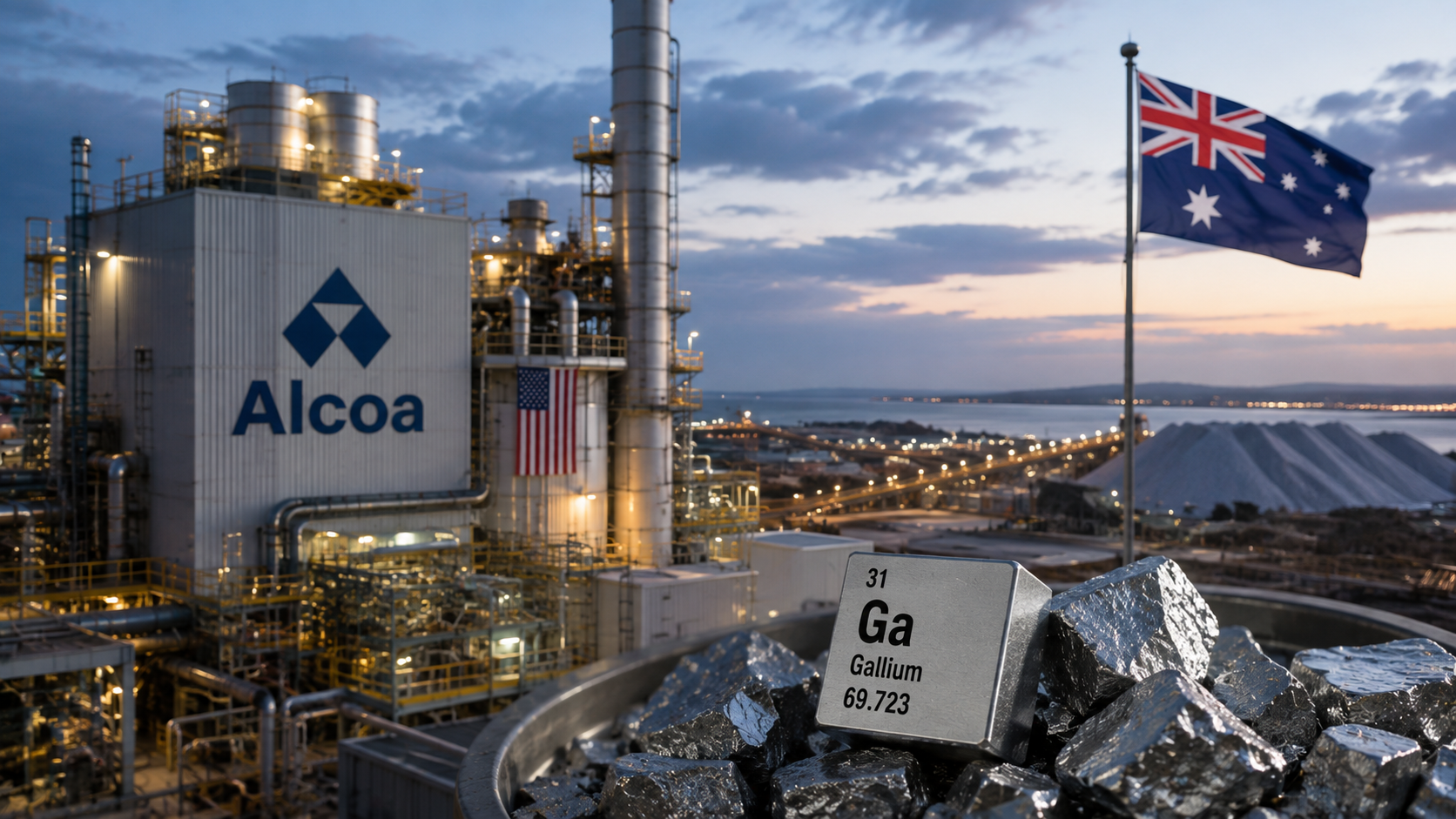
The US Department of War said it would commit $174 million to Alcoa Corp.'s gallium plant to reduce dependence on Chinese supply.
Wagerup adds 100 tons
Alcoa expects the plant at its Wagerup alumina refinery in Western Australia to produce about 100 tons of gallium metal a year, according to the department's Tuesday statement. Construction began last month, placing the project beyond the announcement stage but still short of commercial output.
The project links Alcoa with Japan's Sojitz Corp. and the Japan Organization for Metals and Energy Security. That structure gives Washington an allied supply route through Australia and Japan, rather than a purely domestic buildout for a metal whose processing base is concentrated in China.
China holds the choke point
Gallium is used in high-performance chips for defense systems, including radar hardware and missile-guidance equipment. The department said China accounts for about 98% of global production, an unusually high share for an input tied to both military electronics and advanced semiconductor supply chains.
Beijing introduced export controls on gallium in 2023 and banned direct shipments to the US in 2024, according to the department's account. Those restrictions turned a small-volume specialty metal into a supply-chain test for defense procurement, where substitute materials are not always available on short timelines.
Michael Cadenazzi, assistant secretary of war for industrial base policy, said the agreement with Australia and Japan would help secure gallium for the US defense industrial base. His statement framed the financing as a security measure as much as an industrial one.
Alcoa gets a defense role
For Alcoa, the financing attaches a defense-linked minerals project to an existing alumina refinery footprint. The company is better known for aluminum and alumina, but the Wagerup plant gives it a defined place in a supply chain normally discussed through chipmakers, miners and refiners.
The 100-ton annual target is the project's load-bearing figure. If Wagerup reaches that level, it would not displace China's 98% production share on its own, but it would create a non-Chinese source tied to US, Australian and Japanese policy support.
For defense manufacturers, the mechanism is redundancy. A second qualified source can reduce exposure to export bans, inventory drawdowns and price pressure, even when the new capacity is small beside the dominant producer's base.
Scenarios turn on delivery
If construction proceeds and the plant qualifies material for defense and semiconductor customers, the global macro effect would be narrow but strategic: less risk around one specialty input, rather than a broad change in metals trade. Alcoa would gain a US-backed revenue option at Wagerup, while the wider chip and defense supply chain would have another route for gallium procurement.
If the project slips, produces below the 100-ton target or takes longer to qualify output, the US remains exposed to Chinese export policy for a metal used in sensitive hardware. In that case, Alcoa's payoff would be delayed, and defense suppliers would still need to rely on inventories, alternative contracting or other allied projects.
If Washington extends the same financing model to other critical minerals, the industry effect could be larger than this single plant. The open questions are the Wagerup ramp-up timetable, the eventual customer base and whether China keeps gallium restrictions in place long enough to accelerate more allied processing capacity.