

Pakistan Completes First Manned Space Mission via Chinese Partnership
Pakistan launched its first astronaut to China’s Tiangong space station, marking a major milestone in aerospace cooperation and national technology.
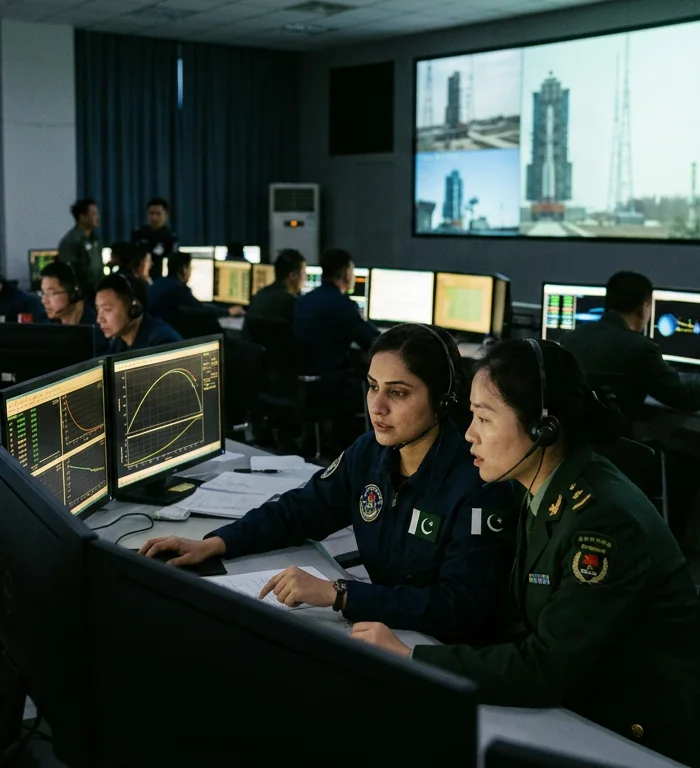
Pakistan successfully placed its first astronaut, Muhammad Zeeshan Ali, into orbit on November 25, 2026, marking a significant milestone in the nation’s aerospace capabilities. The mission, designated Shenzhou-24, launched from the Jiuquan Satellite Launch Centre in China and involved the integration of a Pakistani Air Force pilot into a Chinese-led crew. The spacecraft successfully docked with China’s Tiangong space station several hours after liftoff.
This mission represents a deepening of bilateral space cooperation between Pakistan and China. By leveraging Chinese launch infrastructure and the Tiangong platform, Pakistan has bypassed the need for independent heavy-lift launch capabilities while achieving a high-profile national objective. The collaboration underscores the strategic alignment between the two nations in scientific and technological sectors.
Muhammad Zeeshan Ali
For Pakistan, the mission serves as a significant exercise in national soft power and institutional prestige. The involvement of the Pakistan Space & Upper Atmosphere Research Commission (SUPARCO) in coordinating the mission highlights a shift toward more active participation in international space exploration. The successful deployment is expected to bolster domestic interest in STEM fields and may signal future expansions in space-related research and satellite development partnerships.
From a geopolitical perspective, the mission reinforces the reliance of Pakistan’s space program on Chinese technology. As China continues to expand its presence in low-Earth orbit, its willingness to host international astronauts serves as a diplomatic tool to strengthen ties with partner nations. Observers should monitor whether this mission leads to further joint ventures in satellite surveillance or deep-space research, which could have implications for regional security and technological parity.
More stories
- Türkiye Desk: GTA 6 drains UK mobile spend as Turkish studios feel pressure
- Europe faces attribution gap after 16 cyber, physical incidents
- PIF backs Grand Theft Auto as Saudi players embrace game
- Signal limits screenshots to curb AI access to messages
- Cognition runs Devin Mac workspaces on EC2 in 6 AWS regions
- Salesforce engineers cut 600-failure triage to 90 minutes
- AI coding agents add 30% more code, not software output
- Google tests Gemini 4 update as coding competition grows
Latest news
- Morocco targets 2030 World Cup final with new stadium bid
- Barclays puts AI bust risk at center of US growth debate
- US inflation reaches 3.8% before December Fed rate meeting
- Global stocks fall 0.4% as tariffs and US inflation loom
- CIA hack affects unclassified data; scope remains unclear
- Eisenkot secures first coalition deal but lacks majority
- Trump prepares tariffs on China and other major exporters
- New-car buyers pay record average $50,087 in October