

Barclays puts AI bust risk at center of US growth debate
Barclays estimates AI investment supplied 25% of US growth over the past year, putting an AI bust at the center of economic debate.
The estimate concerns AI’s contribution to growth, not its share of total economic output. The distinction matters: a retreat in investment would remove support for expansion, but would not mean an equivalent percentage of the economy disappeared.
The economic question extends beyond technology shareholders. A reversal could reach household purchases, construction employment and equipment orders, although economists disagree about whether those pressures would be sufficient to produce a US recession.
Share ownership concentrates consumer exposure
The stock-market channel runs through household wealth. If AI-related shares fall and investors reduce purchases in response, weaker consumption would transmit losses from financial portfolios into demand for goods and services.
Federal Reserve figures cited for the second quarter show that the wealthiest 1% owned more than half of individuals’ stock and mutual-fund holdings. That concentration makes the spending decisions of affluent households especially relevant to assessing how a market reversal might reach the economy.
Borrowing secured by shares introduces another possible pressure point. If falling collateral values force borrowers to reduce debt, affected households could cut spending beyond whatever adjustment they would otherwise make after a decline in wealth.
Equipment suppliers face a second channel
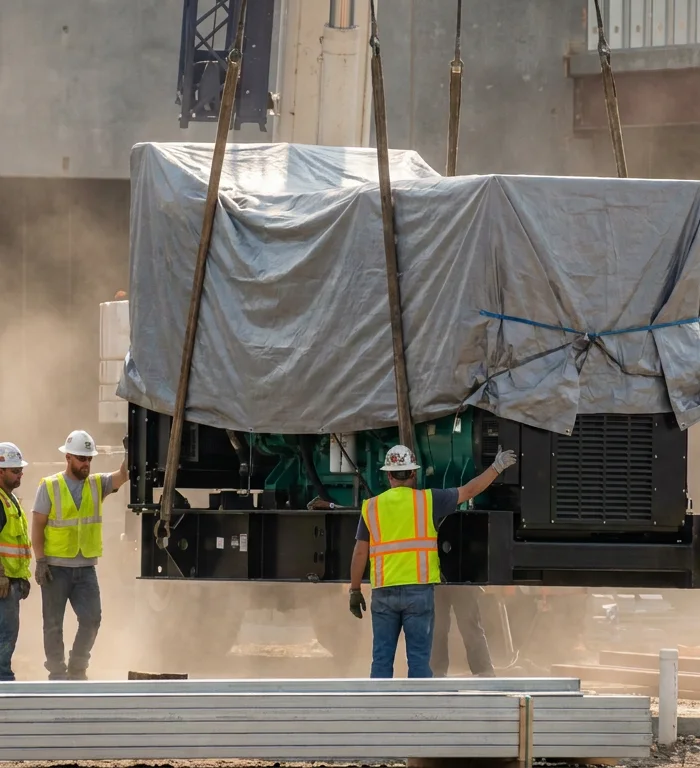
A construction slowdown would transmit the shock differently, through corporate orders and work on building sites. Caterpillar, GE Vernova and Eaton have reported revenue gains connected to data-center demand, linking the expansion to generators, turbines and electrical equipment rather than chips alone.
For those suppliers, the relevant question is whether customers continue committing money to new facilities. If developers postpone projects, equipment orders and construction work could weaken even without a broad stock-market collapse; if projects proceed, industrial demand could hold up despite lower technology valuations.
The composition of investment complicates the GDP calculation. Jonathan Millar, senior U.S. economist at Barclays, estimates that data-center construction contributed about half a percentage point to growth over the past year after accounting for imported chips, which provide little direct addition to domestic output.
That narrower estimate should not be treated as interchangeable with Barclays’ broader assessment of AI investment. One addresses data-center construction after an import adjustment; the other describes AI investment’s contribution to overall growth.
Imported chips shift exposure abroad
In a scenario where developers stop adding capacity, domestic construction and equipment suppliers would lose business while overseas chip producers would face weaker orders. Millar’s assessment is that eliminating data-center construction could produce a recession in Taiwan without necessarily causing one in the United States.
A less abrupt slowdown would create a different set of pressures. If household spending remains resilient and developers complete existing projects, the US effect could be a reduction in growth rather than a recession, while suppliers such as Caterpillar would face a less supportive source of demand.
The more damaging scenario combines weaker consumption with canceled investment. Disappointing returns from AI services or excess computing capacity could prompt that retrenchment; whether either develops, and whether spending elsewhere offsets it, remains the central uncertainty.
More stories
- Deal Sheet: Fortis shutdown costs over 400 jobs
- The Week in Games: GTA 6 turns attention into cash
- US data centres emit 25.7m tonnes of CO2, Harvard says
- German founders need 3,942 hours to open small business
- Leaked Deutsche Bank files test Sewing's reform narrative
- UAE employers plan 2.8% pay rises for 2027
- Brent falls 1% before rate decisions
- Microsoft faces $90.6bn AI spending test in earnings
Latest news
- Morocco targets 2030 World Cup final with new stadium bid
- US inflation reaches 3.8% before December Fed rate meeting
- Türkiye Desk: GTA 6 drains UK mobile spend as Turkish studios feel pressure
- Global stocks fall 0.4% as tariffs and US inflation loom
- CIA hack affects unclassified data; scope remains unclear
- Eisenkot secures first coalition deal but lacks majority
- Trump prepares tariffs on China and other major exporters
- New-car buyers pay record average $50,087 in October