

Fed’s Policy Pivot Throws Future Interest Rate Guidance Into Chaos
Federal Reserve Chairman Kevin Warsh abandons forward guidance for data-driven policy, contrasting with 2026 Nobel-winning monetary research.
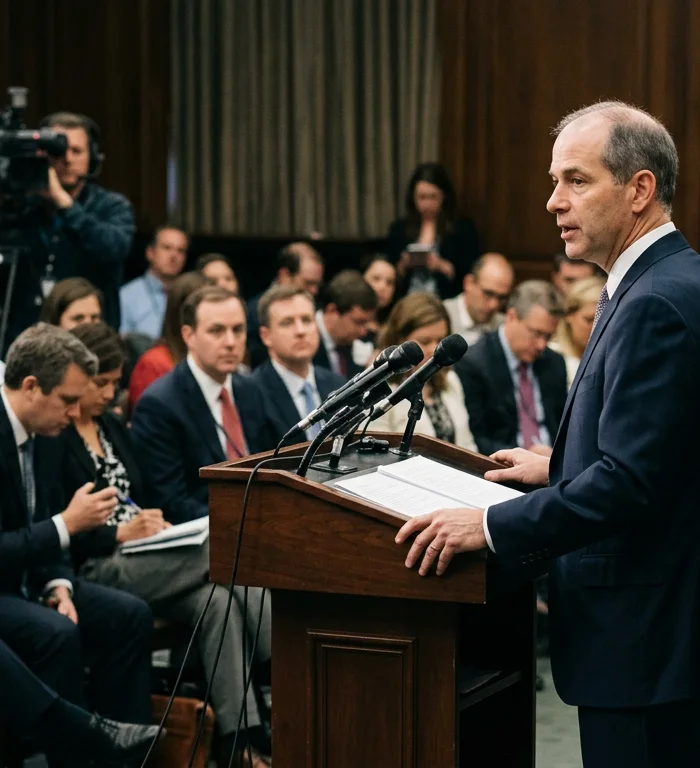
Federal Reserve Chairman Kevin Warsh has initiated an active strategy to dismantle the practice of forward guidance, setting the United States central bank on a course that diverges from recognized monetary theory. The transition replaces structured, long-term policy commitments with short-term observational responsiveness, shifting the institution toward a framework centered entirely on data-dependent decision-making.
Under Chairman Warsh's policy vision, monetary policy choices are designed to prioritize immediate economic indicators rather than pre-announced interest rate trajectories. Warsh has voiced explicit concerns regarding the central bank's historical reliance on forward guidance, contending that continuous public commitments distort financial market signals and hinder policymakers from maintaining operational flexibility when broader economic conditions change.
Real GDP Growth2.1%USA 2026 — IMF (↑ prev: 2.0%)Inflation (CPI)2.4%USA 2026 — IMF (↓ prev: 2.7%)Unemployment Rate4.1%USA 2026 — IMF (↓ prev: 4.2%)
Federal Reserve Chairman Kevin
The central bank's strategic pivot unfolds alongside economic data projections issued by the International Monetary Fund for the United States in 2026. According to IMF statistics, United States Real Gross Domestic Product growth for 2026 is projected at 2.1 percent, representing an increase from the previous forecast of 2.0 percent. Concurrently, Consumer Price Index inflation is projected at 2.4 percent, marking a decrease from the earlier projection of 2.7 percent.
Academic Endorsement of New Keynesian Communication Models
The shift away from explicit signaling stands in contrast to the academic consensus reaffirmed by the 2026 Nobel Prize in Economic Sciences. The award was conferred upon economists Michael Woodford and Robert Hall for their foundational work supporting the New Keynesian framework in central banking operations.
The theoretical model championed by Woodford and Hall underscores the critical necessity of structured forward guidance and transparent communication in central banking. Within this New Keynesian framework, consistent public signaling is recognized as a vital mechanism for managing public expectations and shaping macroeconomic outcomes effectively.
Chairman Warsh's emphasis on short-term responsiveness marks a Chairman Warsh's emphasis on short-term responsiveness marks a notable departure from the established consensus of Woodford and Hall. While the Nobel-winning framework views public commitments as an indispensable tool for expectation management, the new leadership strategy treats forward guidance as a potential source of market distortion that limits institutional agility.
Operational Misalignment Within Central Bank Trading Desks
Despite the ideological shift promoted at the leadership level, internal operations within the Federal Reserve have not entirely abandoned forward guidance practices. Desk operations within the institution continue to utilize public forward guidance as an active tool for managing financial market expectations regarding upcoming interest rate trajectories.
This operational continuation has generated an observable disconnect between Chairman Warsh's stated policy philosophy and the central bank's ongoing tactical communications. The divergence reveals an internal misalignment between executive principles and daily desk operations.
As the Federal Reserve prepares for its upcoming policy meeting, the friction between high-level leadership goals and desk-level communication practices potentially complicates market signaling. Financial participants face an environment where executive communication favors data dependence while institutional desk operations continue to broadcast explicit rate trajectory guidance.
More stories
- Trump defends Russian diesel easing for global markets
- Sebi gives IPO issuers six more months of flexibility
- One in five US households fall behind on payments
- Fed rate outlook splits as Williams sees limited tightening
- U.S. robotics deployment gap risks long-term industrial competitiveness
- US ETF issuers add nearly 1,100 funds in leveraged push
- French 10-year spread widens to crisis levels
- US presses Europe to release diesel reserves
Latest news
- The Picklr seeks lease relief after $4.4m loss
- Packaging Compliance Labs adds 3 Instron systems to pharma lab
- Champions League matchday 2: Man City hosts PSG, Liverpool travels
- Laporta declares Barcelona plays Europe's best football
- Nifty IT jumped 5.2% after HCLTech profit beat
- Fusion CX IPO to cut promoter stake to 80%
- Netflix secures 2030 World Cup rights for Spain, Andorra
- Angelo State soccer seeks first road win at UT Tyler