Faith-Based Film "Daniel and the Fiery Furnace" Explores Ancient Narrative
The faith-based film "Daniel and the Fiery Furnace" dramatizes biblical events, focusing on Daniel's interpretation of Nebuchadnezzar's dream and the…
Ayla Demirhan ·
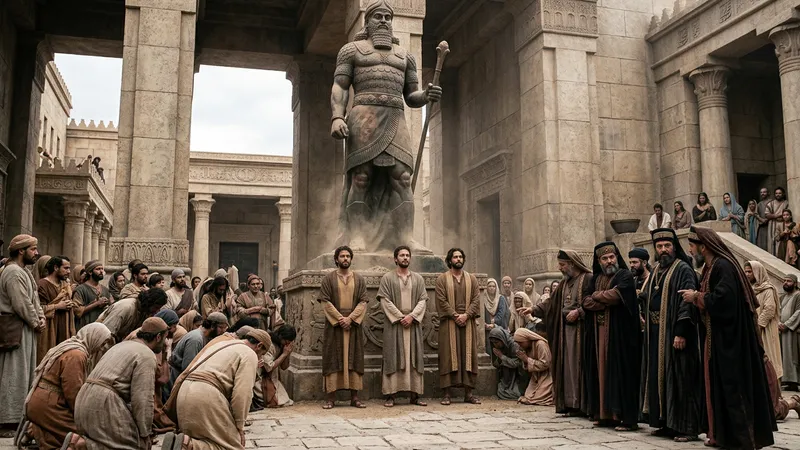
The film Daniel and the Fiery Furnace joins a growing category of faith-based cinema, directly depicting religious conviction. While presenting a simplified narrative, the movie emphasizes divine protection and unwavering belief, drawing from specific events within the Old Testament's Book of Daniel.
Biblical Narrative Adaptation
The film opens with the Babylonian conquest of Judea, showing the forced relocation of thousands of Jews, including Daniel (Mena Massoud) and his companions Meshach (Adam Lahraoui), Shadrach (Sunjay Midda), and Abednego (Zaki Ali), into slavery. King Nebuchadnezzar (Elijah Alexander) experiences a disturbing dream he cannot recall. Daniel, through a vision, interprets the dream as a prophecy of four successive empires—Babylonian, Persian, Greek, and Roman—culminating in a divine kingdom that will encompass the world. This interpretation elevates Daniel to chief advisor.
Faith Under Persecution Jealous advisors later compel all subjects to bow Jealous advisors later compel all subjects to bow before a newly erected statue of the emperor, knowing the Jewish captives would refuse. Meshach, Shadrach, and Abednego defy the decree, facing punishment by being cast into a blazing furnace. The narrative portrays their miraculous survival, walking through the flames unharmed, as a testament to their faith and divine intervention.
Theological and Historical Context
Fiery Furnace
The story of Daniel holds significant theological weight within Judaism, asserting God's omnipresence and protective power beyond geographical boundaries. This philosophical development extends into Christian thought. Historians also note the period's importance for early Christianity, particularly the emerging influence of Zoroastrian ideas, which introduced concepts like a God of Wisdom versus a God of Evil, an enhanced role for Satan, and a Day of Judgment. These concepts, prevalent among certain ancient Hebrew groups like the Essenes, later became central to the teachings of Jesus. Filmic Approach and Reception The production prioritizes its message of faith, with cast and crew conveying strong belief in the film's themes. While the acting is earnest and competent, the narrative occasionally includes tangential discussions that slow the plot's progression. The film's production values are solid, reflecting its creators' conviction. It caters specifically to an audience seeking faith-affirming content, with reports of emotional responses from viewers. The movie offers an alternative to mainstream entertainment, providing a straightforward, albeit simplified, exploration of its source material.