England tightens rules on converting pubs to housing
England tightens pub conversion rules from Monday, requiring 12-month marketing proof and deeper council scrutiny as housing reforms target 1.5m homes by 2029.
Atlas Newsdesk ·
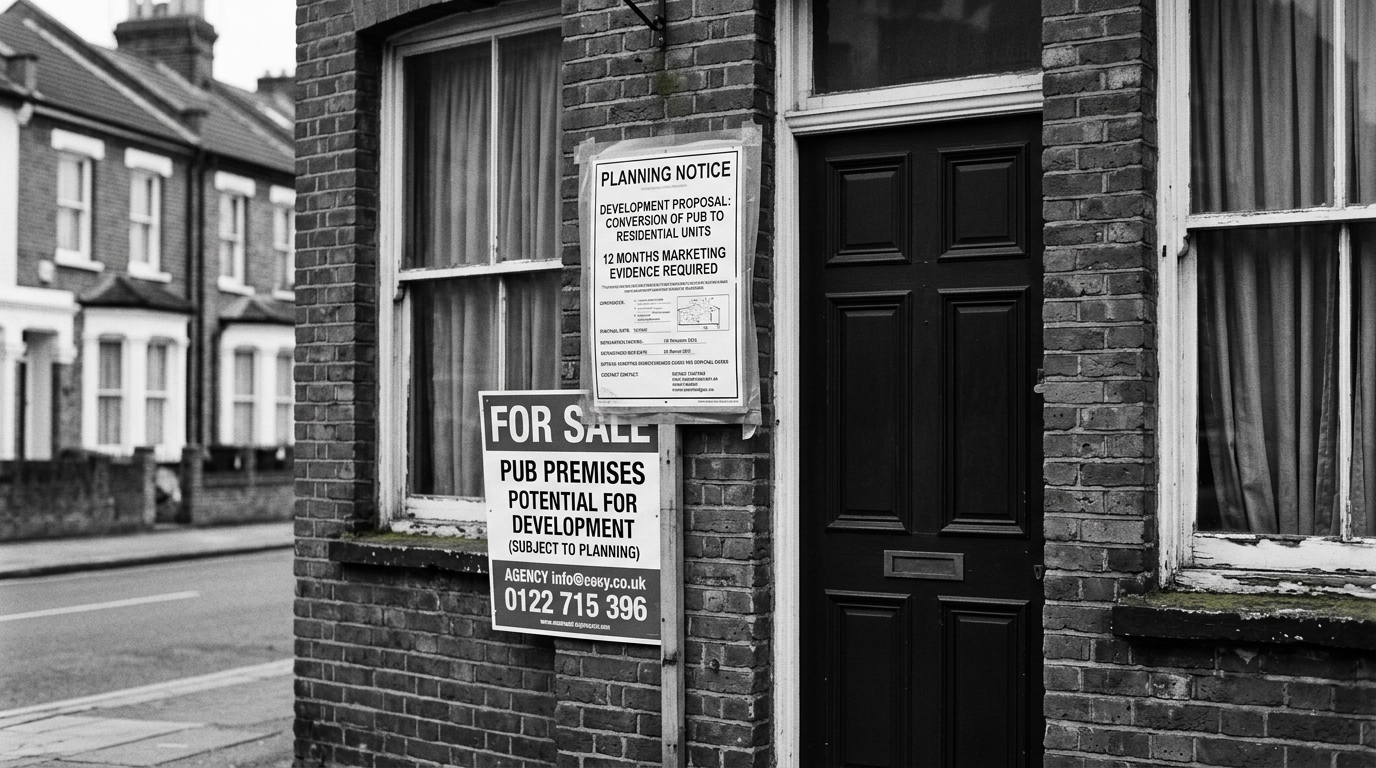
England will begin applying updated National Planning Policy Framework (NPPF) guidance on Monday, increasing the evidential burden on developers and owners seeking to convert historic pubs into residential or commercial uses, officials said.
The revised approach is intended to strengthen protection for venues described by officials as part of local social infrastructure, while keeping planning decisions anchored in documented evidence rather than assertions about trading conditions.
New proof requirements for change-of-use applications Under the
New proof requirements for change-of-use applications
Under the updated guidance Under the updated guidance, applicants will need to show through records that a pub is no longer commercially viable. A central test is a minimum marketing period: the property must have been actively marketed for sale for at least 12 months before an applicant argues for a change of use. Officials said the requirement is designed to demonstrate that alternatives to conversion were given a realistic opportunity. In practical terms, it aims to show another operator—or another viable use as a pub—had a genuine chance to come forward before redevelopment is approved. Local councils given a larger scrutiny role The updated guidance also raises expectations for local authorities assessing proposals. Councils will be expected to carry out fuller evaluations of how a change of use could affect the surrounding community, moving community impact closer to the centre of decision-making. Officials framed the tighter rules as a way to make it harder to justify redevelopment solely by citing reduced trade. The guidance is also intended to narrow the scope for owners to run down business activity and later rely on falling takings as support for a planning application.
Pub protections introduced alongside housing acceleration plans
The pub-focused measures are being introduced at the same time as planning changes aimed at accelerating housing delivery. Officials said the government is moving to create default approval for residential developments near railway stations, presented as a step to support faster construction in locations connected to public transport. Officials have linked the wider planning agenda to Officials have linked the wider planning agenda to a target of building 1.5 million homes by 2029. Taken together, the policy package reflects a dual track: tougher tests for converting pubs, alongside easier pathways for new housing in areas around transport hubs.
Industry response points to costs beyond planning rules
Industry groups welcomed steps that could slow rapid pub conversions, while arguing that broader economic pressures are the main drivers of closures. Business rates and VAT were cited as key factors, indicating that planning protections alone may not resolve the financial conditions facing operators.
Officials and industry participants said the longer-term impact on hospitality will depend on how these planning safeguards interact with operating costs. For now, the immediate shift is procedural: applicants face stricter evidential requirements, and councils are expected to weigh local social effects more explicitly when proposals are submitted.