Belgium court faults asset freeze denial for BCS Bank case
Belgium court found the treasury lacked authority to deny BCS Bank’s Euroclear asset request, leaving the freeze intact while exposing a legal weakness.
Atlas Newsdesk ·
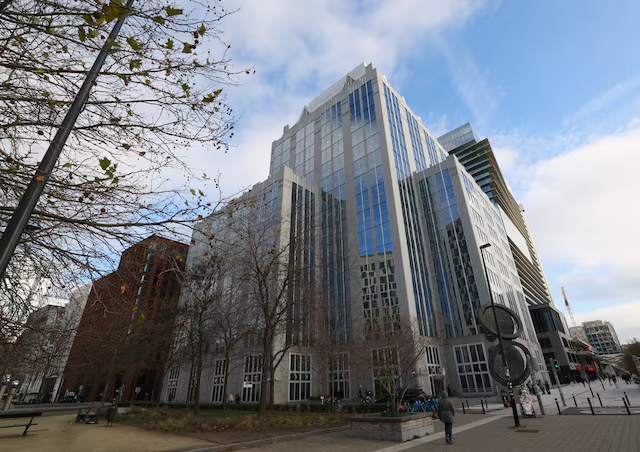
Belgium court found the treasury lacked authority to deny BCS Bank access to frozen Euroclear assets, but left the freeze in place.
The Council of State, Belgium’s top administrative court, ruled that the finance ministry’s treasury department was not properly empowered to reject the Russian bank’s request. The decision did not instruct Euroclear to release the securities and funds.
A Belgian Finance Ministry spokesperson said the ministry was studying the judgment and its possible consequences. The dispute began after BCS Bank asked in July 2024 for its assets to be released, then challenged the treasury’s refusal in October 2024.
BCS denial meets Belgian law
BCS Bank held securities and funds at Euroclear through Russia’s National Settlement Depository. The EU sanctioned that depository in June 2022 after Russia’s full-scale invasion of Ukraine, and the assets held through it were frozen.
The court said EU sanctions rules require Belgium to name a competent authority to decide requests for frozen assets to be released. Belgium assigned that role to the finance minister, who passed it to the administrator-general of the ministry’s treasury department.
The Council of State found that delegation too broad and not defined tightly enough. That finding targeted the Belgian legal mechanism used to reject the request, rather than ordering an immediate change in custody of the assets.
Euroclear holds the larger cache
The ruling formally applies only to BCS Bank. But decisions taken under the same Belgian delegation structure may face similar challenges if asset holders argue that the treasury lacked the authority to reject their applications.
Euroclear’s role gives the case wider weight. Most of the roughly €200 billion ($230.7 billion) in frozen Russian assets held in Europe are kept at the Brussels-based clearing house, according to the figures cited in the case material.
For Euroclear, the immediate operational position appears unchanged because the court did not direct a release. For BCS Bank, the decision creates a legal opening, but not a confirmed route to recovering the frozen securities and funds.
Ukraine loan debate reopens
The case lands as EU governments revisit how far they can go in using immobilized Russian assets to support Ukraine. The European Commission last year proposed using the assets to back a loan for Kyiv.
Belgium opposed that plan, saying it lacked sufficient guarantees that Brussels would not be left alone to handle lawsuits or damage claims from Russia. The plan was dropped, though several EU member states have since asked the bloc to reopen the debate.
Three paths through Brussels
If Belgium rewrites the delegation rules and keeps the freeze intact, the global effect would likely center on legal confidence rather than immediate market flows. BCS would remain blocked, while Euroclear and other custodians would gain a clearer administrative basis for refusals.
If more asset holders challenge past treasury decisions, Belgium could face a slower sanctions process and higher litigation risk. That would complicate EU talks on Ukraine financing, leave BCS with a stronger procedural argument, and force the custody sector to review decisions tied to sanctioned Russian intermediaries.
If the EU revives the Ukraine loan plan with stronger legal guarantees for Belgium, frozen assets could again become collateral for wartime support. The open question is whether member states can align legal risk, fiscal backing and sanctions enforcement without weakening the freeze that currently binds BCS and similar asset holders.