

AT&T Stadium begins natural‑grass conversion for 2026 World Cup
Dallas Stadium is installing natural grass for the 2026 FIFA World Cup, a temporary conversion requiring significant logistical and material investment.
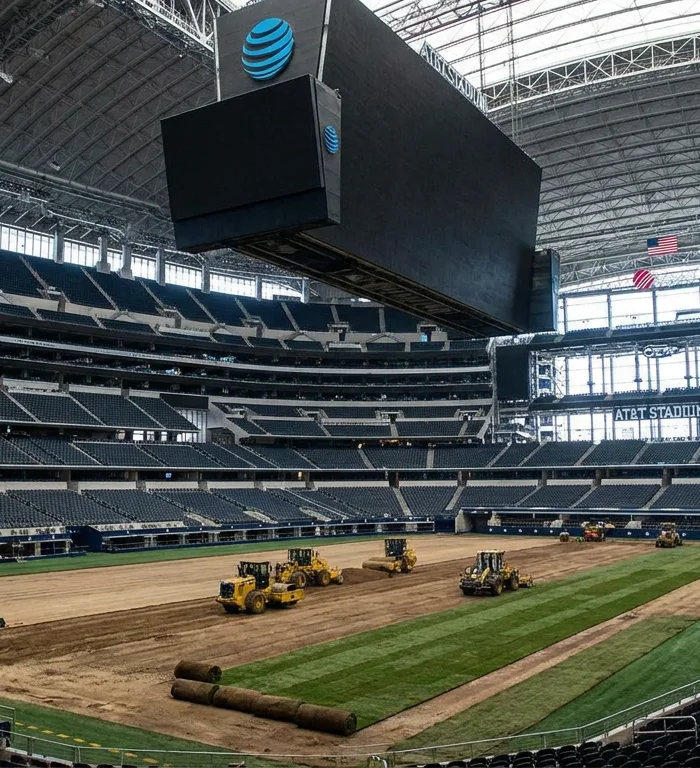
AT&T Stadium in Arlington, Texas — which will operate as Dallas Stadium during the 2026 FIFA World Cup — has begun a full conversion to a natural‑grass pitch to meet FIFA standards. The venue, which typically uses an artificial surface for American football and events, is slated to host nine World Cup matches. Work is already under way on the temporary system to support international play in 2026. Organizers aim to deliver a consistent, FIFA‑compliant surface across all matchdays in Arlington.
Project plans outline a large‑scale operation built around imported sod and new under‑field technology. Grass grown in Colorado has been transported to North Texas for installation, while crews fit specialized ventilation and irrigation systems beneath the surface to protect root health and manage moisture. Overhead, pink grow lights are positioned across the field to aid growth and recovery in a closed environment.
The scope reflects the complexity of adapting a multi‑use, enclosed stadium for elite international soccer. Planners estimate roughly 45,000 labor hours and about 15,000 tons of material will be required to complete the transformation. Because the venue is enclosed, temperature, airflow and light will be closely managed to maintain a uniform playing surface throughout the tournament.
Tournament branding rules also affect operations. During the World Cup period the building will operate under the non‑commercial name Dallas Stadium, in line with FIFA’s commercial guidelines. The grass installation is similarly temporary: operators plan to remove the natural surface after the last World Cup match in Arlington and restore the standard artificial turf for the venue’s year‑round calendar.
Engineering the natural‑grass system at AT&T Stadium
Irrigation, ventilation and light
Under‑pitch infrastructure is critical to performance and safety at this level. The newly installed ventilation and irrigation systems are designed to regulate temperature and moisture within the root zone, while grow lights help the grass photosynthesize and recover between matchdays. The Colorado‑grown sod is laid in sections and will be monitored closely for uniformity, traction and resilience.
Temporary surface and operations plan
Post‑tournament conversion and readiness
Once the World Cup concludes, the natural grass will be taken up and the venue will revert to its standard artificial turf to accommodate its year‑round calendar. Organizers are expected to continue inspections and maintenance rehearsals as the tournament approaches.
The durability of the surface across nine matches and quick turnarounds will be a key operational focus in the lead‑up to 2026. Event operators will refine maintenance schedules and pitch‑protection procedures closer to kickoff to balance broadcast, training and turnaround demands throughout the tournament.
Officials plan continued testing and inspections in the run‑up to 2026 to ensure the playing surface meets tournament standards by kickoff.
More stories
- Morocco targets 2030 World Cup final with new stadium bid
- Hull City 2–0 Brighton: When Resilience Beat Reputation
- Aleksey Batrakov Attracts Barcelona Transfer Interest
- Manchester United weigh Osimhen move, transfer report says
- Ravens 20, Chargers 23: A season at the edge
- Billie Jean King ties 39 majors to equal-pay fight
- Brandon Clarke Death at 29 Prompts Autopsy and Questions
- World Cup halftime show to feature Madonna, Shakira, BTS
Latest news
- Barclays puts AI bust risk at center of US growth debate
- US inflation reaches 3.8% before December Fed rate meeting
- Türkiye Desk: GTA 6 drains UK mobile spend as Turkish studios feel pressure
- Global stocks fall 0.4% as tariffs and US inflation loom
- CIA hack affects unclassified data; scope remains unclear
- Eisenkot secures first coalition deal but lacks majority
- Trump prepares tariffs on China and other major exporters
- New-car buyers pay record average $50,087 in October