AirAsia market share plan tests Malaysia airline capacity
Malaysia is testing whether rival carriers can absorb AirAsia capacity as the airline seeks funding to manage debt, fuel costs and lease pressures.
Atlas Newsdesk ·
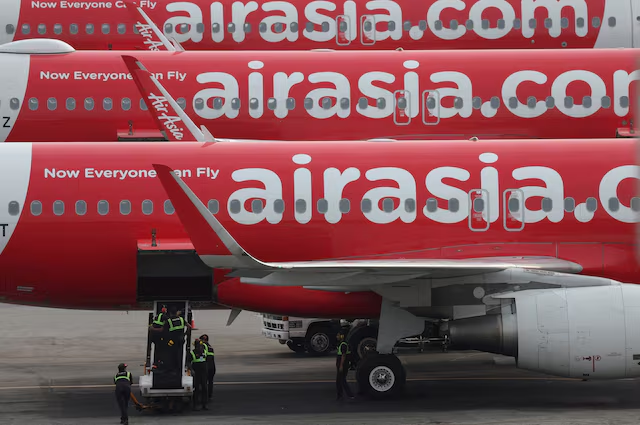
Malaysia is testing backup capacity at rival carriers for AirAsia’s 60% domestic share as fresh funding talks continue, people with knowledge said.
Malaysia tests rival capacity
The government has asked Malaysia Airlines and Batik Air whether they could take on AirAsia domestic routes and passenger volumes if pressure on the low-cost carrier deepens, the people said. The discussions have involved the finance ministry and Malaysia Airports Holdings Berhad (MAHB), the state-linked airport operator, as part of contingency planning rather than a disclosed rescue plan.
AirAsia says it controls about 40% of Malaysia’s overall aviation market and 60% of domestic flying, a scale that makes any service disruption a transport and political issue. The people declined to be identified because the discussions were private, and the finance ministry, Malaysia Airlines and Batik Air declined to comment.
Fuel bill strains accounts
The pressure has intensified after jet fuel costs rose 66% in the second quarter from the previous quarter to an average of $183 a barrel, according to figures cited by people familiar with the matter. AirAsia reported a net loss of 831 million ringgit, about $204 million, for the quarter ended June 30, compared with cash and bank balances of 954 million ringgit, about $234 million.
The carrier’s second-quarter figures also included foreign-exchange losses of 331 million ringgit, about $81 million. Current liabilities stood at 18.4 billion ringgit, or $4.51 billion, as of June 30, a balance sheet position that has framed talks about debt restructuring and new capital.
AirAsia has said it is advancing discussions with financial institutions for up to $1 billion from international debt markets and 700 million ringgit, about $171 million, in local credit facilities. Two people with knowledge of the matter estimated the airline would need at least $3 billion in fresh capital, while AirAsia said its financing targets are enough for its requirements.
MAHB receivables add pressure
AirAsia owes MAHB at least 500 million ringgit, about $122 million, for services including landing and parking fees, according to people familiar with the matter. The airport operator has granted repayment extensions, two of the people said.
MAHB said it regularly engages with airline partners on network and route development, including potential capacity and route opportunities where demand is not being met. It declined to discuss AirAsia’s financial outlook or specific commercial arrangements, while AirAsia said it maintains a constructive relationship with key partners including MAHB’s airports team.
Leases shape any route transfer
Malaysia Airlines and Batik Air told the government they would take on AirAsia operations at scale only if aircraft leases were included, one person said. Without the aircraft, the rivals would have to absorb routes and passengers with their own fleets, a slower process that could leave gaps in schedules.
The two carriers have also indicated a preference for organic expansion rather than buying AirAsia’s whole business, according to people familiar with the talks. AirAsia has been cutting weaker routes, returning 25 older aircraft to lessors and renegotiating vendor contracts to reduce costs.
AirAsia said it does not comment on operational or financial speculation or undisclosed corporate arrangements. Farouk Kamal, deputy group CEO of AirAsia Group, said the airline would disclose material updates on its business and fleet strategy through exchange filings and corporate announcements, and that demand across its network remains strong.
Two funding paths emerge
If AirAsia secures the debt-market and local facilities it is seeking, the global macro channel would be narrow: energy prices would remain the larger inflation input for regional travel, while Malaysia’s low-cost capacity stays broadly intact. For AirAsia, proceeds would support debt restructuring; for the wider sector, Malaysia Airlines and Batik Air would face less pressure to add aircraft quickly.
If financing falls short while fuel stays costly, the mechanism changes. AirAsia would face deeper cost cuts or asset negotiations, Malaysia Airlines and Batik Air would need aircraft as well as routes to protect schedules, and Malaysia’s aviation sector would risk fewer low-cost seats, higher fares and pressure on airport receivables.