

DC Throws Its Biggest Startup Party Yet, 103,900 Jobs Into the Worst Year on Record
Next week’s program is the largest in the event’s 11-year history, even as the surrounding region faces the nation's highest job losses this year.
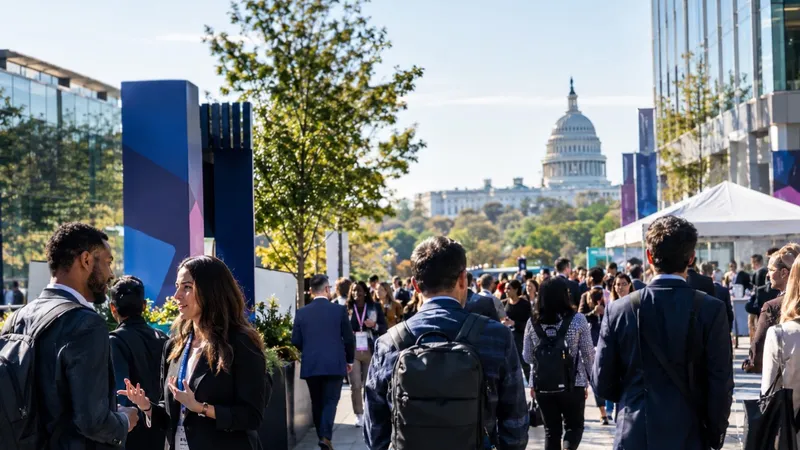
DC Startup & Tech Week opens on Monday, October 19 with the largest program it has staged. The 11th edition runs through Friday, October 23 at venues from Convene Hamilton Square on 14th Street NW to the Martin Luther King Jr. Memorial Library downtown and the National Landing Experience Center in Arlington.
Organizers are targeting 10,000 to 12,000 attendees across more than 150 events and 300 speakers. The track list names the sectors now drawing capital to the capital: artificial intelligence, cyber, defense and dual-use technology, government technology, climate, health and fintech.
Those are the organizers’ numbers, and they move around. The homepage counts 200 events and 8,000 attendees; the registration listing counts 150 events; the welcome copy promises 10,000 bold minds.
The weakest big-city labor market in America
The week opens into the weakest large labor market in the United States. The Bureau of Labor Statistics recorded 103,900 jobs lost across the Washington-Arlington-Alexandria metropolitan area between January 2025 and January 2026, a decline of 3.1% and the steepest of any metro. Boston, the next largest, lost 30,200. The most recent federal reading, for August 2026, shows the metropolitan area down 66,000 jobs over the year, and the Washington division was the only one in the country with a year-over-year decline. The next federal reading lands on October 28, five days after the week closes.
Federal employment accounts for most of that. The Metropolitan Washington Council of Governments calculated in April that the region shed 62,100 federal jobs, a drop of 16.5%, leaving the regional federal workforce at its lowest level since 1990. “The numbers are stark,” Executive Director Clark Mercer said. “We cannot achieve long-term economic resilience without coordinated action.”
The fiscal consequences are already in the District’s books. Chief Financial Officer Glen Lee raised his fiscal 2026 local revenue estimate by $205.5 million on September 30 and cut the projections for fiscal years 2027 through 2030, citing an expected net loss of 45,600 jobs. “The district’s unemployment rate has fallen slightly, but this improvement stems largely from a shrinking labor force rather than from gains in job opportunities,” Lee wrote. Population growth has stalled with it: the Census Bureau put the District at 693,645 residents in July 2025, up 2,335, and revised the previous year downward.
Eleven years, three reinventions
The event began as a founder-community project, a calendar of panels and happy hours assembled from the local network, and for most of its first decade it stayed that. It has never been precious about its own birthday: the 2025 edition was promoted as a 10th anniversary, a co-chair on the current site dates the community to “9 years later,” and this one is billed as the 11th.
Three changes turned it into a trade event. The name took on “Tech” in the 2024 cycle, widening the frame beyond startups to the region’s established technology and contracting base. The track count moved from 14 in 2024 to 17 in 2025 to more than 18 this year, and the geography widened with it, adding Arlington’s National Landing to the downtown venues.
The stage also became official. The 2025 program put Securities and Exchange Commission Chairman Paul Atkins in a fireside chat and Navy Chief Technology Officer Justin Fanelli in a session on selling to government, with the main stage at the Johns Hopkins Bloomberg Center on Pennsylvania Avenue.
The speaker list has leaned local-famous throughout. The past participants the organizers name today include Monumental Sports owner Ted Leonsis, Honest Tea co-founder Seth Goldman, restaurateur Steve Salis, Revolution’s Anna Mason and investor Melissa Bradley. Rachel Koretsky, who also founded the scheduling startup Upace, runs the week as founder and chief executive, and has been explicit about the shift in ambition.
"The last ten years were about proving the DMV is a viable tech hub. The next era is about proving we are a global leader." Rachel Koretsky, founder and chief executive, DC Startup & Tech Week
How procurement replaced the pitch
Claims that Washington is about to become a major technology center are not new. They date to the America Online years and were revived through Steve Case’s Rise of the Rest investment thesis in the 2010s. Neither wave produced the cycle of large exits, recycled founder capital and resident engineering talent that defines the Bay Area, New York or Boston.
What changed over the past 18 months is federal procurement. The PitchBook-NVCA Venture Monitor describes policy as shifting toward commercial-first acquisition and closer Department of Defense alignment with venture-backed dual-use, artificial intelligence and autonomy companies. Proximity to Washington became commercially useful for companies that previously had no reason to maintain an address here, and the Small Business Innovation Research program has been reauthorized through 2031.
The region also acquired physical assets it did not have five years ago.
Virginia Tech’s Innovation Campus in Alexandria opened to students on January 21, 2025: 300,000 square feet across 11 stories, built, furnished and equipped for $302.1 million, with more than 500 graduate students enrolled at opening and Boeing and Northrop Grumman among its donors. Howard University received the Carnegie R1 research classification in February 2025, the only historically Black college or university to hold it, and leads a Defense Department university-affiliated research center on tactical autonomy. George Mason University’s Fuse building in Arlington, with artificial intelligence and virtual reality labs, came out of the same state technology-talent pledge that brought Amazon.
Rising dollars, flat deal counts
Set against national markets, the venture base is small. PitchBook-NVCA counted 97 deals worth $1.0 billion in the Washington ecosystem in the second quarter of 2026, against 761 deals worth $98.6 billion in the Bay Area. Regional startups raised $5.4 billion across 323 deals in 2025, the second-highest annual total in a decade and roughly 1.7% of the $319.2 billion raised nationally. Deal counts are about a quarter below their level four years ago.
The concentration matters more than the totals. Two rounds for the Rockville nuclear developer X-energy, a $779 million Series C1 and a $700 million Series D, accounted for about 26% of the 2025 regional figure. In the second quarter of 2026, four startups took roughly 70% of the money, among them a $380 million round for the Chevy Chase nuclear firm Blue Energy. In the third quarter, which Technical.ly reported at $1.4 billion across 88 deals, the top 10 companies took nearly 80%, led by energy, defense and biotechnology. The quarterly series is correspondingly unstable: the same regional market recorded $514.6 million in the second quarter of 2025 and nearly $1.0 billion a year later.
The pattern is visible in where the sector’s largest rounds are actually raised. Anduril closed a $5 billion Series H at a $61 billion valuation in May, led by Thrive Capital and Andreessen Horowitz, from Costa Mesa. The National Venture Capital Association is headquartered in Washington. The money is organized here and deployed elsewhere.
The arrival of frontier artificial intelligence is the clearest new signal, and also the most easily misread. Anthropic announced on March 11 that it was opening its first Washington office and tripling its policy team. “AI is advancing faster than any technology in history, and the window to get policy right is closing,” said Sarah Heck, its head of public policy. OpenAI is taking 14,500 square feet at the Gallup Building at 901 F Street NW, according to the Washington DC Economic Partnership, and its Washington lead, Chan Park, said the team had grown from “just a handful of us here in D.C.” Both are government-affairs and government-sales operations. Neither has announced a single engineering role in Washington.
The lobbying data describes the same phenomenon at scale. Public Citizen reported on February 24 that more than 3,500 federally registered lobbyists, about one quarter of the total, reported working on artificial intelligence issues at least once in 2025, an increase of 168% since 2022. Anthropic’s own year illustrates how close the sector now sits to federal power: the company was designated a supply-chain risk by the Defense Department in February, and a district court vacated that designation on August 27, finding it violated the governing statutory scheme.
The commercial property market tells the same split story. Brokers disagree on direction for the third quarter, with Cushman & Wakefield reporting District vacancy at 23.5% and negative absorption while CBRE reported 360,154 square feet of positive absorption and attributed demand to legal and technology transactions. They agree on the shape: CBRE puts prime and trophy vacancy at 8.3% against a market above 19% on every measure, and notes that General Services Administration leasing is running well below historical averages. Premium space is tight. Government-vacated commodity space is not.
Financial regulation supplies a parallel draw. The CLARITY Act cleared Senate Banking without reaching a floor vote, and stablecoin rulemaking under the GENIUS Act is still being written, which keeps crypto and fintech policy teams resident in Washington for reasons that have nothing to do with building products here.
Two numbers cut against the momentum case, and both belong to the region’s biggest promises. Amazon’s second headquarters employed about 8,500 people in April against 25,000 pledged, a target ARLnow reports has slipped to 2038, with 7,232 incentive-qualifying hires logged through 2024 against a 10,000 threshold and the second construction phase at PenPlace paused since March 2023. And the global claim is contested on the merits: Startup Genome ranked Washington 17th worldwide in 2025, down five places, citing decreased global reach, and its 2026 briefing materials value the ecosystem at $66.0 billion against $106.5 billion for Austin and $96.4 billion for Seattle.
Put the pieces together and a narrower story emerges than the one the week tells about itself. Washington has won a real and durable position as the world’s principal policy and procurement capital for technology. Companies come here to shape rules and win contracts, and that business is booming. What the data does not yet show is a city where things get built, and a good share of the current activity tracks the priorities of the sitting administration more closely than any local technical depth.
The organizers need scale to hold sponsors. Their published economic-impact figures, $3.2 million in direct impact and a projected $10 million to $20 million over time, carry no stated methodology. The sponsor base remains dominated by economic-development agencies, business improvement districts, banks and professional-services firms, with The Nuclear Company and NobleReach new to the 2026 list and large technology companies scarce.
The District government is a sponsor through the Deputy Mayor for Planning and Economic Development, the Washington DC Economic Partnership and the Department of Small and Local Business Development, and it has put money behind the thesis through a venture fund of funds launched in 2025 and managed by K Street Capital. Its political leadership is about to change. Mayor Muriel Bowser announced on November 25, 2025 that she would not seek a fourth term. Ward 4 Councilmember Janeese Lewis George won the Democratic primary on June 16 and faces the general election on November 3; she would take office in January 2027 and inherit the Chief Financial Officer’s reduced revenue baseline.
Virginia’s jurisdictions are partners and competitors at once. Arlington Economic Development, the Alexandria Economic Development Partnership and the Virginia Innovation Partnership Corporation all sponsor the week, and the institutional wins of the past two years sit on the Virginia side of the Potomac. Arlington County was the only urban jurisdiction in the region to record positive domestic migration last year.
Investors want a deeper pipeline and are watching Congress. “How do we continue to get that early stage group going? Because that feeds the beast,” Richard Chilton of BlueWing Ventures told Technical.ly . Josh Weed of Veteran Ventures Capital, in the same reporting, flagged the political risk to the defense budgets now driving regional deals: “When you have everything in one party’s hand, they get to push through what they want to push through. Now it will be more of a negotiation.”
None of this will be settled next week. The program will produce the usual signals, a mayor-in-waiting’s first remarks to the sector, a procurement official’s pitch to founders, a funding announcement timed for the room.
The harder question sits in the quarterly data that follows. Washington has built a credible position as the place where technology is governed and sold to government, and that position is holding while the federal payroll that long carried the region shrinks around it. Whether anything is being built here, rather than lobbied for, is a question the venture figures will answer more honestly than any conference stage.
More stories
- DC schools face labels after 2 years of subgroup gaps
- Regional flu data point to earlier activity, not severity
- National Theatre enters D.C. preservation review
- MARC riders face 25-minute delays after Rockville derailment
- DC firms face online licensing shift in October update
- P20 gun brandishing leaves Metro rider injured in Prince George's