Yuan strengthens before Trump-Xi summit as PBOC eases curb
The yuan hit a more than three-year high before a Trump-Xi summit as China’s central bank allowed faster currency gains.
Atlas Newsdesk ·
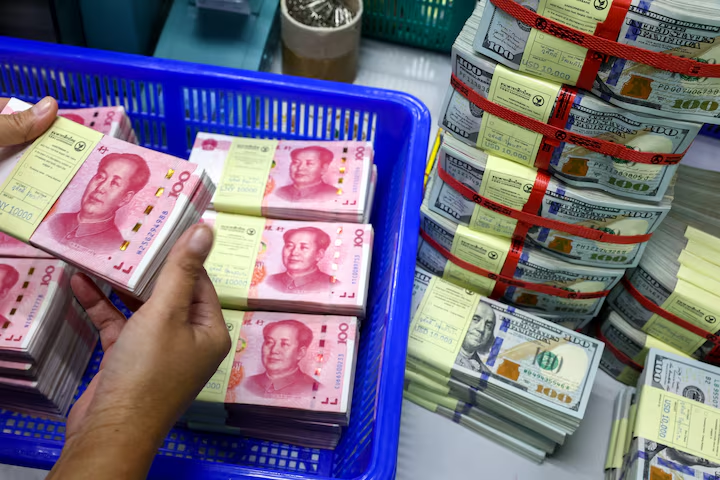
The yuan rose to 6.6950 per dollar on Monday before a Trump-Xi summit, adding currency stability to a week of trade talks.
The onshore currency ended the domestic session at 6.6955 per dollar, its firmest close since June 30, 2022. The offshore yuan traded near 6.6946 per dollar, within a few pips of the onshore high and up about 0.03% in Asian dealing.
PBOC fixing moves closer
The People’s Bank of China set the daily midpoint at 6.7487 per dollar before trading opened, the strongest fixing since February 3, 2023. The level was still 536 pips weaker than a market estimate, leaving the official guide below where traders expected it to sit.
China’s spot yuan can move 2% on either side of the midpoint each trading day, making the fixing a central tool for managing the currency. For nearly a year, the central bank has set that guide weaker than market expectations, a pattern traders and analysts have treated as an effort to slow yuan appreciation.
That gap has narrowed this month after reaching its widest level since February. The faster strengthening of the midpoint suggests the PBOC has become less resistant to gradual gains, at least around a politically sensitive week for US-China relations.
Summit sets currency backdrop
US Treasury Secretary Scott Bessent and Chinese Vice Premier He Lifeng finished talks in New York on Sunday ahead of the September 23-25 meeting between President Trump and Chinese President Xi Jinping. The agenda is expected to include artificial intelligence, trade relations, supply chains and Middle East tensions.
Analysts do not expect a large policy breakthrough from the leaders’ meeting. Still, a steadier yuan reduces one source of friction by limiting the room for fresh claims that China is using depreciation to support exports.
Goldman Sachs analysts said the stronger fixing before the summit was consistent with recent history and could give the offshore yuan more room to strengthen. They said the meeting itself should help preserve a more stable trading relationship, allowing Chinese policymakers to tolerate sustained but gradual appreciation.
The currency move comes with broader foreign-exchange markets quieter after a series of major central bank rate increases last week. The dollar index was steady at 100.23 after gaining more than 1% last week following the Federal Reserve’s rate increase.
Yield gap limits the signal
OCBC analysts urged caution, writing, "Given the wide US-China yield differential and still-soft domestic fundamentals, part of the recent appreciation may reflect policy-managed stability around the summit rather than a fundamental re-rating of the RMB." That caveat keeps the PBOC’s fixing path at the center of the next market test.
If the central bank keeps narrowing the gap between its fixing and market expectations, the yuan may trade with a stronger bias while global investors read currency stability as support for lower US-China negotiating risk. For the PBOC, that path would preserve control over the pace of appreciation; for exporters and currency traders, it would mean tighter margins and less tolerance for one-way dollar-yuan positioning.
If the yield differential instead dominates after the summit, the yuan’s recent strength could stall even without a policy reversal. That route would leave global markets focused again on interest-rate gaps, keep the PBOC balancing stability against weak domestic fundamentals, and give manufacturers and supply-chain firms less clarity on exchange-rate costs.
The main open question is whether the stronger midpoint settings continue after September 25. The answer will show whether Beijing is allowing a short period of summit-related calm or preparing a longer adjustment in how tightly it leans against yuan gains.