Volkswagen restructuring deepens as workers protest cuts
Volkswagen said it will widen restructuring after cutting its 2026 margin outlook to no more than 1%, intensifying talks with unions.
Atlas Newsdesk ·
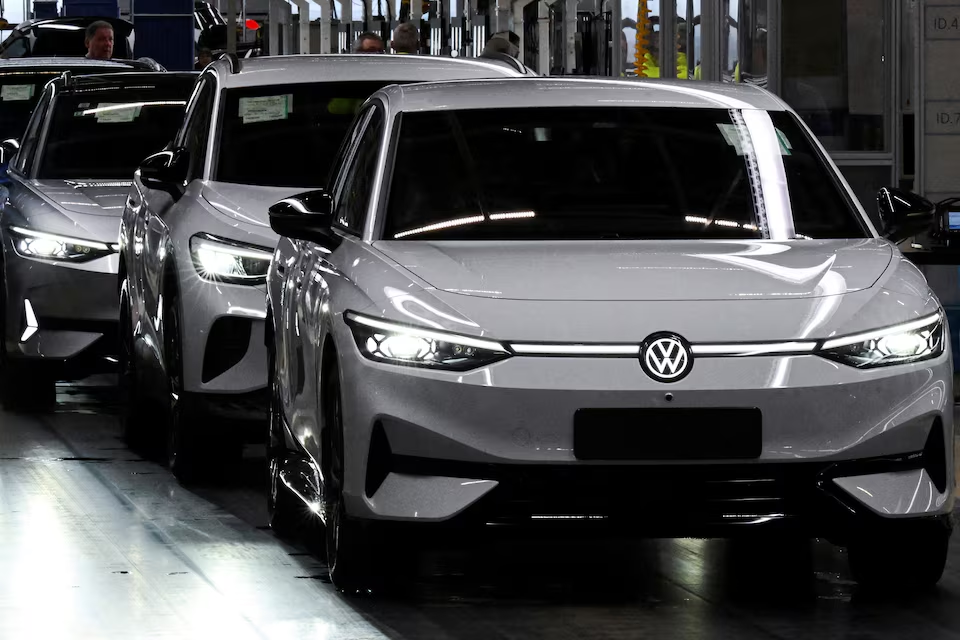
Volkswagen restructuring will accelerate after the carmaker cut its 2026 margin outlook to 1% at most, putting jobs and plants under pressure.
The decision landed as workers at Volkswagen, BMW and Bosch staged nationwide protests on Monday, less than three days after the profit warning. The demonstrations reflected a wider confrontation in Germany’s auto industry over job reductions, possible production moves and the risk of plant closures.
Wolfsburg talks widen
Thomas Schaefer, head of the Volkswagen brand, told staff at the company’s Wolfsburg headquarters that measures agreed in 2024 had not delivered enough. "I had hoped that the measures agreed in 2024 would already be sufficient. Unfortunately, that has not been the case," he said.
Schaefer said the company and employee representatives would discuss the next phase of the performance program. "We have absolutely no time to lose and will therefore significantly step up our performance programme once again," he told employees.
Under the plan described to workers, Volkswagen would cut a further 50,000 jobs as part of a restructuring agreed this month, a deal that avoided a broader confrontation with powerful unions. Works council chief Daniela Cavallo and IG Metall head Christiane Benner called for stronger protection against competition from China, a more effective European Union subsidy policy and the continuation of phased retirement.
China pressure reaches margins
The 2026 margin cut puts a number on the strain facing Volkswagen: profit margin is now expected to reach 1% at most, after the company lowered its prior outlook last week. Volkswagen cited a sluggish Chinese market, higher provisions for retirements and a weaker outlook for Porsche, its sports car brand.
The pressure is not confined to Volkswagen. European automakers are competing with Asian rivals in both export markets and at home, while Volkswagen is also dealing with excess production capacity in Europe, US tariffs and falling profits in China.
The shift toward electric vehicles has added another constraint because demand has accelerated in a segment that is less profitable for traditional automakers than combustion-engine cars. IG Metall official Horst Ott blamed management for the gap, saying, "Most managers have failed to keep pace with developments in e-mobility, digitalisation and battery technology, thereby causing the German automotive and supplier industries to fall behind."
Market pressure spreads
Volkswagen shares were down 1.1% by 1148 GMT on Monday after the stock was excluded from the Euro Stoxx 50 index, extending Friday’s decline. Porsche shares fell 1.6% over the same period, while Porsche SE, Volkswagen’s biggest shareholder, dropped 3.1% after cutting its own 2026 guidance on Friday.
If Volkswagen and employee representatives agree on capacity reductions and phased retirements, the company would have a clearer route to lowering costs while limiting labor disruption. The macro effect would be concentrated in Germany’s industrial base, with suppliers exposed to lower volumes and European automakers watching whether unions accept deeper cuts.
If weak Chinese demand and US tariffs persist instead, Volkswagen’s margin target would remain under pressure through weaker sales mix, lower factory use and higher restructuring needs. For the wider sector, that route would favor companies with lower-cost electric platforms and leave German suppliers more exposed to delayed investment cycles.
If EU subsidy policy and trade protections move closer to union demands, the industry could gain more time to adjust capacity and technology spending. The main open question is whether talks in Wolfsburg produce a labor deal before market pressure forces Volkswagen to take faster action on jobs, plants and model investment.