Volkswagen restructuring widens as workers protest job cuts
Volkswagen will intensify restructuring after cutting its 2026 margin outlook to 1%, raising pressure on jobs, unions and Germany’s auto supply chain.
Atlas Newsdesk ·
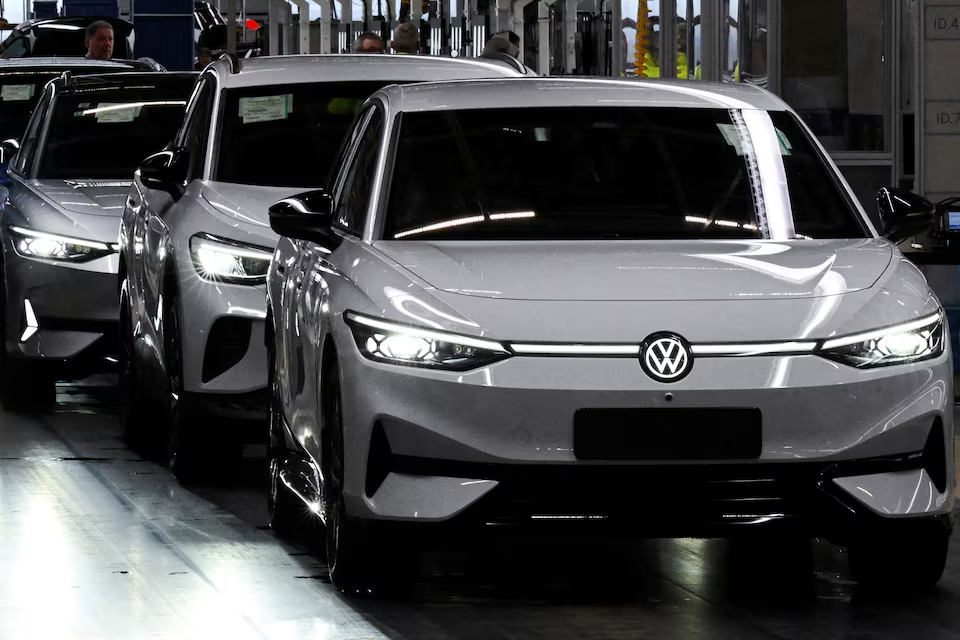
Volkswagen restructuring will accelerate after a profit warning capped by worker protests. China weakness and EV pressure now frame the talks.
Schaefer tightens Wolfsburg program
Thomas Schaefer, head of Volkswagen's core brand, told employees at Wolfsburg on Monday that the measures agreed in 2024 had not delivered enough. "We have absolutely no time to lose and will therefore significantly step up our performance programme once again," he said.
The message landed less than three days after Volkswagen cut its 2026 profit-margin outlook to no more than 1%. The company cited a slower China market, higher provisions for retirement measures and weaker expectations for Porsche, its sports-car brand.
German auto workers protested nationwide at Volkswagen, BMW and Bosch, pushing back against job cuts, possible production moves and plant-closure threats. The timing pulled factory employment deeper into the political debate after two state elections on Sunday.
Unions press China protections
Volkswagen plans to cut a further 50,000 jobs under a restructuring agreement reached with stakeholders this month. The accord avoided a full confrontation with unions, but it did not settle the dispute over where German car production should sit as demand shifts.
Daniela Cavallo, Volkswagen's works council chief, and Christiane Benner, head of IG Metall, called for stronger defenses against unfair competition from China, a more effective European Union subsidy policy and continued phased retirement. "We expect corporate leaders and management teams to take responsibility for Germany as an automotive nation, for employees and for jobs," Benner told workers at Wolfsburg.
EV demand squeezes margins
Volkswagen is carrying several pressures at once: overcapacity in Europe, US tariffs and lower profits in China. The company also said faster demand for less profitable electric vehicles is weighing on a business long supported by combustion-engine models.
Horst Ott of IG Metall said management had failed to keep up with electric mobility, digitalization and battery technology, leaving German automakers and suppliers behind. His criticism moves the dispute from a cost-cutting exercise into a wider argument over technology, investment and industrial policy.
The sector problem is larger than Volkswagen. BMW and Bosch workers joined the protests, showing that pressure from Asian rivals and the electric-vehicle transition is spreading across both carmakers and suppliers.
For suppliers, lower volumes at German plants can cut orders before final assembly jobs are touched. For manufacturers, the risk is that cost savings arrive while product investment in batteries, software and EV platforms still has to rise.
Shares extend Friday declines
Volkswagen shares fell 1.1% by 1148 GMT on Monday, after the company was excluded from the Euro Stoxx 50 benchmark index. Porsche shares slipped 1.6% by the same time, extending Friday's decline after Volkswagen lowered expectations for the sports-car unit.
Porsche SE, Volkswagen's biggest shareholder, fell 3.1% after cutting its own 2026 guidance on Friday. Those moves kept investor attention on whether restructuring can protect cash flow while volume and pricing remain under pressure.
Three paths for Wolfsburg
If China demand stabilizes and retirement provisions are absorbed, Volkswagen could use the 50,000-job plan to lower fixed costs without a larger rupture with unions. That path would ease pressure on German industrial output, give Volkswagen room to fund EV investment and push rivals to copy negotiated reductions.
If China stays weak and EV sales remain less profitable, the 1% margin ceiling could keep pressure on factories and suppliers into 2026. In that case, global trade flows would feel weaker European auto exports, Volkswagen would face tougher capital allocation choices and suppliers would be exposed to lower orders.
If European subsidy policy changes or trade protection against China tightens, the effect would depend on design and timing. Targeted support could help battery and software investment, while poorly matched measures could raise costs for consumers and delay the industry shift Volkswagen is trying to finance.