U.S. payrolls rebound may face Haitian TPS drag in August
Employers are expected to add 56,000 U.S. payrolls in August after a July drop, with Haitian TPS expirations and Fed policy in focus.
Lauren Collins ·
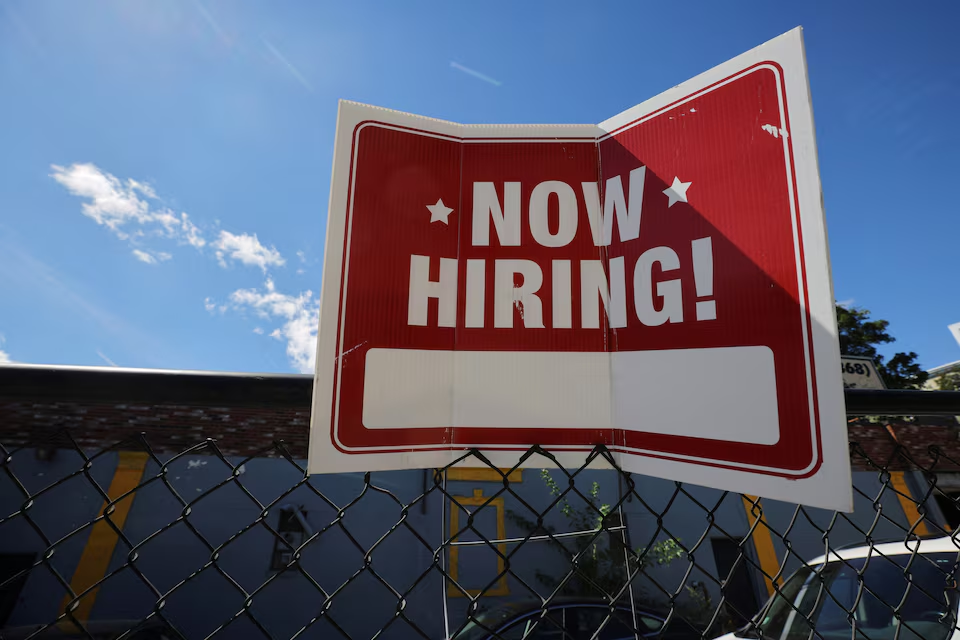
Employers are expected to add 56,000 U.S. payrolls in August after a 23,000 July drop, showing hiring remains constrained.
Economists in a pre-report survey forecast the unemployment rate at 4.1%, unchanged from July. Their payroll estimates ranged from a 25,000 job loss to a 121,000 gain, a spread that reflects uncertainty over seasonal education hiring and immigration-related work authorization changes.
A 56,000-job August estimate
The Labor Department report due Friday is expected to show a rebound from July, when local government education employment fell by 49,600. Economists said that category often distorts late-summer payroll figures, and a partial reversal was expected to support the August total.
Leisure and hospitality was also expected to recover after two months of job losses, according to economists cited in the survey. Those gains may be limited if employers in labor-intensive services reduced staff after work permits lapsed for some Haitian immigrants who had Temporary Protected Status.
Haitian TPS permits narrow gains
Michael Gapen, chief economist at Morgan Stanley, said his team assumed a 15,000 payroll drag from the TPS revocation. He said the affected Haitian workers accounted for an estimated 160,000 positions on national payrolls, making the size of the August effect hard to pin down from one month of data.
The drag would likely show up first in health care and caregiving jobs, where employers rely heavily on immigrant labor, economists said. Some workers who lost TPS may shift to other visa categories, which would make the payroll hit temporary rather than a lasting reduction in employment.
Veronica Clark, an economist at Citigroup, cautioned that a weak reading should not be attributed only to TPS expirations. She said other labor indicators, including hiring plans, had also softened, pointing to a broader loss of momentum after stronger job creation earlier in the year.
Labor supply keeps joblessness low
Economists have described the labor market as a slow-hiring, slow-firing environment: companies are adding fewer workers, but layoffs have not risen enough to push unemployment much higher. President Trump’s 2025 import tariffs, oil-price pressures and supply-chain strains tied by economists to the U.S.-led war with Iran have all been cited as restraints on hiring.
The White House’s immigration enforcement agenda, including deportations and TPS revocations, has also reduced labor supply, according to economists. They estimate the break-even pace of job growth, the monthly gain needed to absorb growth in the working-age population, at zero to 50,000 jobs, far below levels associated with faster population growth.
Gregory Daco, chief economist at EY-Parthenon, said labor force participation had fallen by a full percentage point since the start of the year. He attributed the decline to slower population growth, aging demographics, rising retirements and lower immigration flows.
CPI takes the Fed spotlight
The August jobs report is not expected by economists to settle the Federal Reserve’s September 15-16 rate decision on its own. The Consumer Price Index report due next week is expected to carry more weight, with annual wage growth forecast to slow to 3.0% from 3.2% in July.
Fed Governor Christopher Waller said Thursday he was inclined to support holding rates steady if incoming data confirmed that inflation pressures were easing. CME’s FedWatch tool showed markets pricing a 50% chance of a rate increase, down from 63.2% on Wednesday.
Longer-term Treasury yields have risen as investors weighed inflation risks and the Fed’s limited forward guidance, according to economists. Brian Bethune, an economics professor at Boston College, said markets had already delivered about 75 basis points of tightening through the yield curve.
Higher yields have fed into housing finance costs, with Freddie Mac reporting the 30-year fixed mortgage rate at 6.71% this week, the highest level in more than a year. If borrowing costs stay near that level, housing demand could weaken further, pressuring builders, lenders and consumer-linked sectors.
Three paths from Friday
If payrolls rise near 56,000 and wage growth slows to 3.0%, global markets may treat the report as consistent with slower US demand rather than renewed inflation pressure. For the Fed, that would keep attention on CPI; for services employers, it would suggest a soft labor market rather than a collapse in staffing needs.
If the TPS drag is larger than Morgan Stanley’s 15,000 estimate, the immediate effect would be weaker payrolls in health care, caregiving and hospitality. If CPI instead runs hotter, higher yields could tighten global financial conditions, leave the Fed with less room to hold rates steady, and deepen the strain on housing and other rate-sensitive industries.