US Iran attacks resume as Hormuz risks jolt markets anew
US Iran attacks resumed with strikes across Gulf states, reported civilian deaths in Iran and market pressure from higher oil and bond yields.
Lauren Collins ·
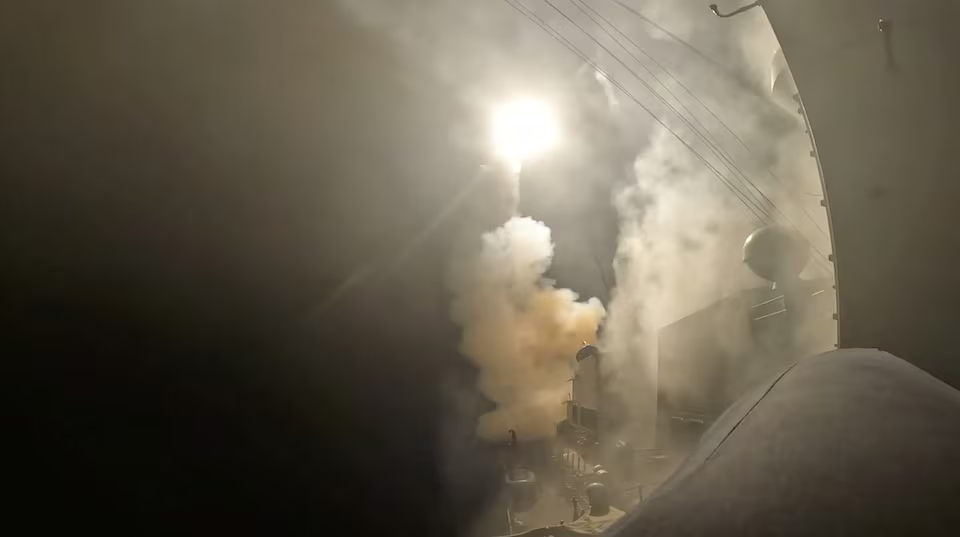
US Iran attacks resumed Wednesday with strikes across Gulf states, five reported wedding deaths in Iran and renewed pressure on oil markets.
Hormuz sites draw U.S. strikes
U.S. Central Command said Tuesday's operation hit Islamic Revolutionary Guard Corps air defense and radar networks, naval equipment, mine deployment capacity and communications nodes. Iranian media reported several strikes near the Strait of Hormuz, the energy shipping channel where Tehran has warned tankers against transiting without approval.
Iran said it responded against U.S. assets in Bahrain, Jordan, Kuwait and Iraq, according to official statements. The IRGC claimed large U.S. casualties in Jordan, while two U.S. officials said initial assessments showed no American deaths or injuries there.
Gulf defenses report interceptions
The IRGC said Wednesday it launched missiles and drones at Kuwait's Ali Al Salem Air Base, including facilities it described as drone sites and accommodation for a U.S. commander. Kuwait's fire service said a drone hit a residential complex in the capital early Wednesday, causing damage and a fire but no casualties.
Jordan's armed forces said air defenses engaged 13 ballistic missiles that entered its airspace; 10 were intercepted and three landed in remote areas. Bahrain said Iranian drones were intercepted and destroyed, while Qatar said the strikes would complicate efforts to contain the confrontation and held Iran responsible for the consequences.
The IRGC also claimed missile and drone strikes on U.S. bases in Erbil in northern Iraq and said several U.S. personnel were killed. Neither Iraq nor the U.S. confirmed that account, leaving the Erbil claim single-sourced to the IRGC.
Civilian deaths and oil pressure
Iran's Red Crescent said five people were killed and 50 wounded at a wedding near Sirik, a coastal area on the Strait of Hormuz. Iranian state media, citing a provincial official, gave a higher wounded figure of 68 and reported that a 4-year-old child was among the dead.
U.S. officials have not commented on the wedding incident. Iran's Foreign Ministry linked the deaths to earlier strikes, including a blast in Minab that it said killed 160 people at a girls' school on the first day of the war; the Pentagon has not issued an official finding on that strike.
In Khuzestan province, the deputy governor said U.S. missile strikes on three sites overnight killed seven people and injured eight, according to Iranian state media. Iran's Foreign Ministry said the country would answer the attacks with firmness, while warning governments that assist the U.S. military in the region of wider consequences.
The exchange interrupted a quieter stretch since July, when both sides had largely avoided direct fire and no diplomatic channel had produced a durable pause. President Trump said Washington had a stronger position and claimed near control of the Strait of Hormuz, while also saying Iran's economy was collapsing.
The market reaction moved through energy and rates. Asian stocks fell after the U.S. strikes, oil reached a five-week high and the U.S. 10-year Treasury yield climbed to its highest level in almost three years, extending a bond selloff across global markets.
If the attacks keep spreading across Gulf bases and shipping lanes, the macro channel runs through crude prices, fuel costs and bond yields. For Washington, that would add domestic pressure before November congressional elections; for the Gulf energy and shipping sectors, it would raise insurance, routing and security costs.
If air defenses and diplomatic pressure instead limit the next round of strikes, the immediate market shock may narrow to oil-linked assets and regional risk premiums. The unresolved questions are whether civilian casualty claims are independently assessed, whether U.S. forces confirm additional losses, and whether Hormuz traffic faces new operational restrictions.