US Diplomacy Seeks Israel-Lebanon Peace, Sides Hezbollah
US diplomacy is pursuing an Israel-Lebanon peace framework while seeking to curb Hezbollah, with follow-on meetings expected after initial talks.
Lauren Collins ·
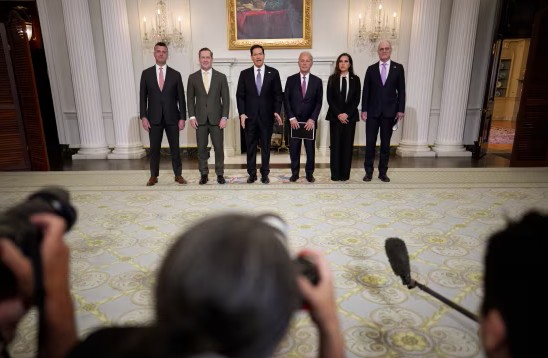
WASHINGTON — The United States has started a new diplomatic initiative aimed at building a lasting peace framework between Israel and Lebanon while also seeking to limit Hezbollah’s regional influence. Secretary of State Marco Rubio described the trilateral engagement with Israeli and Lebanese officials as a historic effort focused on long-term stability, according to his remarks to reporters.
Rubio said the objective is to move past short-term cease-fires and instead tackle deeper drivers of conflict that have endured for decades. He framed the effort as an attempt to set out the basic structure for a durable settlement between the two countries, with discussions designed to create a foundation that could support a permanent agreement.
In his comments, Rubio said, “The hope today is that we can outline the framework upon which a permanent and lasting peace can be developed.” He also warned that progress would not be immediate, calling the engagement “a process, not an event,” and indicating that sustained work would be required over time.
Officials presented the talks as building on earlier U.S. mediation, including the 2022 maritime border agreement between Israel and Lebanon. The current push, however, is described as more complicated because it directly confronts Hezbollah’s entrenched role. The group is portrayed as a powerful armed actor with significant political weight inside Lebanon, and as a security threat to Israel.
The U.S. approach is also positioned as an effort to strengthen the Lebanese state and its official armed forces by engaging both Jerusalem and Beirut. The initiative is described as a strategic shift toward weakening Hezbollah, which officials characterized as an Iran-backed organization. A successful outcome, officials said, could alter regional security dynamics and potentially reduce Iranian influence in the Levant.
Alongside the longer-term goal of a peace structure, immediate de-escalation remains part of the backdrop to the talks. Officials said the broader ambition is to create conditions in which Hezbollah’s military apparatus would no longer be necessary, aligning the security environment more closely with state authority rather than non-state armed power.
Officials also acknowledged that the initiative faces major hurdles. Its viability depends on support from multiple factions within Lebanon, and it is expected to encounter resistance from Hezbollah and its patrons. Follow-on meetings are anticipated to convert the initial framework into specific, actionable proposals, with the reactions of regional powers and the level of commitment from the Israeli and Lebanese governments set to be key indicators of whether the effort can advance.
Implications
Country Impact: For Israel and Lebanon, the initiative centers on moving beyond temporary cease-fires toward a durable settlement framework. The effort also hinges on internal Lebanese buy-in and the willingness of both governments to sustain follow-on talks.
Industry Impact: The source does not cite specific sector measures, but it frames the initiative around security and state authority, including bolstering Lebanon’s official armed forces. Any shift in stability expectations can matter for cross-border economic activity, though no concrete industry outcomes are detailed.
Market Impact: The source describes the talks as aimed at long-term stability and reducing Hezbollah’s influence, which can affect regional risk perceptions. It also notes that reactions from regional powers and the commitment of the parties will be key signals, leaving uncertainty around timing and deliverables.