

Ukraine Courts Ghana on Child Returns as Washington Eyes Africa Diplomacy
Kyiv's push to bring Ghana into a child-reunification coalition gives Washington a humanitarian channel for Ukraine diplomacy in West Africa.
Ukraine Courts Ghana on Child Returns as Washington Eyes Africa Diplomacy
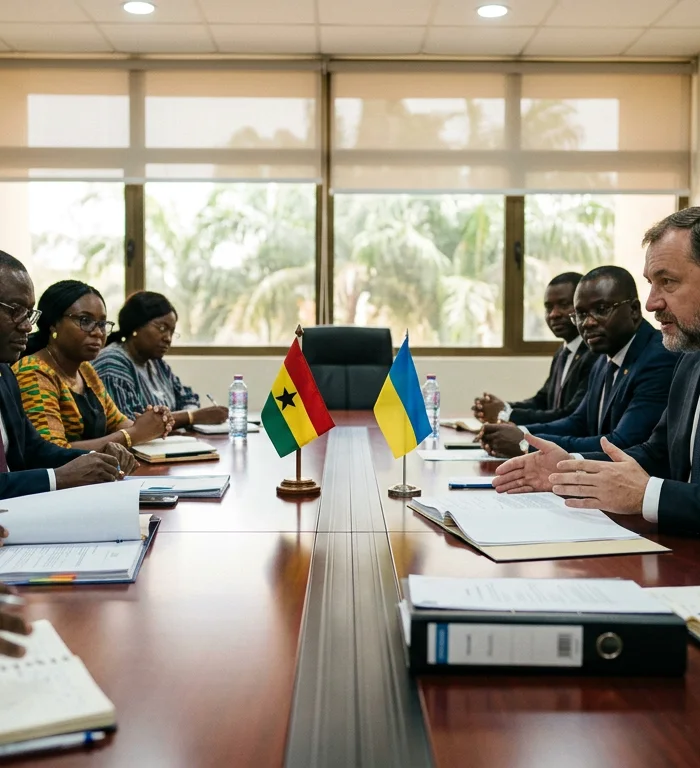
Ukraine is seeking Ghana's support for a campaign to reunite Ukrainian children separated from their families during Russia's war, a diplomatic move that gives Washington a lower-risk opening in West Africa. The appeal centers on the International Coalition for the Return of Ukrainian Children, a humanitarian initiative tied to one of the most legally sensitive allegations against Moscow.
For the White House and State Department, the Ghana approach matters because it moves the Ukraine argument away from arms transfers and battlefield alignments. If Kyiv can widen support among African governments on child returns, US officials gain a moral and legal issue that may be easier for non-aligned states to endorse than sanctions or military aid.
The child-reunification campaign sits alongside a separate legal track that has followed Russia's full-scale invasion of Ukraine since 2022. In March 2023, the International Criminal Court issued arrest warrants for Russian President Vladimir Putin and Maria Lvova-Belova, Russia's presidential commissioner for children's rights, over alleged responsibility for the unlawful deportation and transfer of Ukrainian children from occupied areas.
Moscow has rejected the court's authority, and Russia is not a party to the Rome Statute that created the ICC. The warrants still changed the diplomatic terrain: governments that may avoid taking sides on arms deliveries can face sharper scrutiny when the issue is framed as the return of children to their families.
Its appeal to Ghana is part of a The coalition Ukraine is promoting aims to mobilize governments around documentation, diplomatic pressure and practical pathways for family reunification. Its appeal to Ghana is part of a broader effort to bring countries in Africa, Asia and Latin America into a narrower Ukraine agenda that does not require them to endorse every Western position on the war.
Ghana is a useful test case. It is a democracy with influence in West Africa, a record of participation in multilateral diplomacy and ties to both Western institutions and non-Western partners. Its decision would be watched in Washington less for its direct leverage over Moscow than for what it signals to other African capitals.
The United States has struggled to win consistent African support on Ukraine-related votes at the United Nations. Many governments have condemned violations of sovereignty in principle while resisting pressure to align with Washington's sanctions strategy or to treat Russia as their central security problem.
That caution reflects both history and current interests. Russia has expanded its political and security relationships in parts of Africa, including through Africa Corps, the successor structure to Wagner-linked deployments. Western officials have tried to counter that presence with development, security assistance and diplomacy, but many African governments have resisted framing the continent as a venue for great-power loyalty tests.
Kyiv's child-return diplomacy is designed for that environment. It asks governments to support a humanitarian objective rather than to join a military coalition, and it places the burden on a principle most states already claim to support: separated children should be identified and returned to lawful guardians where possible.
Washington's role is likely to stay partly indirect. The White House's National Security Council coordinates Ukraine policy across agencies, while the State Department's Africa and Europe bureaus would be central to any effort to encourage Ghana and other governments to join or endorse the coalition. The Pentagon is less central to this track because the issue is diplomatic and legal, not operational.
Congress could still matter. Lawmakers who support Ukraine aid may use hearings, letters or funding language to press the administration to prioritize child returns in outreach to African partners. Skeptics of additional Ukraine military assistance may find the humanitarian lane harder to oppose, though they could still question whether it changes Russia's behavior.
The diplomatic value for Kyiv is straightforward. Each additional government that joins the coalition makes it harder for Moscow to cast the child-deportation allegations as a dispute only between Russia, Ukraine and Western capitals. A Ghanaian endorsement would not force Russia to return children, but it would broaden the political audience demanding accountability.
For Ghana, the calculus is more delicate. Joining a child-return coalition would place Accra on the side of a humanitarian initiative without necessarily committing it to sanctions or military support. But any formal step could still be read by Moscow as a political signal, especially if it comes with public language on accountability.
The issue also intersects with the International Criminal Court's standing in Africa. Several African governments have long criticized the court as uneven in its focus, while civil-society groups and legal advocates argue that ICC cases remain important tools for accountability when national systems cannot act. Ghana's posture will therefore be read through both the Ukraine war and a longer debate over international justice.
The main uncertainty is whether the coalition can move beyond symbolic endorsement. Diplomatic signatures can raise pressure, but child returns require identification, access, records, intermediaries and cooperation from authorities controlling the children. Without those mechanisms, the coalition risks becoming another statement of principle with limited practical effect.
For Washington, the upside is that even symbolic movement has strategic value. If Ghana or another ECOWAS member joins, US diplomats can point to African support for a Ukraine-related humanitarian initiative while avoiding the appearance of demanding a military alignment. That would help the administration argue that opposition to child deportations is not just a Western position.
The downside is also clear. If Ghana declines formal membership, or if African voting patterns on Ukraine-related human rights measures remain dominated by abstentions, it would show the limits of issue-specific diplomacy. Russia would retain room to argue that much of the Global South rejects Western efforts to isolate it.
The falsifiable test is whether Ghana and at least one other ECOWAS member formally join the International Coalition for the Return of Ukrainian Children or co-sponsor a UN resolution focused on child deportations by May 30, 2025. If they do, Washington will have evidence that a humanitarian Ukraine track can widen support in Africa without demanding explicit military alignment; if they do not, the effort will suggest that non-aligned governments remain unwilling to turn legal concern over deported children into a formal diplomatic break with Moscow.
More stories
- Houthi-Saudi Attacks Extend Yemen Border Risk
- Washington tests IMF-backed UK fiscal reset against NATO spending demands
- Egypt construction consulting may hit $10.06 billion by 2031
- Etihad, Qatar halt Saudi flights after airport attack
- U.S. Imposes Sanctions on ICC Following Nobel Peace Prize Award to Navi Pillay
- North Korea Conducts Tactical Ballistic Missile Test to Upgrade Weapon Systems
- Ukraine faces 70 missiles; Zelenskiy says at least 11 die
- US and Greece launch counterterrorism data-sharing pact
Latest news
- Bondholders seek more as Treasury yields climb this year
- Georgia death leaves Six Flags facing unanswered questions
- Standard Lithium adds energy veteran with 300,000 options
- Poundland's 12,000 jobs face risk in rescue talks
- Loops AI raises $3.5 million seed round with a16z Speedrun
- Taban Gıda bankruptcy puts wheat imports at risk
- Turkey posts $4.1 billion August current-account surplus
- Oncology decision-support market may reach $2.33 billion