

UBS 58% cloud-growth call puts hyperscaler AI margins on watch
InvestingLive’s single-source report frames strong AI demand; the earnings test is whether revenue growth survives depreciation, financing and rates pressure.
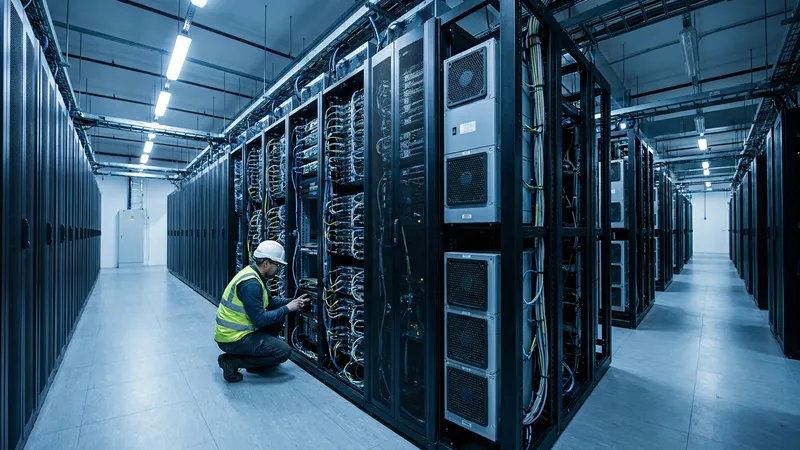
A chief financial officer, reviewing quarterly cloud spend, might applaud the acceleration in hyperscaler revenue as a sign of AI's direct impact. This top-line growth, however, could mask a less favorable reality beneath the surface. Accelerated consumption of pre-committed funds and increasing server depreciation costs may be driving this apparent surge, rather than a genuine expansion in software-driven ROI.
That matters because the report frames AI demand as firm heading into earnings season, while the next evidence will come quickly: ASML reports on Wednesday, followed by the major cloud providers later in the month.
The revenue number is not the margin answer
UBS’s reported case rests on a set of demand signals. InvestingLive said UBS pointed to Meta’s Muse AI assistant, which Sensor Tower data put at more than 6.6 million downloads and 1.8 million daily active users in its first month.
The same report said TSMC reported a 51% rise in quarterly revenue, Samsung flagged an almost ninefold jump in operating profit, Hon Hai beat sales estimates, and Marvell raised its fiscal 2028 revenue forecast. Those figures support the bank’s view that AI compute and infrastructure demand remains robust, but no one in the reported packet is on the record.
The dominant market read is straightforward: if cloud revenue growth accelerates from 48% in the June quarter to 58% in the September quarter, enterprises are turning AI into paid cloud consumption at scale. That may be right, but the mechanism is still unproven in the packet. A hyperscaler can report faster cloud revenue growth because customers are drawing down committed cloud allocations, because AI inference workloads are rising, or because new software demand is expanding.
Those are not the same business. The source gives the top-line growth rate; it does not separate durable new AI revenue from pre-committed spend being consumed faster.
Compute demand can still pressure cloud economics
The margin issue sits below the revenue line. UBS, according to InvestingLive, recommends a diversified approach favoring quality chip and hardware names, megacap platforms and defensive tech. That caution is doing more work than the headline number suggests.
AI demand that shows up as compute usage is not automatically high-margin software revenue. It can require expensive accelerators, networking equipment, power and server refresh cycles before the provider knows whether a customer’s AI product will retain users or produce recurring application revenue. The report does not give cloud operating margins, server useful lives, utilization rates, or depreciation schedules.
That omission is the thesis investors and enterprise buyers should watch.
If the 58% September-quarter growth rate reflects high-value application demand, cloud providers should show healthy margins while hardware suppliers continue to benefit. If it reflects a burst of low-margin inference and committed-spend burn, the same revenue acceleration can coexist with weaker operating leverage.
The packet contains supportive hardware signals from TSMC, Samsung, Hon Hai and Marvell, but it does not prove that hyperscalers are earning software-like returns on the AI workloads driving cloud consumption. The bank’s own warning about growth, financing and safety concerns points to that fragility.
The buyer risk moves to commitments
For chief information officers and finance chiefs, the near-term procurement question is less whether AI demand exists than how it is being purchased. The report says UBS sees the AI boom as running on real demand after nearly five years, but also says the bank wants investors to be pickier about where they ride it. That same selectivity applies to enterprises.
If vendors translate cloud acceleration into bigger multi-year commitments, buyers may be asked to reserve capacity before they can prove that AI features generate paid usage inside their own companies. That creates a budget risk even when the technology works.
The counter-read is that UBS’s caution may simply be normal late-cycle risk control, not evidence of an AI margin squeeze. Strong chipmaker results, early consumer adoption for Muse, and a higher cloud growth forecast all point in the same direction in the InvestingLive summary. A hot US inflation print on Wednesday that lifts Treasury yields would weigh on long-duration tech valuations regardless of AI fundamentals, the report said.
In that version, volatility comes from rates and valuation, not from cloud economics. The test is whether the major cloud providers can pair accelerating growth with convincing evidence that AI workloads are not diluting cloud margins.
Earnings will expose the weak link
The next proof points are not more launch metrics. InvestingLive said results, rather than narrative, are expected to drive the AI trade through the coming earnings season.
ASML’s Wednesday report will test the upstream equipment story, while the major cloud providers later in the month will test whether revenue acceleration is translating into durable profitability. Investors should also compare management language on financing risk, customer commitments and AI safety costs with the reported UBS preference for quality and defensive tech.
If the tone moves from demand capture to cost discipline, the margin question becomes harder to dismiss.
The observable signals that would weaken this analysis are plain. Cloud providers would need to show that operating leverage is improving while revenue growth accelerates, that server-related costs are not rising faster than cloud revenue, and that enterprise software companies are reporting standalone AI add-on sales rather than vague usage.
Conversely, a shortfall against the accelerating cloud growth UBS expects would likely hit richly valued megacaps hardest, according to InvestingLive. The story ends, for now, with the earnings calendar: ASML on Wednesday, inflation data on Wednesday, and the major cloud providers later in the month.
More stories
- Amazon’s $7 billion Decart talks test AWS margin strategy
- Amazon talks to buy Decart for $7B as AWS lock-in risk grows
- iFi prices Up Play Bluetooth dongles at $59 and $89
- XRP Ledger Developers Deploy Emergency Patch to Fix Nine-Year-Old Token Minting Flaw
- Bandai Namco sets 2027 cross-play test for Sparking Zero
- Deadlock’s Solomon hides 8-to-32 chess reload boards
- My.Games says Hunting Rivals passed $3m revenue and 3m installs
- India launches CAG-BHASHINI AI translation tool
Latest news
- Manchester City Defeats Liverpool 3-0 at Anfield
- Port City Coach Ennin Vows Response After Hearts Defeat
- Senators oppose President Trump diesel deal with Russia
- Gajwani casts 250,000 startups as India deep-tech base
- Prime Minister Releases Secret Manchester City Meeting Records
- Ghanaian Football Pitches Hamper Player Development, Coach Says
- Hearts Coach Kapor Criticizes Ghana Pitch Conditions
- Brad Pitt, Ines de Ramon Appear Together at Film Festival