Turkey-Malaysia defense warmth puts a new Southeast Asia file on Washington's desk
Turkey’s defense ties with Malaysia have grown steadily since 1964, signaling Ankara’s search for security partners beyond its traditional NATO lane.
Lauren Collins ·
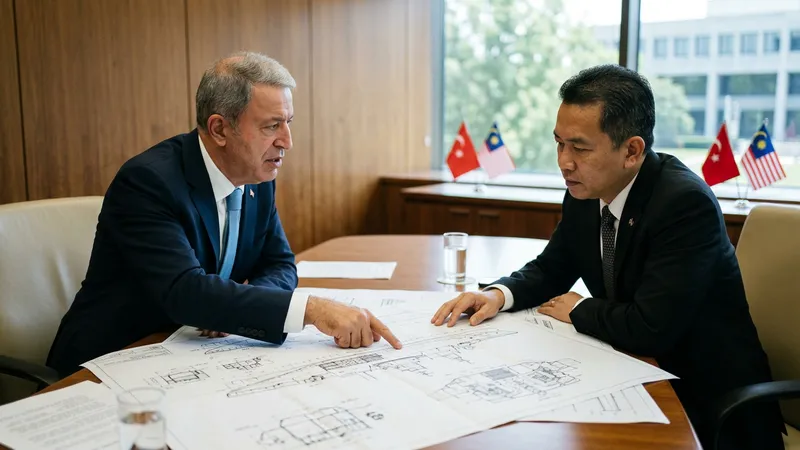
Turkey-Malaysia defense warmth puts a new Southeast Asia file on Washington's desk
Turkey’s defense minister, Yaşar Güler, said this week that relations with Malaysia have developed steadily since diplomatic ties began in 1964, a reminder to Washington that Ankara’s defense diplomacy now stretches well beyond the NATO map.
Its importance for US officials is the direction
The statement did not announce a new arms deal, exercise or basing arrangement. Its importance for US officials is the direction of travel: a NATO ally with a growing defense-industrial base is deepening political and security ties with a Southeast Asian state that already balances relations among Washington, Beijing and regional partners.
Turkey and Malaysia established diplomatic relations in 1964, giving the relationship a six-decade arc that Turkish officials now frame around trust, shared interests and expanding cooperation. Güler’s remarks fit a broader Turkish pattern: Ankara is looking for political room and export markets in Asia while maintaining its formal place inside the Western alliance system.
For Washington, the issue is not that Turkey and Malaysia talk. It is that defense relationships can become channels for procurement, technology transfer, training and political alignment, even when no formal alliance emerges. A single ministerial statement is not a strategic turn, but repeated high-level language can prepare the ground for deals that later force US planners to adjust assumptions.
Southeast Asia
The Malaysia side of the equation matters because Kuala Lumpur has long avoided a simple alignment with any one major power. Malaysia works with the United States on security matters, trades heavily across Asia and manages a close but complex relationship with China. That hedging gives outside partners room to enter, especially if they offer equipment, training or industrial cooperation without the political conditions often attached to Western defense ties.
Turkey brings a different proposition. It is a NATO member with combat-tested defense companies, a diplomatic style that often mixes transactional bargaining with political symbolism, and an incentive to sell to states that want alternatives to US, European, Russian or Chinese systems. For Southeast Asian governments, Turkish equipment and co-production offers can look like a way to diversify without choosing a side.
The Washington dilemma is therefore less about one bilateral relationship than about accumulation. If Turkey builds defense links with Malaysia while also expanding ties elsewhere in Asia, the Pentagon and State Department may face a more crowded partner landscape in a region already central to US-China competition. The National Security Council would also have to judge whether Turkish activity complements US objectives, competes with them or sits uneasily between the two.
Congress adds another layer. Lawmakers have spent years debating Turkey’s role inside NATO, including disagreements over arms purchases, regional policy and Ankara’s ties with Russia. A visible Turkish push into Southeast Asian defense markets would not automatically trigger opposition on Capitol Hill, but it would give defense committees another reason to ask how US technology, NATO interoperability and third-country transfers are being managed.
The most immediate effect would fall on Malaysia’s procurement choices. If Kuala Lumpur sees Turkish systems as affordable, politically flexible and compatible with its desire for autonomy, Turkish firms could gain a foothold in areas such as unmanned systems, armored vehicles, naval platforms, munitions or electronics. The source material did not identify a specific procurement line, so any sector-level effect remains conditional rather than established.
For Turkey, the upside is clear. Defense exports support industrial scale, reduce dependence on narrower markets and give Ankara more diplomatic leverage. A Southeast Asian partnership with Malaysia would also reinforce Turkey’s claim to be more than a regional actor confined to the Middle East, the Black Sea and the eastern Mediterranean.
For the United States, the strategic effect depends on the mechanism. If Turkish-Malaysian cooperation stays transparent, interoperable and commercially limited, Washington may treat it as a manageable extension of allied industrial activity. If it turns into technology transfer in sensitive areas, defense coordination that excludes US systems or political messaging that positions Turkey as an alternative to Washington, the State Department and Pentagon would likely have to engage earlier and more directly.
The global macro link is indirect but real. Defense-industrial partnerships are increasingly tied to supply chains, export financing and technology ecosystems. If middle powers such as Turkey and Malaysia deepen defense production or procurement ties outside traditional supplier blocs, the global arms market becomes more fragmented, and US leverage through licensing, sanctions risk and alliance channels becomes less automatic.
There is also a China angle, though it should not be overstated from Güler’s remarks alone. Malaysia’s foreign policy is built around room for maneuver, not ideological alignment. A Turkish offer that gives Kuala Lumpur another option could strengthen Malaysia’s hedging position; it could also complicate Washington’s effort to present itself as the primary security partner for maritime Southeast Asia.
The test is whether the rhetoric produces a measurable defense milestone by December 23, 2026. If Turkey and Malaysia announce a joint exercise, a defense procurement, a technology-transfer arrangement or another high-level visit explicitly framed around security cooperation, Washington will have evidence that Ankara’s Southeast Asia push is moving from diplomacy into capability-building; that would modestly complicate the US regional playbook, give Turkey a stronger Asian defense platform and add pressure on Western and Asian suppliers competing for Malaysian contracts. If no such step appears, the statement will look more like relationship maintenance than a pivot, leaving US policy largely unchanged while Malaysia continues its existing hedge among the United States, China and other partners.