Thales AI push seeks global rules for battlefield systems
Thales AI regulation push adds pressure on governments to set rules as Europe weighs battlefield autonomy and dependence on US software.
Jason Kwon ·
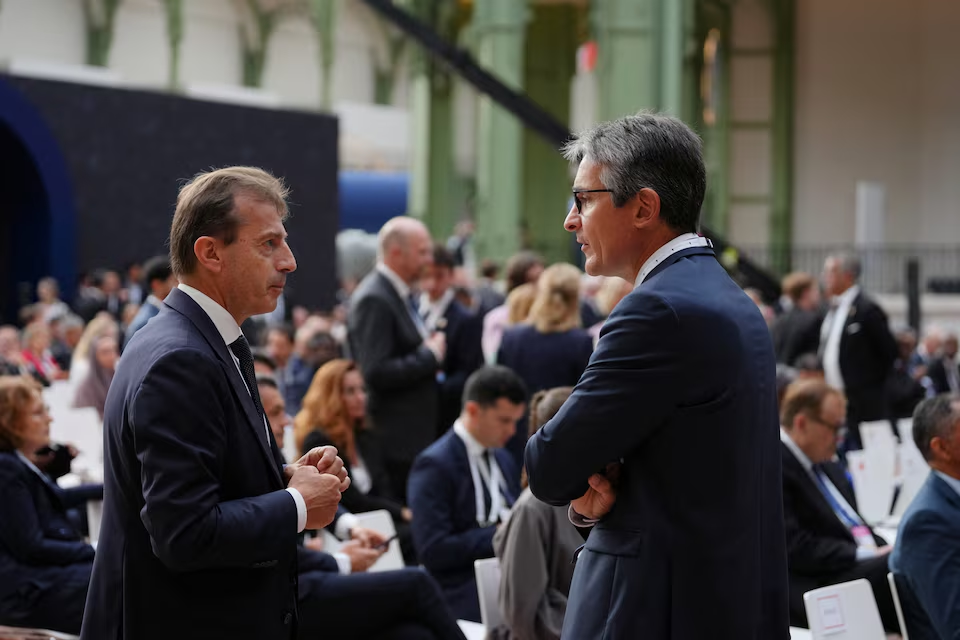
Thales AI regulation call put Europe’s biggest defense-technology company behind global rules for battlefield systems as autonomy concerns spread.
Patrice Caine, chief executive of France-based Thales (TCFP.PA), told reporters Thursday that technical safeguards alone would not settle how artificial intelligence is used in war-fighting tools. He said governments must set the framework that sits above those controls, placing the issue in public policy rather than engineering alone.
Caine shifts the AI burden
“I am convinced that we have the ways and means to have AI under control. It's not a technical debate, it falls in the hands of governments,” Caine said. He added: “The world needs a proper framework that comes on top of these technical guarantees.”
The comments came one day after France’s Finance Minister Roland Lescure urged France and Europe to move faster on artificial intelligence development. Lescure framed the issue around technological dependence, warning that European users should not have to rely mainly on US providers.
President Trump has rejected calls from Anthropic CEO Dario Amodei and other Silicon Valley executives to slow the pace of AI development. That divide leaves European defense companies trying to argue for both faster deployment and more explicit rules.
Battlefield software gets political
Artificial intelligence is already becoming part of military decision systems, where software can process drone video, satellite imagery and other feeds to help identify targets. The operational appeal is speed: commanders can receive sorted information faster than human teams can review raw data.
The same function makes oversight harder. A system that ranks targets, filters imagery or recommends action can influence battlefield decisions even when a human remains formally in charge.
NATO’s selection of Palantir Technologies’ Maven Smart System for headquarters operations has sharpened the European debate. European groups are promoting their own command-and-control systems as governments examine where military data is stored, how it is processed and whether outside providers can remain available during a crisis.
Analysts cited in the debate say France and other European countries are focused on two risks: the handling of sensitive defense information and the chance that Washington could restrict access to US technology. Palantir did not comment in the material provided.
Hexaforce carries the sovereignty pitch
Thales presented its AI-based Hexaforce system as a “sovereign” command-and-control product. The company said the system is not subject to US ITAR export controls, a point aimed at governments that want operational freedom over defense software.
Caine avoided a direct public fight with Palantir, even as he signaled that the market remains open. “The battle is only beginning,” he said when asked about demand for such systems.
He also pushed back when asked about the US company co-founded by Peter Thiel. “We didn't pronounce the word Palantir since the beginning — you did,” Caine said, before adding that Palantir’s product covers “quite a very tiny part of NATO use.”
Other French companies working on command-and-control systems include Mistral AI and Comand AI. Their presence gives France a domestic software base, but defense clients also require systems that can connect with allied platforms already in use.
Two paths for defense AI
If governments agree on common rules for military AI, the global macro effect would be a more predictable procurement environment for allies buying sensitive technology. For Thales, that would strengthen the sales case for Hexaforce; for the sector, it would push vendors to prove auditability, data control and interoperability.
If US systems keep setting the standard instead, Europe’s defense-software market may remain tied to American platforms despite sovereignty concerns. That path would limit Thales’ near-term leverage, while forcing European suppliers to make their products work alongside Palantir and other US tools rather than replace them outright.
The main open question is whether European governments can move quickly enough to write rules while also funding competitive systems. Caine’s argument places Thales in the middle of that trade-off: Europe wants more autonomy, but military buyers still need software that works across NATO networks.