SpaceX Debuts Higher After $75 Billion IPO
SpaceX raised $75 billion and opened above its $135 offer price on Nasdaq, pushing Elon Musk’s paper fortune past $1 trillion while exposing public investors…
Edward Mullen ·
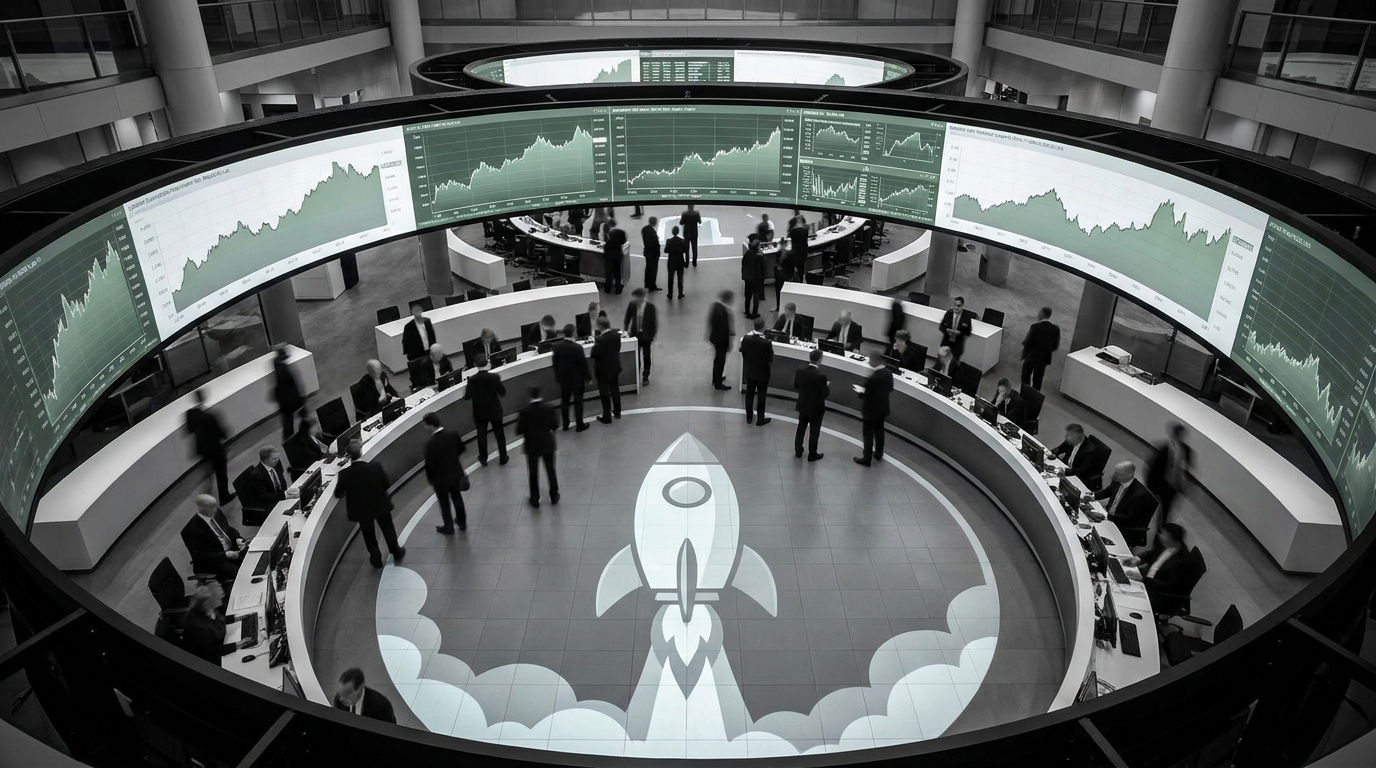
SpaceX moved from private-market prize to public-market giant Friday, with its Class A shares opening at $150 on Nasdaq as SPCX after the company sold 555,555,555 shares for $135 each. The sale brought in $75 billion and implied an equity value of about $1.77 trillion at pricing, before the first trade lifted the company toward roughly $1.96 trillion. By early afternoon, the stock had traded near $168.90, putting market value around $2.21 trillion and pushing Elon Musk’s estimated net worth past $1 trillion. The debut immediately placed SpaceX among the world’s most valuable listed companies, even though its earnings profile is far thinner than the mature technology giants it now sits beside.
A Noon Trade Ignites Demand
The biggest change is simple: a company once priced through private rounds, tender offers and secondary-market scarcity now has a live public quote. SpaceX chose this moment because its next phase requires capital on a scale that even its launch and satellite businesses cannot comfortably fund on their own. The prospectus says proceeds are expected to support AI compute infrastructure, launch systems, satellite constellation growth and general corporate needs, tying the IPO directly to Musk’s broader industrial plan. That gives investors a rare listed vehicle spanning rockets, broadband, artificial intelligence and social-media assets, but it also turns long-dated ambitions into a stock that will be judged every trading day.
The financial picture is large but uneven. SpaceX reported $18.674 billion in 2025 revenue, total costs and expenses of $21.263 billion, a $2.589 billion operating loss and a $4.937 billion net loss, according to the prospectus table. The first quarter of 2026 showed more strain, with $4.694 billion in revenue and a $4.276 billion net loss, reflecting the expense of building beyond the company’s established launch and connectivity operations. The filing also recasts results to include xAI and X after common-control transactions, which means investors are not buying the old SpaceX alone but a combined Musk platform with space, connectivity, AI and social-media exposure.
SpaceX gave individual investors unusual access to the float, with reports that roughly one-fifth of the IPO was placed with retail accounts, far above the slice typically available to small buyers. Brokerages including SoFi, Fidelity, Charles Schwab and Robinhood handled heavy demand, and SoFi said eligible customers who placed orders received an allocation, though many buyers still reported getting less than they requested. Early private holders saw a different kind of payoff: BRC Group Holdings, the company once known as B. Riley Financial, is set for about $58.5 million of carry value linked to SpaceX shares held for wealth-management clients, according to Chief Executive Bryant Riley. Riley said those advisers began buying roughly $100 million of SpaceX shares for clients in 2018, with some entry prices near $3, a reminder that much of the richest value creation happened before the public listing.
Musk's Control and Investor Influence
Public buyers are getting economic exposure, not equal power. The prospectus says Musk is expected to hold about 82.4% of common-stock voting control after the offering, while the dilution table shows new investors buying about 4.2% of shares and contributing nearly half of the total consideration measured there. The charter structure gives Class B holders far greater influence, and the filing says Musk’s removal from his board, CEO and chairman roles would require approval by the Class B vote. Pension officials from New York and California had warned before the deal that such provisions, combined with arbitration and controlled-company status, would leave public investors with limited tools if strategy or governance falters.
The listing resets expectations for private technology companies that have spent years raising money outside public markets. SpaceX’s raise exceeded the prior IPO record set by Saudi Aramco, and reports indicated that Nasdaq rule changes could put SpaceX into index-linked funds faster than usual, potentially forcing passive vehicles to buy shares sooner. That matters because the next wave of large offerings is no longer only a venture-capital issue; it affects retirement funds, index investors and global asset managers who may end up owning stocks they did not actively select. SpaceX is also being watched as a possible opening act for other megacap private companies, including AI groups expected to pursue listings of their own.
Future Challenges and Market Scrutiny
The first-day rally does not settle the harder question: whether a company valued above many profitable global champions can grow fast enough to justify the price. SpaceX must prove that Starlink expansion, reusable launch economics, Starship development, AI infrastructure and orbital data-center plans can eventually produce operating leverage rather than only larger funding needs. Analysts argued the IPO price was too high and estimated a far lower value, pointing to unproven technology and heavy capital requirements. The first public earnings cycle, index-inclusion decisions, post-IPO trading volatility and any delays in major technical programs will now test whether investors bought a durable platform or paid peak prices for Musk’s most ambitious story.