Seoul Central Asia summit targets critical mineral deals
The Central Asia summit produced more than 70 agreements as South Korea sought wider cooperation on critical minerals, energy and supply chains.
Lauren Collins ·
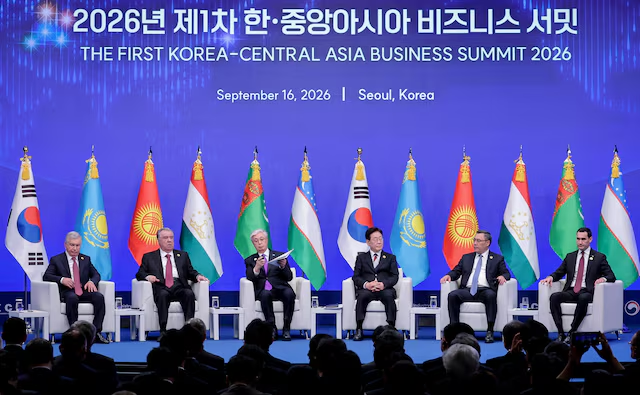
The Central Asia summit produced more than 70 accords as South Korea sought deeper minerals, energy and supply-chain ties with five states.
President Lee Jae Myung hosted the leaders of Kazakhstan, Uzbekistan, Turkmenistan, Kyrgyzstan and Tajikistan on Wednesday, closing three days of bilateral meetings. The agreements and memorandums of understanding covered energy, mining, infrastructure, technology and investment, according to the summit announcements.
Seoul widens minerals agenda
Lee framed the meeting as a shift from buying resources to building industrial links around them. Speaking at a business forum after the summit, he said, "Beyond simple raw materials trade, we must strengthen cooperation across the entire critical minerals value chain, from exploration and refining to high-value materials processing and finished-product manufacturing."
Lee said South Korea would support that work through South Korean-led rare metals centers in Central Asia. Those centers are meant to promote joint research and workforce training, giving Seoul a role earlier in the supply chain rather than only at the import stage.
The approach reflects South Korea's position as a resource-poor industrial economy with exposure to crude oil, uranium and strategic mineral supply risks. Seoul has pursued wider economic links with Central Asia and other Eurasian partners since launching its New Northern Policy in 2017.
Astana gets the 2028 meeting
The summit created a regular leaders' framework, with meetings scheduled every two years. Kazakhstan is set to host the next gathering in Astana in 2028, giving the six governments a dated checkpoint for turning signed documents into projects.
Kazakhstan took the most visible bilateral role during the week. South Korea and Kazakhstan signed agreements covering nuclear energy, crude oil and critical minerals, and raised their relationship to a comprehensive strategic partnership.
Separate meetings with Uzbekistan, Turkmenistan, Kyrgyzstan and Tajikistan produced accords in strategic minerals, energy, infrastructure, trade, investment and digital technologies. The range of topics gives Seoul more than one channel for engagement, but it also leaves implementation spread across ministries, state companies and private firms.
SK Group follows supply chains
SK Group Chairman Chey Tae-won used the business forum to echo Lee's emphasis on processing and materials. "We will expand critical minerals cooperation beyond simple development to encompass the entire supply chain, from refining to materials production," Chey said.
Chey also called for stronger cooperation in renewable energy and nuclear power. For SK Group, the opportunity outlined at the forum is not limited to extraction; it extends to refining, materials production and energy projects that can support industrial investment.
The wider industry effect depends on whether the agreements create bankable projects rather than diplomatic language. If companies can secure upstream access and processing partnerships, South Korean manufacturers would have more options for inputs used across energy, technology and advanced materials.
Three paths for resource security
If the framework converts memorandums into operating projects before the 2028 Astana summit, South Korea could add another supply corridor for minerals and energy. The macro effect would be incremental diversification in strategic commodities; the company effect would be a broader project pipeline for groups such as SK; the sector effect would be tighter links between Central Asian resources and South Korean processing.
If financing, infrastructure or regulatory terms slow execution, the near-term impact would be more limited. South Korea would still have a diplomatic platform in Central Asia, but companies would face a longer wait for investable assets and the broader industry would see fewer changes to supply-chain structure.
A third path is selective progress, with energy or minerals projects moving faster than digital and infrastructure cooperation. Under that scenario, the global macro effect would be concentrated in a narrower set of commodities, SK Group would focus on the most commercially developed segments, and suppliers would adjust around specific materials rather than a region-wide industrial shift.
The main open question is whether the more than 70 agreements gain financing, permits and commercial sponsors before leaders meet again in 2028. That execution test will determine whether Seoul's Central Asia push becomes a supply-chain strategy or remains a diplomatic framework.