Nvidia’s Huang Sees AI Data Centers Fueling Trades Hiring
Nvidia CEO Jensen Huang says the AI data-center boom will drive demand for skilled trades, offering new career paths beyond software or college.
Jason Kwon ·
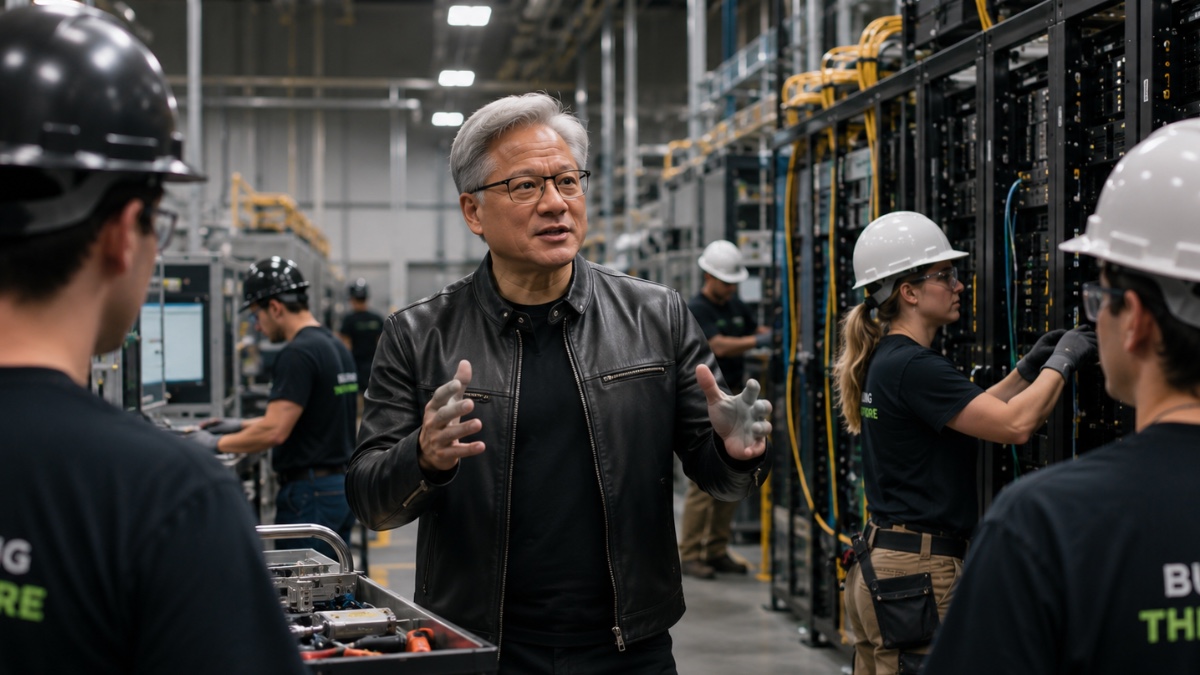
Nvidia CEO Jensen Huang is telling young workers that the AI economy will need more than coders. As companies race to build data centers for artificial intelligence systems, Huang says electricians, plumbers and carpenters will be essential to turning that digital ambition into physical infrastructure. In a late-2025 interview with Channel 4 News in the U.K., he said economies will need very large numbers of skilled tradespeople to construct the factories and facilities behind AI computing. His message cuts against a common Gen Z anxiety: that artificial intelligence will mainly close off entry-level career paths.
Data Centers Change the Math
The shift is happening because AI requires enormous computing capacity, and that capacity has to live somewhere. Nvidia’s chips sit at the center of the AI buildout, making the company both a supplier to the boom and a beneficiary of the infrastructure race it is helping to accelerate. The company announced a $100 billion investment in OpenAI tied to data centers using Nvidia AI processors. McKinsey has projected that global data-center capital spending could reach $7 trillion by 2030, a scale that would require not just semiconductors and power contracts, but crews capable of building, wiring and maintaining huge sites.
A Trade-School Opening
Huang’s comments also point to a different career map for young people weighing college, debt and job security. He argued that the skilled-craft part of the economy is likely to expand sharply as AI infrastructure grows. That means trade school, apprenticeships and licensing programs could become more valuable for some workers than a generic office-track degree. The opportunity is not simply that construction jobs exist today; it is that AI infrastructure may keep demand elevated across multiple years if companies continue racing to add computing power.
The labor impact can be large even at the level of one facility. A 250,000-square-foot data center can require as many as 1,500 construction workers while it is being built, with many roles paying above $100,000 when overtime is included and without requiring a four-year degree. After opening, the same facility may need roughly 50 permanent employees to keep it operating. The article’s figures also suggest a broader local effect, with each on-site role supporting additional jobs in the surrounding economy through services, suppliers and related spending.
Fink and Farley Warn
Huang is not alone in warning that the AI buildout could run into a labor bottleneck. BlackRock CEO Larry Fink said in March 2025 that he had raised the issue with the White House, arguing that the U.S. could lack enough electricians to construct AI data centers. Ford CEO Jim Farley has made a similar point about manufacturing and reshoring, saying political ambition is not enough without workers to staff new industrial projects. Farley has cited shortages of 600,000 factory workers and 500,000 construction workers in the U.S., numbers that frame the data-center boom as part of a wider blue-collar labor squeeze.
The Physical Side of AI
The broader implication is that AI may redistribute opportunity rather than simply erase it. Software roles, especially junior ones, face pressure as companies test automation across coding, customer service, research and administrative work. Yet the physical side of AI is much harder to automate quickly: land has to be prepared, buildings erected, pipes installed, electrical systems connected and cooling systems maintained. Huang has also said that if he were 20 again, he would lean more toward the physical sciences than software, a revealing comment from the head of one of the world’s most important chip companies.
Some young workers are already treating trades as a route around college debt and uncertain office hiring. Jacob Palmer, a Gen Zer in North Carolina, chose an electrical apprenticeship after high school instead of college. By 21, he had started his own business, grossing nearly $90,000 in 2024 and reaching six figures in 2025. His example does not guarantee the same outcome for every apprentice, but it shows why the data-center boom could make trade work more attractive to young people who want income, independence and a skill tied to real infrastructure demand.
The main uncertainty is whether the workforce can scale quickly enough. Training electricians, plumbers, welders and other specialists takes time, and licensing rules, immigration policy, housing costs near construction sites and regional labor shortages could all slow projects. The U.S. Department of Education has made skilled-trades expansion a priority, but public programs may not move as fast as private capital chasing AI capacity. For Gen Z, the opening is clear: the AI economy may still offer strong careers, but some of the best entry points could be in tool belts rather than office towers.