Natural gas prices in Texas are negative and producers burn it off while shortages loom elsewhere
Texas gas prices fell to -$9.75 at Waha in mid-March 2025, while Europe and Asia surged on Hormuz and Qatar LNG disruptions.
Atlas Newsdesk ·
Texas Gas Prices Plunge Below Zero Amid Global Supply Squeeze
HOUSTON – Natural gas in West Texas briefly traded at negative prices in mid-March 2025, signaling a severe local oversupply and transportation bottlenecks.
This localized price collapse occurred as international buyers faced escalating costs due to heightened supply risks in critical global shipping lanes and production hubs.
Permian Basin Sees Negative Pricing
During the week of March 15, 2025, spot prices at the Waha hub in the Permian Basin plummeted to an unprecedented -$9.75 per million British thermal units (BTUs).
The drastic drop was attributed to a significant surplus of natural gas in the region, coupled with insufficient pipeline capacity to transport volumes to other markets, according to reports.
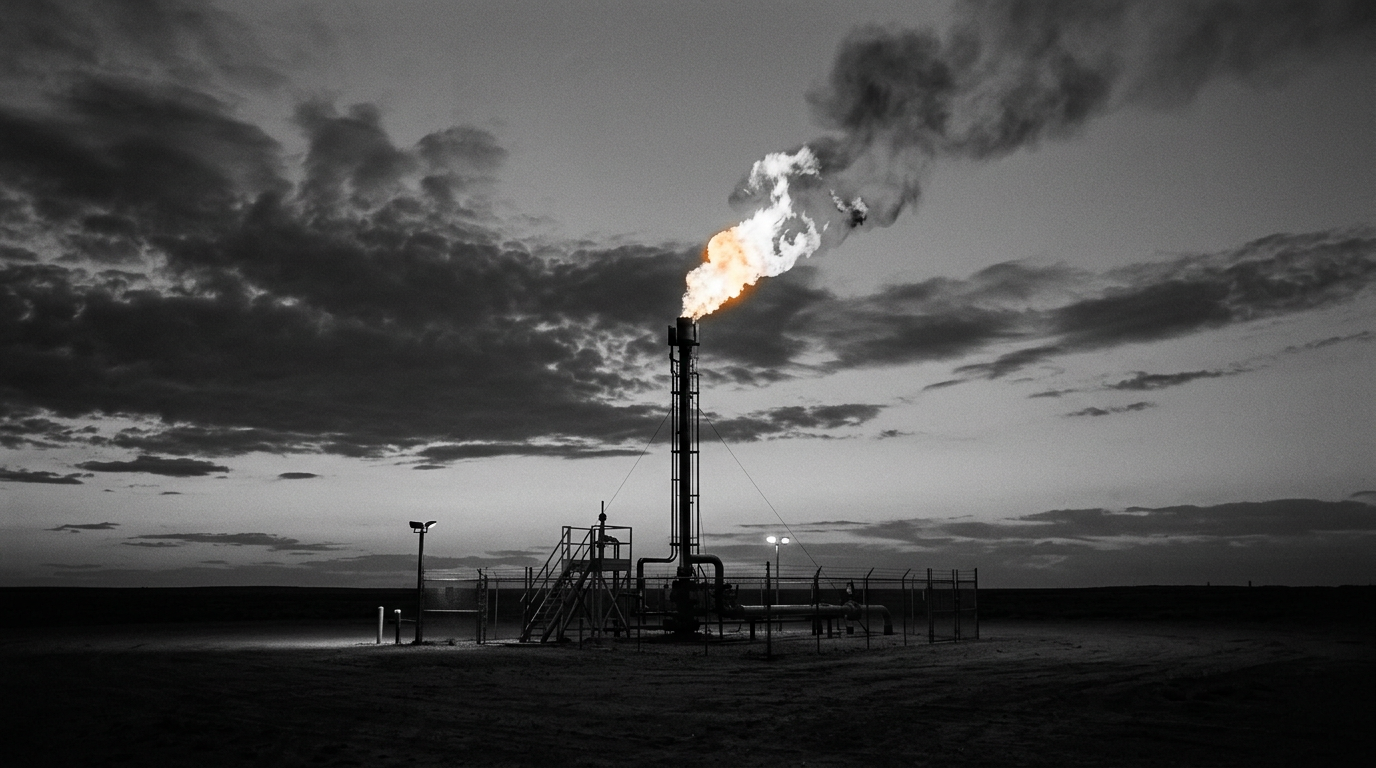
Producers, facing limited options, resorted to burning off excess supply, with flaring activity reportedly reaching a five-year high.
Oil production in the area remained profitable enough that some operators tolerated losses on associated gas rather than curtailing crude output.
Global Markets Face Disruptions
Concurrently, outside the United States, global gas prices surged due to disruptions linked to the U.S.-Israel war on Iran.
The Strait of Hormuz was partially closed, impacting approximately 20% of global oil and liquefied natural gas (LNG) flows that typically transit this vital waterway.
Separately, an attack on Qatar’s Ras Laffan Industrial City damaged two LNG production trains.
This incident cut roughly 17% of Qatar’s LNG exports, with repairs potentially requiring up to five years, suggesting a prolonged constraint if this timeline holds true.
European and Asian Prices React
In Europe, benchmark gas futures climbed by as much as 35%, reaching around 70 euros per megawatt-hour.
This figure translates to more than $20 per million BTUs, approximately double pre-war pricing, highlighting the rapid impact of geopolitical shocks on energy markets.
Asian LNG spot prices were projected to exceed $30 per million BTUs during summer conditions if the Hormuz disruption persists.
Projections suggested prices could even surpass $40 if the closure extends for six months, though the duration remains unconfirmed.
Implications of Divergent Markets
This stark divergence underscores a structural issue: regional pipeline limitations can trap supply and depress local prices even when international markets are tight.
For global buyers, the constraints at Hormuz and Ras Laffan point to higher procurement costs and increased competition for flexible LNG cargoes.
Asian governments are reportedly considering demand-management measures, including four-day workweeks, and increasing coal-fired generation to address potential shortages.
Key uncertainties include the duration of shipping disruptions, the actual pace of repairs in Qatar, and whether new infrastructure can alleviate the Permian’s takeaway limits.