NASA's Roman telescope signals a shift toward integrated data infrastructure in space procurement
Discover how NASA’s Roman Space Telescope will revolutionize astronomy through advanced data processing and analysis infrastructure.
Edward Mullen ·
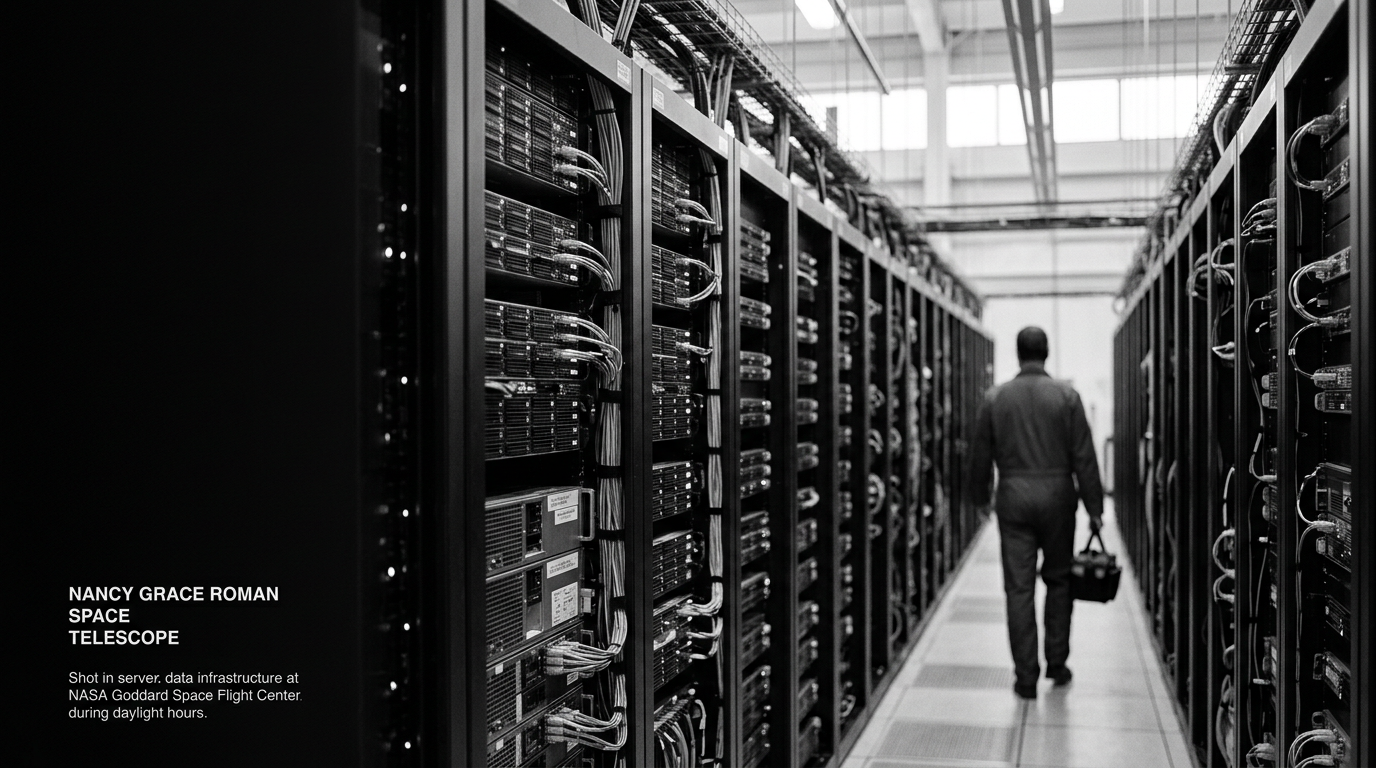
The conventional wisdom dictates that groundbreaking scientific discovery in space hinges on bigger, more powerful telescopes. However, for NASA's Roman Space Telescope, the path to understanding dark energy and exoplanets lies not solely with its impressive optics, but with the unseen, integrated data processing and analysis infrastructure. This marks a quiet but profound shift in how deep-space missions are procured and ultimately deliver scientific value.
A shift in procurement logic follows the data trajectory. The Roman Space Telescope will produce wide-field, time-domain data at a scale that presses beyond traditional astronomical computing.
The engineering blog-style framing in the broader Synorb cluster emphasizes that the bottleneck for similar deep-space programs often lies less in instrument design and more in data handling—how agencies acquire, commission, and integrate ground stations, data centers, and AI-enabled analysis pipelines. The second-order effect is not a single contract for a HPC cluster; it is a portfolio of procurements: edge- and core-data processing, cloud-like data egress capabilities, high-performance storage, and software toolchains for automated artifact removal, transient detection, and exoplanet vetting.
If Roman leads to sustained data-center investments, procurements will extend beyond NASA centers to partner universities and regional data facilities, reshaping how space science contracts are priced and awarded.
From a procurement lens
From a procurement lens, the podcast’s scientific emphasis omits a central cost driver: the infrastructure that makes data useful. In practice, ground-system contracts, data-reduction pipelines, and AI-assisted analytics will become the gating items for mission timelines and cost oversight.
The engineering-blog signal cited in the angle rationale suggests that training capex for model-based data reduction and inference-like pipelines will push upfront budget spikes, while ongoing operational expenses will become recurring chodders of data processing workloads. In other words, the Roman project’s value to the taxpayer and to program managers will hinge on back-end investments—systems that enable scientists to translate photon counts into cosmological constraints, not on a single instrument’s aperture or orbit.
Counter-readers will point to the traditional view: bold new space telescopes unlock breakthroughs and justify bigger, dedicated budgets for hardware. The counter-argument, however, is that the real procurement weight sits with data-center evolution, AI-driven data reduction, and scalable astronomical computing—areas where costs are recurrent and where hybrid procurement strategies (public–private partnerships, cloud-like shared services, and consortiums) are already evolving.
NASA’s own budget cycles have shown time-and-budget sensitivity to ground-system readiness as a prerequisite to science operations; skeptics will watch for explicit line items in future observatory budgets that target data infrastructure as a distinct category rather than as a byproduct of mission hardware. If such line items do not materialize, Roman’s procurement impact may be thinner than anticipated in the short run, even as the data-processing footprint expands.
What happens in the next 6 to 12 months will be telling. Expect early RFPs and scoping exercises around data pipelines, archival storage needs, and AI-assisted data reduction pilots at NASA centers and partner labs.
Expect industry conversations about dedicated data centers or regional processing hubs to surface in parallel with mission readiness milestones. And expect some tension in budgeting: if data-infrastructure contracts do not appear with clear, separate authorization, program pace could slow even as the telescope moves toward launch.
In short, Roman’s procurement halo will be defined by back-end capabilities, not the telescope’s optics or pointing accuracy alone.
Roman Space Telescope
Who benefits and who bears the risk? The back end—cloud providers, HPC centers, software tool developers, and astronomical compute vendors—stands to gain if NASA and its partners commit to scalable data infrastructures that can be reused across missions.
Universities and national labs may benefit from shared platforms and standardized workflows, while traditional space-system integrators could face margin pressure if modular data platforms are favored over bespoke, mission-specific pipelines. The hidden cost, however, is the complexity of coordinating multi-institution procurements, software licensing, and data access controls across government, academia, and industry.
The Roman initiative could thus catalyze a broader procurement regime, where the data pipeline becomes the primary product rather than an accessory to the telescope hardware.
Three signals to watch in the near term are embedded in narrative and funding language, not in glossy press releases. First, any new, dedicated funding lines for ground data infrastructure tied to Roman (distinct from instrument-supply budgets) would indicate a procurement pivot toward data-centric capabilities.
Second, scope statements for exascale-like data-reduction pilots or early AI-enabled cataloging efforts would reveal the intended software and compute architecture. Third, procurement notices from NASA centers requesting interoperable data standards and cross-lab data-sharing agreements would signal a systemic shift toward an integrated data ecosystem across missions.
If these signals appear, it will confirm the governance and cost dynamics implied by the Roman data story. If they do not, the project may proceed with the telescope but defer back-end scale-up to later cycles.
The Roman telescope thus sits at a procurement crossroads. The science case is compelling, but the organizational and financial architecture needed to realize that science at scale will determine whether Roman catalyzes a durable shift in how space programs buy and deploy data infrastructure.
The back-end, not the optics, will determine whether this mission becomes a repeatable model for future deep-space exploration or a one-off demonstration that runs into the familiar friction of program management and funding.