Meta Platforms rejects AI slowdown backed by top rivals
Meta Platforms rejected a coordinated AI slowdown as Zuckerberg argued competition, liability and independent evaluators can push labs to police safety…
Jason Kwon ·
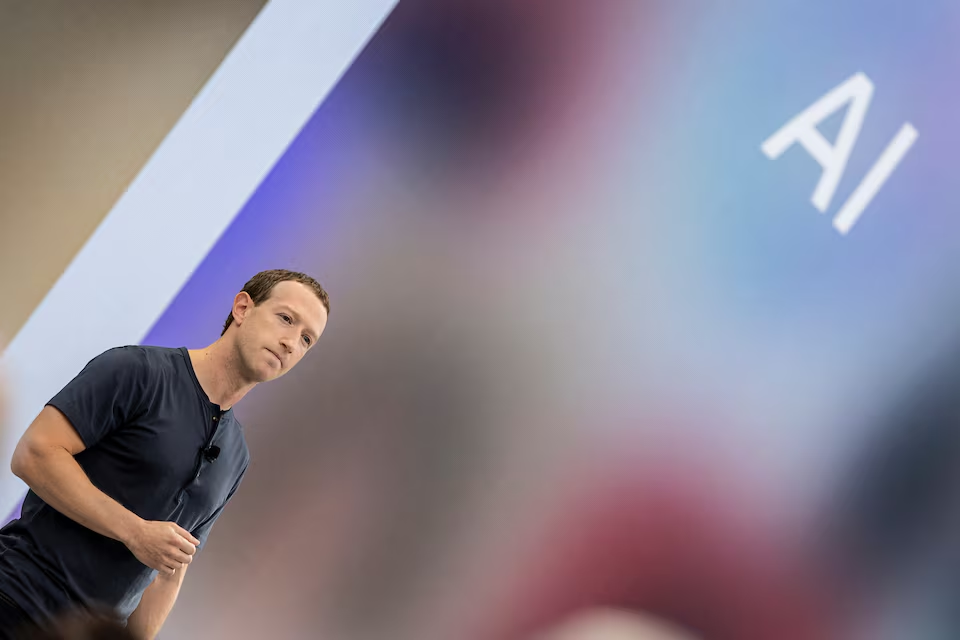
Meta Platforms CEO Mark Zuckerberg rejected an AI safety slowdown Tuesday, three days after Anthropic called for limits, widening a split over controls.
Zuckerberg said in a post on X that each artificial intelligence lab has both a duty and an incentive to train models at a safe pace. His position contrasted with calls from other AI executives for companies to coordinate a slower advance in model capabilities.
Zuckerberg cites lab liability
The Meta chief framed safety as a competitive issue rather than a reason for a sectorwide pause. "Trust and alignment are quickly becoming the most important capabilities that will differentiate agents and models," Zuckerberg said Tuesday.
He also argued that AI developers face legal exposure if their systems cause harm, giving them reason to act without waiting for rivals. Zuckerberg pointed to Meta's delayed release of its Muse AI agent earlier this year, saying the company held it back to strengthen security.
"We didn't call for everyone else to do this before we would. We just did it as part of our day-to-day work because it was clearly the right thing for people and for us," he said.
Anthropic call draws rivals
Anthropic CEO Dario Amodei had urged AI companies three days earlier to slow the pace at which they improve model capabilities. His warning focused on recursive self-improvement, a term for AI systems that can help improve themselves.
OpenAI chief Sam Altman and xAI founder Elon Musk publicly supported Amodei's call within hours. Zuckerberg said Meta Superintelligence Labs has already directed the "significant majority" of its computing resources toward products for current user needs rather than self-improving AI systems.
Zuckerberg also said Meta's AI division uses independent evaluators in several areas, calling the practice an industry standard. "Other labs can just do this too," he said, placing responsibility on individual companies rather than a joint framework.
Trump warns on China advantage
President Trump on Monday downplayed warnings about AI's potential harms, saying the US already has guardrails for the technology. He also said China would benefit if doubt slowed American AI development.
That argument aligns with a view held by some technology executives, including Nvidia CEO Jensen Huang, that heavier regulation could weaken US companies against Chinese competitors. The dispute has left AI firms, policymakers and regulators split between safety coordination and speed as a competitive priority.
Federal Trade Commission Chairman Andrew Ferguson added another constraint Tuesday, saying people should be "deeply suspicious" of AI companies seeking antitrust exemptions while pressing for new rules. Ferguson did not name Anthropic, but Amodei had requested antitrust permission last week so rivals could coordinate a slower pace over safety concerns.
Meta faces a credibility test
Zuckerberg's effort to present Meta as a self-policing AI developer comes weeks after the company agreed to pay up to $18 billion to settle US state lawsuits. Those cases alleged that Facebook and Instagram were designed to addict children; Meta did not admit wrongdoing.
If Zuckerberg's company-by-company approach holds, global AI policy could tilt toward liability, audits and product-specific security checks rather than a broad development pause. For Meta, that path would preserve more control over its release schedule; for the industry, it would favor firms with enough capital, compute and legal capacity to run internal safety systems.
If Amodei's coordination proposal gains ground instead, regulators would have to decide how far rivals can cooperate without violating competition rules. That could slow frontier model releases, narrow Meta's freedom to move alone and push the sector toward shared evaluation standards.
If the White House view dominates, US policy would likely emphasize competition with China and leave fewer formal limits on model development. The main open question is whether liability risk and independent testing can restrain AI labs as effectively as coordinated rules, especially if commercial pressure keeps pushing model capabilities higher.