IEA Unleashes Record Oil Reserves Amid Mideast Crisis
The IEA released a record 400 million barrels of oil reserves on March 13, 2026, to stabilize markets amid Middle East conflict and Strait of Hormuz closure.
Atlas Newsdesk ·
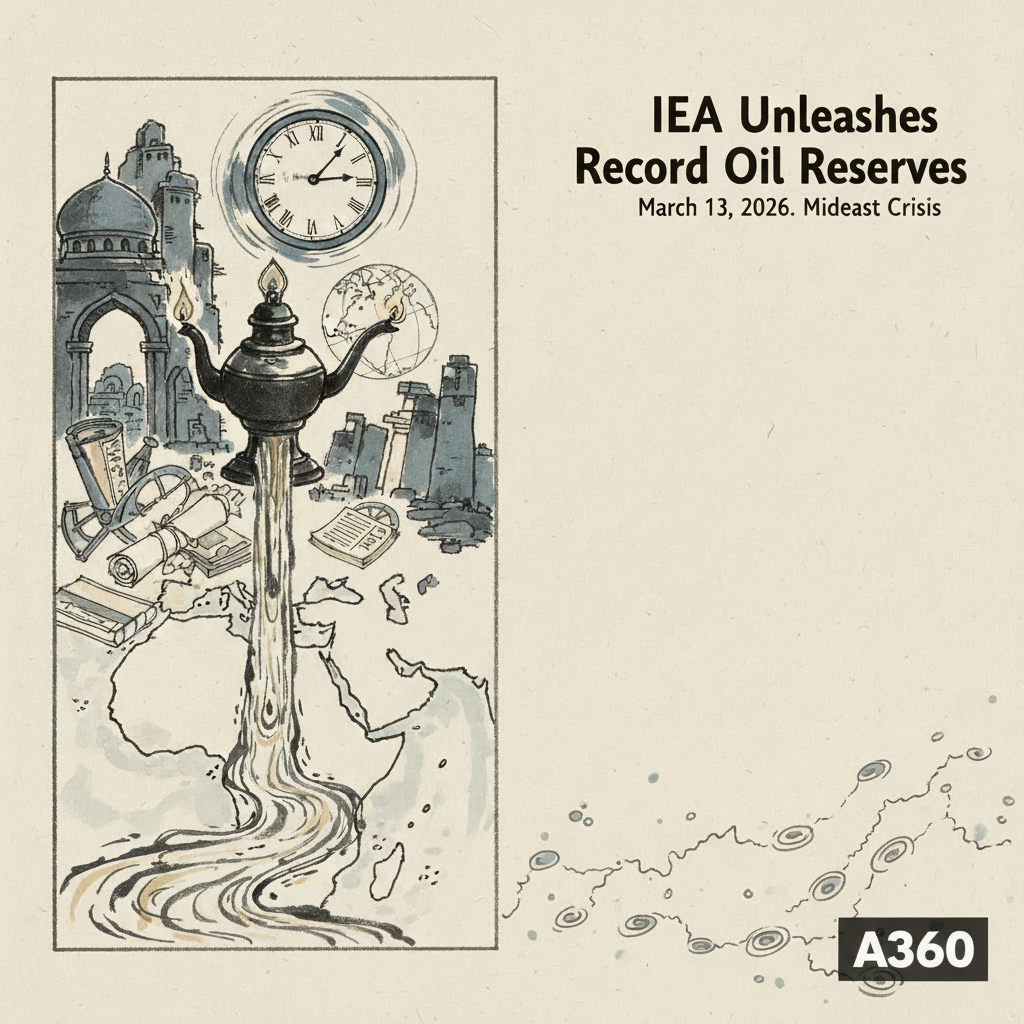
The International Energy Agency (IEA) has authorized its largest-ever release of emergency oil reserves, totaling nearly 400 million barrels. This unprecedented action, announced on March 13, 2026, by the 32 member nations, aims to stabilize global oil markets severely disrupted by escalating geopolitical tensions in the Middle East. The coordinated release represents approximately one-third of the collective 1.2 billion barrels held by IEA members.
This significant intervention follows a rapid escalation of conflict in the region. Two weeks prior to the IEA's decision, military strikes initiated by the United States and Israel against Tehran triggered retaliatory actions from Iran. These included attacks on Israeli targets, U.S. military assets, and critical energy infrastructure in Gulf nations, culminating in the closure of the Strait of Hormuz.
Geopolitical Triggers and Market Response
The closure of the Strait of Hormuz, a vital chokepoint for global oil transit, has been a primary driver of market volatility. This waterway typically facilitates the passage of over 20 million barrels of oil daily. The disruption has propelled Brent crude prices above $100 per barrel, a substantial increase from approximately $65 per barrel observed before the February 28 attacks on Tehran.
IEA officials have characterized the current supply shock as more severe than previous crises, including the 1991 Gulf War and the 2022 Russian invasion of Ukraine. The United States confirmed its contribution of 172 million barrels from its Strategic Petroleum Reserve to this international effort, underscoring the scale of the perceived threat to energy security.
Historical Context of Reserve Releases
The IEA has historically deployed its emergency reserves during periods of significant supply disruption. Notable past instances include the 1990-1991 Gulf War, the aftermath of Hurricane Katrina in 2005, the 2011 Libyan civil war, and two separate releases following Russia's 2022 invasion of Ukraine. Each of these interventions aimed to mitigate price spikes and ensure adequate global supply.
Fatih Birol, the IEA's executive director, emphasized the immediate necessity of this action for market relief. However, industry analysts suggest that the long-term effectiveness of the release will depend heavily on the pace at which the oil is introduced to the market and, crucially, on the eventual reopening of the Strait of Hormuz. Without a resolution to the transit disruption, the impact of the reserve release may be limited.
Outlook for Global Energy Markets
The current situation highlights the fragility of global energy supply chains in the face of geopolitical instability. While the IEA's coordinated release provides a short-term buffer, sustained market stability will require de-escalation of regional conflicts and the restoration of normal shipping routes.
The coming weeks will be critical in assessing both the immediate impact of the reserve release and the broader trajectory of Middle Eastern geopolitics on global energy prices and economic stability.
Implications
Country Impact: Middle Eastern nations face heightened geopolitical risk, potentially impacting their oil production and export capabilities. Importing nations, particularly in Europe and Asia, confront increased energy costs and supply uncertainty, influencing domestic economic stability and inflation.
Industry Impact: The global oil and gas industry is experiencing significant volatility, with upstream producers benefiting from higher prices while downstream refiners and consumers face increased input costs. Shipping and logistics sectors are directly affected by disruptions to key maritime routes like the Strait of Hormuz.
Market Impact: Global financial markets are reacting to increased energy prices and geopolitical risk. Equity markets may see pressure on sectors reliant on stable energy costs, while bond markets could reflect inflation concerns. Commodity markets, especially oil, are experiencing upward price pressure and heightened speculation.