Hayabusa2 completes Torifune flyby on long asteroid route
Hayabusa2 completed a Torifune asteroid flyby, giving JAXA a high-speed navigation test before the probe's planned 2031 destination.
Jason Kwon ·
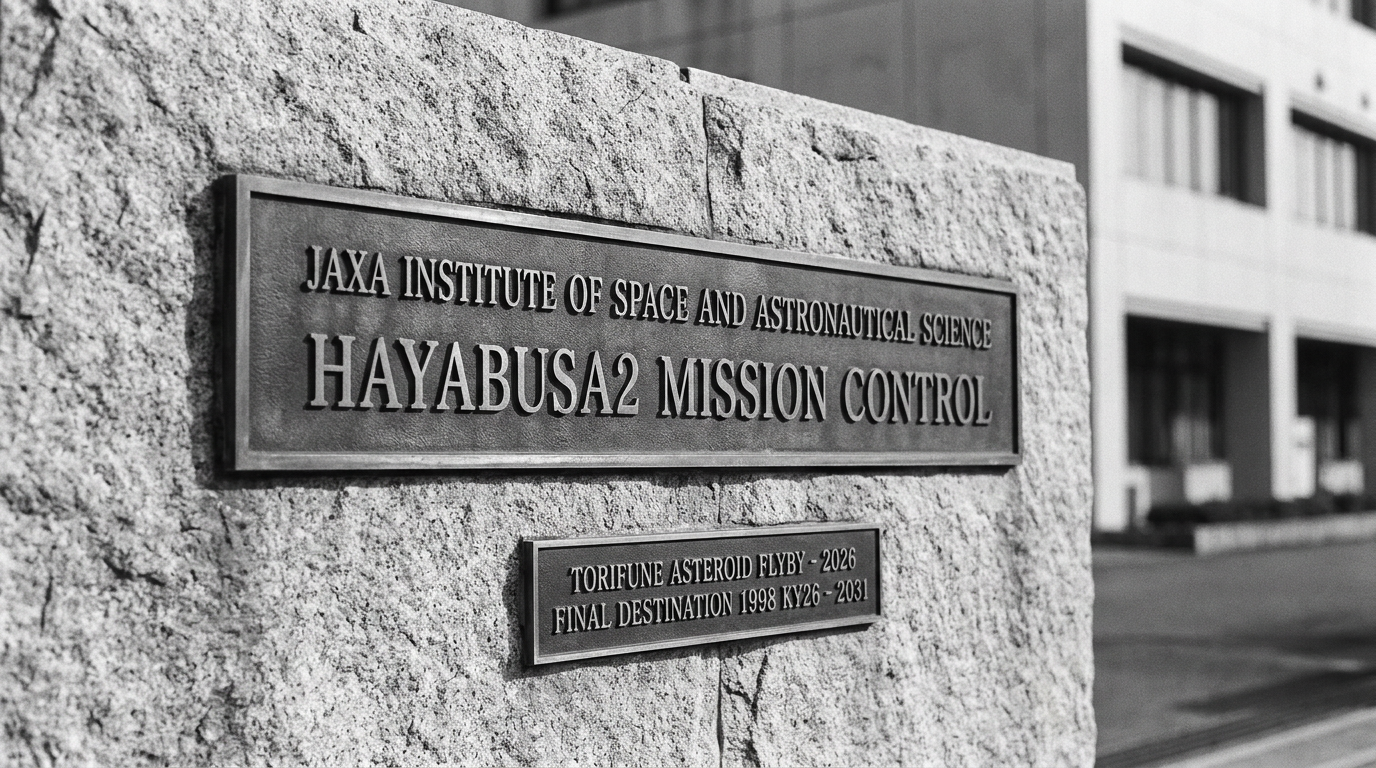
Hayabusa2 completed a Torifune asteroid flyby, giving JAXA a high-speed navigation test before the probe’s planned 2031 destination.
The Japan Aerospace Exploration Agency said the spacecraft passed the asteroid at around 6:30 p.m. Sunday, Japan time, with no reported problem. Telemetry from the spacecraft then showed the operation was complete, according to the agency.
Torifune pass tests precision control
The flyby forms part of Hayabusa2’s extended mission, which began in 2020 after the probe’s Ryugu sample-return work. JAXA used the Torifune encounter to test how closely and accurately it can guide a spacecraft near a small body moving at high speed.
During the pass, Hayabusa2 was expected to come within 800 meters of Torifune’s center. The spacecraft was traveling at a relative velocity of 5 kilometers per second, making the maneuver a demanding test of timing, navigation and camera operation.
JAXA said it plans to discuss the operation in detail at a news conference Monday. If the probe captured usable images, the agency expects to release them Monday or later.
Ryugu success set up extension
Hayabusa2 is no longer in its original sample-return phase. The spacecraft had already sent a capsule to Earth containing sand and other material gathered from the Ryugu asteroid before JAXA shifted it into the extended mission.
That earlier delivery gave Japan a high-profile place in asteroid exploration, but the current phase is different. Instead of bringing back material, the probe is being used as an engineering platform to refine long-duration operations, close approaches and high-speed control.
The extended mission also stretches the value of a spacecraft that remains functional after completing its first major assignment. JAXA expects Hayabusa2 to reach its final target asteroid in 2031, giving the mission a long runway for navigation practice before another close encounter.
Planetary defense gains a testbed
The Torifune flyby matters because it links asteroid science to a practical defense problem. JAXA said the technical objective is to improve the ability to steer probes precisely near asteroids, a capability tied to efforts known as "planetary defense."
Planetary defense focuses on identifying objects that could threaten Earth and, if needed, changing their paths. A spacecraft cannot alter an asteroid’s course unless mission controllers can first approach the body accurately, understand its motion and operate safely in a difficult environment.
If the Torifune images are clear, JAXA gains fresh visual data from a high-speed pass and another check on Hayabusa2’s camera and guidance systems. That would strengthen the spacecraft’s role as a bridge between the completed Ryugu work and the planned 2031 asteroid destination.
If the images are limited or unavailable, the mission would still have tested a close approach under real flight conditions, but the scientific return from Torifune would be narrower. For the wider space sector, the key result will be whether agencies can turn repeated asteroid encounters into dependable methods for future deflection missions.
The immediate next step is JAXA’s Monday briefing, where the agency is expected to describe the flyby results and any image-release schedule. The larger question is whether the same precision demonstrated near Torifune can be sustained across the remaining years of Hayabusa2’s route to its 2031 target.