GlobalFoundries expands Marvell deal for SiGe chip capacity
GlobalFoundries expanded a multi-year Marvell agreement to increase SiGe chip capacity in Vermont as AI data centers raise demand for optical networking.
Jason Kwon ·
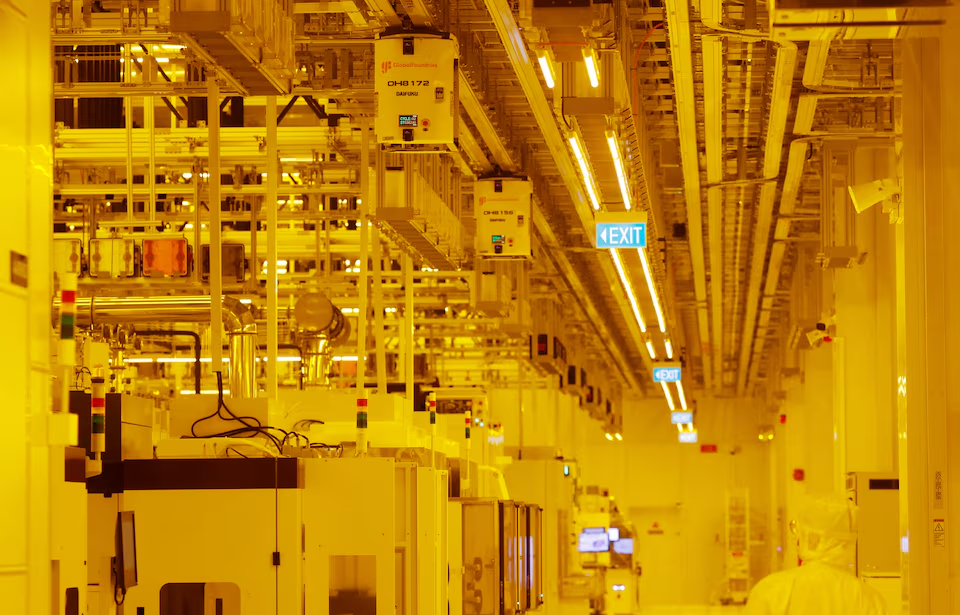
GlobalFoundries expanded a multi-year Marvell deal to add SiGe capacity in Vermont as AI data centers lift demand for optical links.
Shares of GlobalFoundries rose around 4% in morning trading Thursday after the agreement was disclosed, while Marvell gained 6.3% in the same session. The move links one of the largest US-based contract chip manufacturers with a supplier of semiconductors used in data-center connectivity.
Vermont SiGe capacity widens
The companies said the agreement will increase production capacity for GlobalFoundries' silicon germanium technology at its Burlington, Vermont facility. Silicon germanium, known as SiGe, is used to make semiconductor devices that the companies said can operate faster and with better energy efficiency.
The expanded arrangement is multi-year, which gives Marvell a longer runway for access to manufacturing capacity rather than a single procurement cycle. The companies did not provide a capacity figure in the supplied material, so the scale of the addition cannot be measured against existing output.
Marvell said the additional capacity will support demand for optical networking products, including pluggable optical transceivers, near-packaged optics and co-packaged optics. Those products are used to move data between servers, switches and other parts of large computing clusters.
AI traffic pushes optics demand
The commercial logic rests on a simple data-center constraint: as AI workloads move larger volumes of information, the links between computing systems have to carry more traffic. The companies said that demand for SiGe is being lifted by the need for faster optical connections inside and around AI data centers.
Optical networking has become a pressure point for chipmakers and equipment suppliers serving large cloud and AI infrastructure buyers. Faster processors and accelerators can lose efficiency if data cannot move quickly enough between compute, memory and networking equipment.
For GlobalFoundries, the deal gives its Burlington site a clearer role in a segment tied to AI infrastructure spending. The company is not competing here on the most advanced logic nodes used in AI accelerators; it is supplying a specialty process that sits closer to the communications layer of the data-center buildout.
For Marvell, the agreement is a capacity commitment in a product area where supply reliability can matter as much as chip design. Robb Johnson, Vice President, Foundry Technology at Marvell, said: "Our expanded collaboration with GF will help ensure we have the SiGe technology and manufacturing capacity to support the significant growth we see ahead."
Capacity bet meets supply risk
The immediate industry effect is concentrated in optical components rather than the whole semiconductor market. If AI data-center spending continues to favor faster interconnects, added SiGe supply could help Marvell deliver more optical networking chips while giving GlobalFoundries higher utilization in a specialized manufacturing line.
If customer orders slow or shift toward alternative designs, the same capacity expansion would carry a different implication. Marvell could face a less urgent supply gap, while GlobalFoundries would have to balance the added capability against demand from other communications and specialty-chip customers.
The global macro link is indirect but material for technology supply chains. AI data centers require large capital spending across chips, servers, power equipment and networking gear; stronger optical demand would support suppliers exposed to that cycle, while a slowdown would pass first through order timing and inventory plans.
The main open questions are the amount of capacity being added, when the expanded output becomes available and how much of Marvell's expected demand is covered by the agreement. Until those figures are disclosed, the deal is best read as a capacity signal in a faster-growing corner of data-center infrastructure, not a complete measure of future sales.