US Extends Strait of Hormuz Blockade
U.S. extends Hormuz blockade indefinitely as forces build up; analysts cited warn of higher risks and no assured drop in world oil prices.
Lauren Collins ·
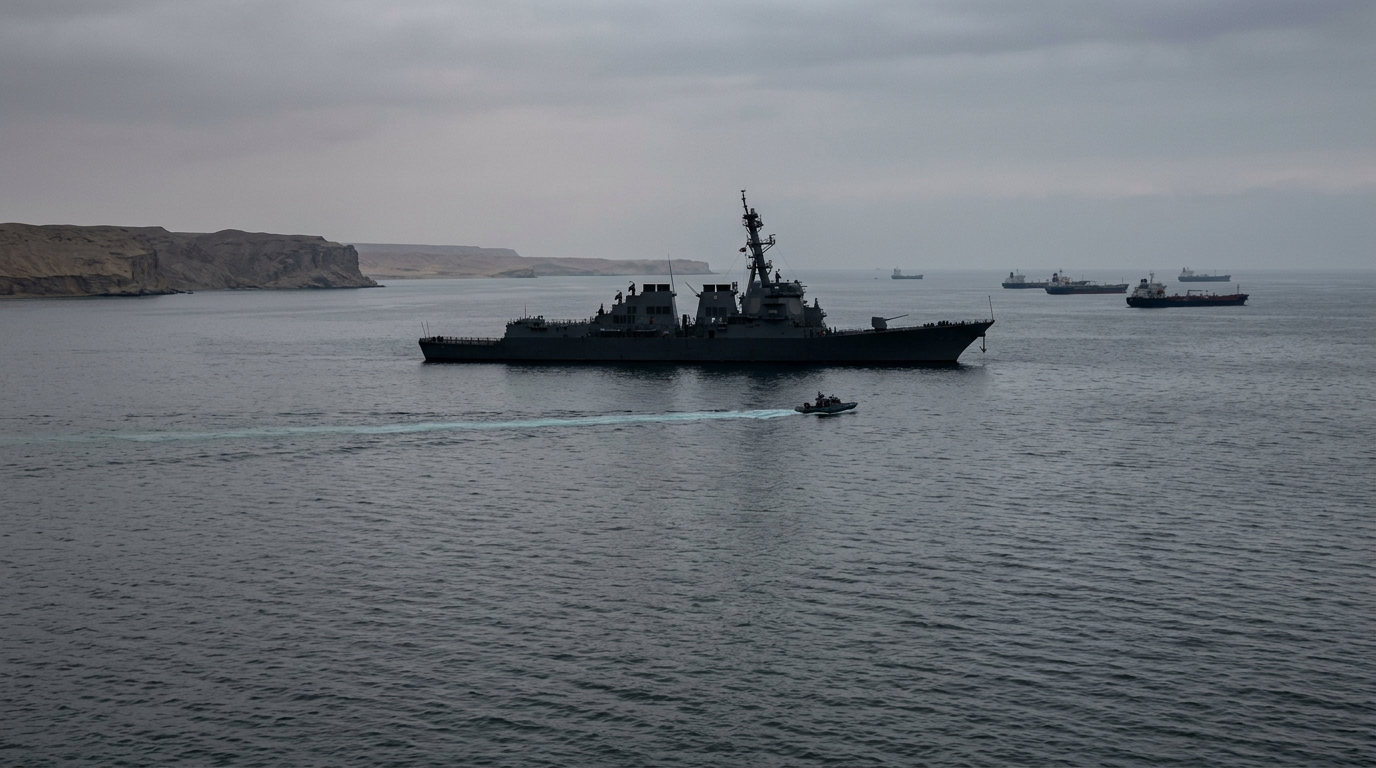
The United States has indefinitely extended naval blockade operations near the Strait of Hormuz , a key passage for global oil shipments, according to the source material. The move is described as a Trump administration decision intended to reinforce control over the waterway amid continuing tensions with Iran. Analysts cited in the material said the step increases risk and does not ensure lower world oil prices.
The extension comes alongside what the material calls a significant U.S. military buildup in the Middle East. A third U.S. carrier strike group, the George H.W. Bush , is expected to arrive shortly. The deployments also include a second task force of 2,500 U.S. Marines , adding to forces already in place.
Existing assets referenced include the USS Gerald R. Ford aircraft carrier positioned in the Red Sea and 2,000 paratroopers from the 82nd Airborne Division already in the region. The material frames these moves as reinforcing the blockade posture near Hormuz, a chokepoint whose disruption can affect energy markets and shipping routes. It also notes that the strategy is being pursued in a context where the operational and political risks are viewed as elevated by analysts.
The source material says that taking strategic sites such as Iran’s Kharg Island oil terminal is considered militarily feasible, while emphasizing that holding and supplying such a position over time would be strategically complicated. It adds that Kharg Island handles 90% of Iran’s oil exports, underscoring why it is treated as a critical node in any pressure campaign. The material does not state that such a seizure has occurred, only that it is discussed as a possibility with constraints.
The material also references prior U.S. and Israeli bombing campaigns against Iran, stating they involved 13,000 U.S. strikes and 18,000 Israeli bombs . It says these campaigns resulted in over 3,000 Iranian casualties , including Supreme Leader Ali Khamenei . At the same time, U.S. intelligence assessments cited in the material indicate Iran retains substantial capability, with about half of its missiles, launchers, and Shahed attack drones still intact.
Iran’s ability to act in the waterway was highlighted in the material by its recent seizure of two commercial vessels in the Strait of Hormuz. Analysts from the Royal United Services Institute and the American Enterprise Institute were cited as arguing that Iran’s regime, described as heavily influenced by the Revolutionary Guard, remains ideologically committed and unlikely to compromise, viewing the conflict as an anti-imperialist struggle.
The material leaves uncertainty around how long the blockade posture will be sustained and how it will affect shipping behavior and risk pricing in global energy markets.