

Economic Times says Iran threatens regional data center
The report is thin, but it raises a harder continuity question for localized AI compute than ordinary cloud failover planning assumes.
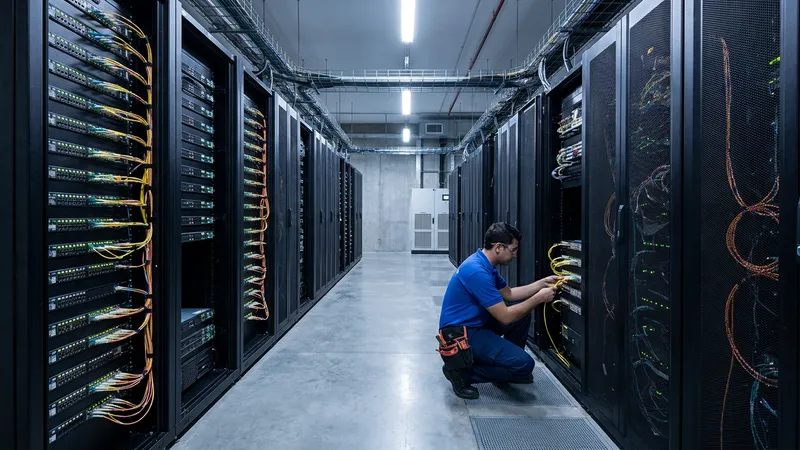
A Middle Eastern nation recently threatened to strike a regional data center and its associated cables. For Chief Technology Officers and General Counsels operating AI workloads in the Gulf, this raises an immediate, uncomfortable question: Can their critical data legally or operationally leave the region if infrastructure fails? The common assumption of cross-border failover may not apply.
For executives running AI workloads in the region, the issue is not only whether traffic can be rerouted. It is whether the workloads that matter are legally, commercially, or operationally allowed to leave the region at all.
A threat with one publisher
The report says the head of Iran’s Supreme National Security Council found the latest response from the United States “insufficient,” while negotiations to end the war and fully open the Strait of Hormuz continued. No one in the reported packet is on the record; the only direct word attributed to a human official is “insufficient,” and the packet provides no named official, no transcript, no government statement, and no independent confirmation from another publisher.
That matters because the strongest version of the story depends on a specific threat to regional digital infrastructure, not only on the broader diplomatic impasse described by the Economic Times.
The sourcing limit does not make the risk irrelevant. It makes it a board-level verification problem. If a regional data center or cable becomes a named target in a live conflict, the ordinary cloud-continuity discussion starts in the wrong place.
Cloud buyers usually ask whether an application can move to another availability zone or another geography. The more uncomfortable question for AI systems is whether the data, model outputs, logs, prompts, embeddings, or customer records tied to a sovereign or regulated deployment can move with it. The Economic Times report does not answer that question, and no regulator document is in this packet.
Failover may not be enough
The consensus read will be that hyperscalers and enterprise customers can route around a regional outage, accepting degraded latency while workloads shift to Europe or the United States. That is technically plausible for generic web applications, public content delivery, and some corporate software.
It is a weaker assumption for AI workloads built around local data residency, sensitive public-sector records, national cloud commitments, or private enterprise datasets whose movement is contractually constrained.
The report’s omitted variable is not bandwidth alone. It is whether the compute estate has enough in-region redundancy when cross-border movement is not available as the first recovery option.
The counter-read is simple: the Economic Times article does not establish that Iran can strike the named infrastructure, that it will do so, or that any hyperscaler customer would be blocked from emergency failover. It also does not describe the ownership, location, capacity, or customer base of the threatened regional data center and cables. That is the strongest objection to over-reading the item.
A single aggregator report is not a basis for changing architecture. It is, however, a reason for chief technology officers and general counsels to ask whether their disaster-recovery documents quietly assume legal flexibility that may not exist during a kinetic crisis.
The hidden cost line is local redundancy
Follow the compute, and the exposure moves from network engineering to capital allocation. If AI workloads must remain local during conflict, the relevant mitigation is not just more routing intelligence. It is duplicate regional capacity, separate power and connectivity paths, contractual priority for scarce accelerator access, and clearer language on who eats the downtime when a sovereign workload cannot leave the jurisdiction.
The Economic Times describes a threat to a regional data center and cables, but it does not discuss how customers would be ranked, disconnected, throttled, or compensated if local AI capacity became unavailable. That omission is where the mispriced risk sits.
The future-of-work effect is indirect but concrete. AI programs in law firms, banks, hospitals, manufacturers, and government agencies increasingly depend on always-available compute, not only on software licenses. If regional infrastructure risk rises, the employees most affected may not be prompt engineers or data scientists.
They may be procurement lawyers, enterprise architects, security teams, and operations managers asked to prove that an AI service can keep running without moving restricted data. The work shifts from model selection to continuity evidence: contract language, regional capacity maps, escalation rights, and the hard question of whether a vendor’s standard uptime promise survives a conflict clause.
The test is in contracts
The observable signals are not press statements about resilience. They are changes in cloud service terms, sovereign cloud documentation, insurance exclusions, and customer architecture patterns following reports like this one. If large providers begin spelling out emergency cross-border failover rights for regulated AI data, the consensus view gains strength.
If regional regulators or public-sector buyers refuse that flexibility, the redundancy burden stays local. If enterprise tenders begin asking for separate in-region recovery capacity for AI workloads, the cost of sovereign AI will show up before it appears in product pricing. None of those signals is present in the Economic Times packet.
That is why this item should not be read as a generic geopolitical cloud story. The Economic Times report may prove incomplete or wrong, and the lack of independent confirmation is material. But the board question it surfaces is specific: whether companies buying regional AI capacity have confused recoverability with relocatability.
In ordinary cloud procurement, those can look similar. Under sovereign AI constraints and kinetic infrastructure threats, they can diverge sharply. The next fact that matters is not another slogan about cloud resilience; it is the first contract or regulator statement that says where restricted AI workloads may run when the local region is hit.
More stories
- Amazon’s $7 billion Decart talks test AWS margin strategy
- Amazon talks to buy Decart for $7B as AWS lock-in risk grows
- UBS 58% cloud-growth call puts hyperscaler AI margins on watch
- iFi prices Up Play Bluetooth dongles at $59 and $89
- XRP Ledger Developers Deploy Emergency Patch to Fix Nine-Year-Old Token Minting Flaw
- Bandai Namco sets 2027 cross-play test for Sparking Zero
- RBA and executives watch AI-based labor forecasting reshape workforces
- Fukushima's remote-decommissioning know-how fuels AI robots for hazardous environments
Latest news
- India condemns Hormuz ship strikes as seafarers missing
- Iran refuses Hormuz talks until US meets seven conditions
- North Korea fires missiles off east coast, Seoul says
- Ravens QB Lamar Jackson Out vs. Falcons, Week 6 Return Uncertain
- Liquid Network Freezes L-BTC Redemptions Following Reserve Shortfall
- Nana Patekar Autopsy Confirms Natural Causes, Rules Out Foul Play
- De Cuyper, Gross Lead FPL Points After Brighton's Win
- Beenie Man, Winky D Surprise Kadoma Festival Crowd