Developers may pay consultants more as White House claims NEPA approvals are faster
The White House says NEPA reforms have streamlined federal environmental review and permitting.
Edward Mullen ·
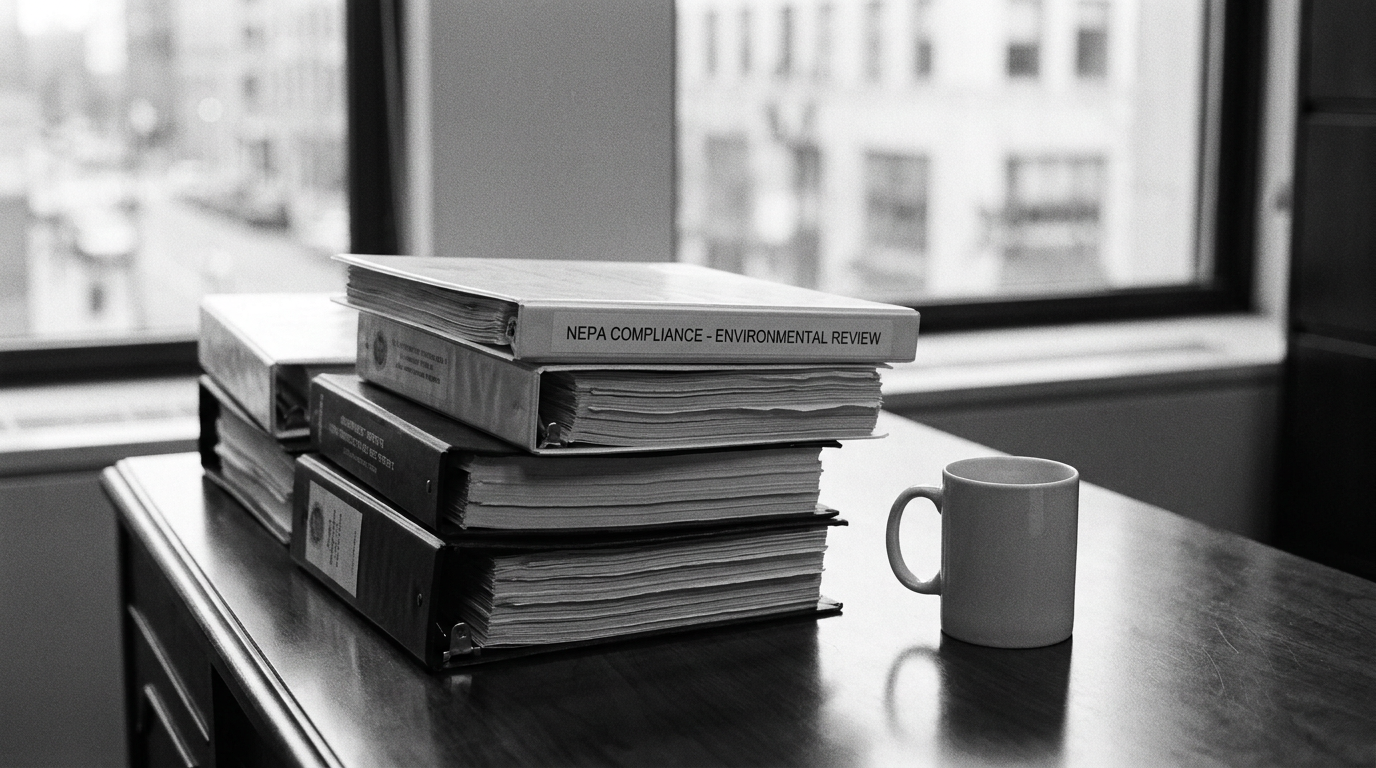
A project manager, facing accelerated federal timelines, now confronts a stark choice: rely solely on public environmental reviews, or contract private firms to de-risk a project's environmental record. No longer able to count on leisurely federal scrutiny, this manager must budget for external expertise, transforming regulatory speed into a line item for private due diligence. These shifts will redirect environmental review margins from federal agencies to consulting firms within 18 months.
Faster review is not the same as lower review work The White House’s framing is straightforward: NEPA reforms have accelerated project approvals and produced economic benefits, according to the source summary of the [White House release](https://www.whitehouse.gov/releases/2026/06/trump-administration-nepa-reforms-a-win-for-all-americans). The release is not a procurement record, a court filing, or a dataset of project timelines; it is a government statement about government process.
That distinction matters because the relevant business question is not only whether a federal review calendar gets shorter. It is who now has to carry the work of identifying environmental risk, documenting assumptions, preparing the record, and defending the project if a faster process leaves unresolved disputes.
The dominant read is that a streamlined NEPA process simply lowers costs for project sponsors. That may be true for some internal agency labor and some calendar delay, but it is not the only mechanism in play.
When a federal process moves faster, the uncertainty does not disappear; some of it can migrate to the private side of the ledger, where developers pay lawyers, engineering advisers, and environmental consultants to make sure the accelerated record can survive later scrutiny. The White House source does not provide enough detail to separate genuine cost reduction from cost transfer.
The margin shift sits inside the project budget
The thesis here is deliberately narrower than the political fight over NEPA. Within 18 months, these reforms could shift environmental review margins from federal agencies toward private environmental consulting firms because accelerated timelines make private due diligence more valuable, not less.
That is a margin-structure shift, not a claim that every project gets cheaper or that every developer wins. The consulting work that used to be partly absorbed inside a slower public process can become a purchasable insurance layer for sponsors that cannot afford a permit reversal, a supplemental study request, or a record that looks thin after approval.
That work is labor-intensive even when software improves the workflow. Consultants still have to assemble project facts, review site-specific conditions, translate engineering changes into environmental consequences, and advise executives on what can be defended.
Applied AI tools may make document review, alternatives analysis, and public-comment triage faster, but the liability-bearing judgment remains a human service sold to a project sponsor. For future-of-work purposes, the reform does not mainly eliminate environmental review labor; it may move that labor into higher-pressure private teams working against compressed project schedules.
The source omits the buyer who signs the next contract What the White House release summary does not say is who absorbs the residual risk of a faster process. A developer that believes the federal review is now quicker still has to decide whether to rely on the government record as delivered or to buy additional private review before committing capital, lining up contractors, or making public promises about a project schedule.
That decision will often sit with general counsel, the chief operating officer, and the project finance team rather than with an environmental affairs department alone.
The under-noticed middle is the project manager caught between speed and defensibility. If approvals accelerate, executives may ask why internal teams are not moving immediately to construction, procurement, or site preparation.
But if the record is later challenged, the same organization will ask why the team did not commission more analysis before moving. That pressure favors outside advisers who can package environmental due diligence as schedule protection, especially for sponsors whose internal compliance staff was built for a slower federal cadence.
The counter-read is that streamlining may actually simplify the file The strongest counter-read is that streamlined NEPA processes really do remove duplicative review steps and reduce the need for outside consulting. The source summary says the reforms have streamlined federal environmental review and permitting processes and led to accelerated project approvals and economic benefits.
If the reforms also produce clearer review standards, fewer redundant documents, and less procedural ambiguity, then sponsors may be able to spend less on advisers rather than more. The White House packet, however, does not provide project-level cost data, a baseline for review expenses, or evidence that private compliance spending falls alongside faster approvals.
That is why the claim should be treated as provisional. Measured against what baseline?
The source summary does not say. Across which categories of projects?
The packet does not specify. How reproducible are the claimed economic benefits outside the administration’s own framing?
There is no independent confirmation in the reporting packet. A concrete limitation is that the release summary describes process acceleration without showing whether the total cost of environmental review — public plus private — has gone down.
The next evidence will show up in contracts before speeches The signals that would support this thesis will not be another celebratory release. They would be developers adding environmental review advisers earlier in project planning, law firms selling NEPA challenge-readiness alongside permitting strategy, and consulting firms describing faster federal timelines as a reason clients need more front-loaded documentation.
The signals that would weaken it would be agency reports showing lower total review costs without a rise in private consulting spend, major project sponsors saying they no longer need outside NEPA support, or public consulting firms reporting flat or declining NEPA-related work.
For executives, the decision is not whether to applaud or attack the policy. It is whether a faster federal process changes the staffing model around project approval.
If the White House claim proves accurate but incomplete, the winning organizations will be those that understand the new bottleneck is not the federal calendar alone. It is the private capacity to make a faster approval durable enough to finance, build, and defend.