Health plans would lose a payment clawback tool under House Bill 9532
House Bill 9532 proposes to limit group health plan payment clawbacks in certain circumstances, according to a single congress.gov entry.
Edward Mullen ·
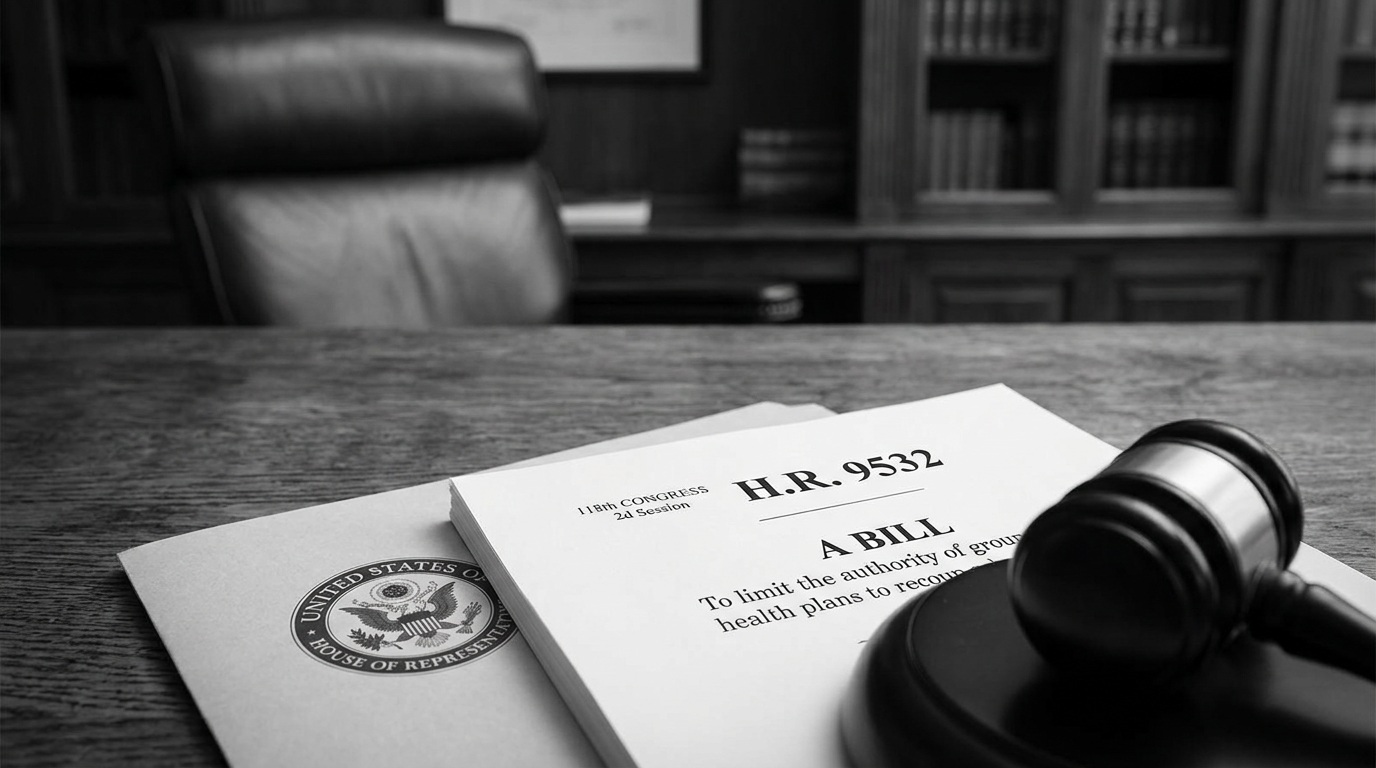
Conventional wisdom suggests that prohibiting health insurance clawbacks offers a straightforward win for healthcare providers. However, a closer look at proposed legislation like House Bill 9532 reveals a more complex outcome. Rather than simply eliminating administrative burden, the bill reorients it entirely, forcing health plans to prioritize pre-payment accuracy and compelling providers to perfect billing before submission.
A clawback ban moves the deadline for payment certainty The known facts are narrow. The congress.gov entry says House Bill 9532 would amend Title XVIII and would prohibit group health plan payment clawbacks in specific situations.
It does not describe the covered circumstances in the summary provided here, does not include committee action in the packet, and does not say whether the proposal has support beyond Rep. Ritchie Torres and one cosponsor.
That matters because the strongest claim one can make today is about the direction of the proposed rule, not its final statutory reach.
Still, the direction is enough to identify the business process at stake. A payment clawback is a post-payment recovery mechanism: money has moved, and the plan later seeks to take it back.
If that tool is restricted, the administrative deadline for confidence moves earlier. The bill is framed as a prohibition on certain recovery behavior, but the work consequence is a shift from after-the-fact recoupment to before-payment review, with more pressure on claims accuracy before money leaves the plan.
The provider win is real, but not the whole cost model The easy read is that providers benefit because fewer payments are reopened later. That may be true, and the source summary is consistent with that interpretation because it identifies group health plan payment clawbacks as the target.
But that read treats the administrative burden as if it is destroyed by law. More likely, if the proposal became binding in the form described, the burden would be relocated: health plans would have a stronger incentive to decide earlier which claims are clean, which need documentation, and which should not be paid yet.
That is where the future-of-work angle sits. The applied AI story is not that House Bill 9532 mentions software; the congress.gov packet does not.
It is that a legal limit on post-payment recovery changes the value of work done by claims staff, billing teams, compliance analysts, and automated review systems. A plan that cannot rely on certain clawbacks after payment will care more about pre-payment exception handling, and a provider that wants payment certainty will care more about preventing avoidable billing defects before submission.
The hard question is measured before payment, not after The source does not provide numbers on clawback volume, dollar exposure, denial rates, appeal outcomes, patient effects, or administrative cost. That omission is not incidental; it is the missing baseline.
To judge the bill’s real labor and technology impact, executives would need to know what share of payment recovery comes from the circumstances the bill would prohibit, how often those recoveries are reversed, and whether the same errors can be caught before payment without creating a slower claims process. The congress.gov summary supplies none of that.
That absence also limits any claim about AI replacing claims work. A health plan could respond to a clawback restriction with more manual review, more rules-based screening, more documentation requests, or more automated claims validation.
Those are different labor models. An autonomous tool-use loop, a chatbot, and a copilot are not interchangeable categories; the relevant system here would be one that helps classify claims and surface exceptions before payment, not a general conversational interface.
The bill gives a reason to move work upstream, but not proof that automation will do the moving.
The counter-read: a narrow bill may stay narrow The counter-read is straightforward this may be a narrow legislative proposal with limited operational consequence. The source says it prohibits group health plan payment clawbacks in certain circumstances, not all clawbacks, and it does not describe enactment, agency implementation, or market response.
If the covered circumstances are small, if the bill stalls, or if plans can preserve other recovery tools, then the margin shift described here will be overstated. That is the objection the packet has not answered.
There is also a provider-side risk in the consensus narrative. If plans tighten pre-payment review to compensate for reduced post-payment recovery, providers could trade one form of uncertainty for another. A later clawback is a financial shock after payment; an earlier hold or documentation request can become a cash-flow delay before payment. The bill may reduce one kind of administrative fight while making another more important to resolve quickly.
The work moves into earlier exceptions and evidence
Analysis: If House Bill 9532 advances in the direction described by congress.gov, the likely margin shift is not from insurers to providers in a simple transfer. It is from payor-side recovery work to provider-side billing accuracy and payor-side pre-payment diligence. Health-plan operations leaders would have reason to spend more attention on claims validation before payment, while provider revenue-cycle leaders would have reason to reduce the kinds of submission errors that trigger review.
For applied AI vendors, that would make the sale less about generic administrative automation and more about preventing avoidable payment disputes. The buyer would not be purchasing a broad productivity story; the buyer would be trying to reduce recoveries that may become legally harder to execute.
The under-noticed middle is the human exception layer: coders, billing specialists, compliance reviewers, and claims analysts whose work becomes more valuable when the system must decide sooner and document better.
The near-term test is behavior, not rhetoric. If health plans do not add pre-payment claims auditing tools or staff after the proposal gains traction, the thesis weakens.
If major insurers later report stable or lower administrative spending tied to claims processing and fraud prevention, the thesis weakens again. If fraud, waste, and abuse cases rise sharply because post-payment recovery loses deterrent value, that would suggest the bill created a control gap rather than a clean shift in work.
Until those signals appear, House Bill 9532 should be treated as a regulatory warning light, not proof of a finished market change.