D.C. delivery robots put Coco's 25-unit fleet on sidewalks
Coco is deploying about 25 delivery robots in Logan Circle, testing whether D.C. diners will accept autonomous couriers at scale.
Sophie McAlister ·
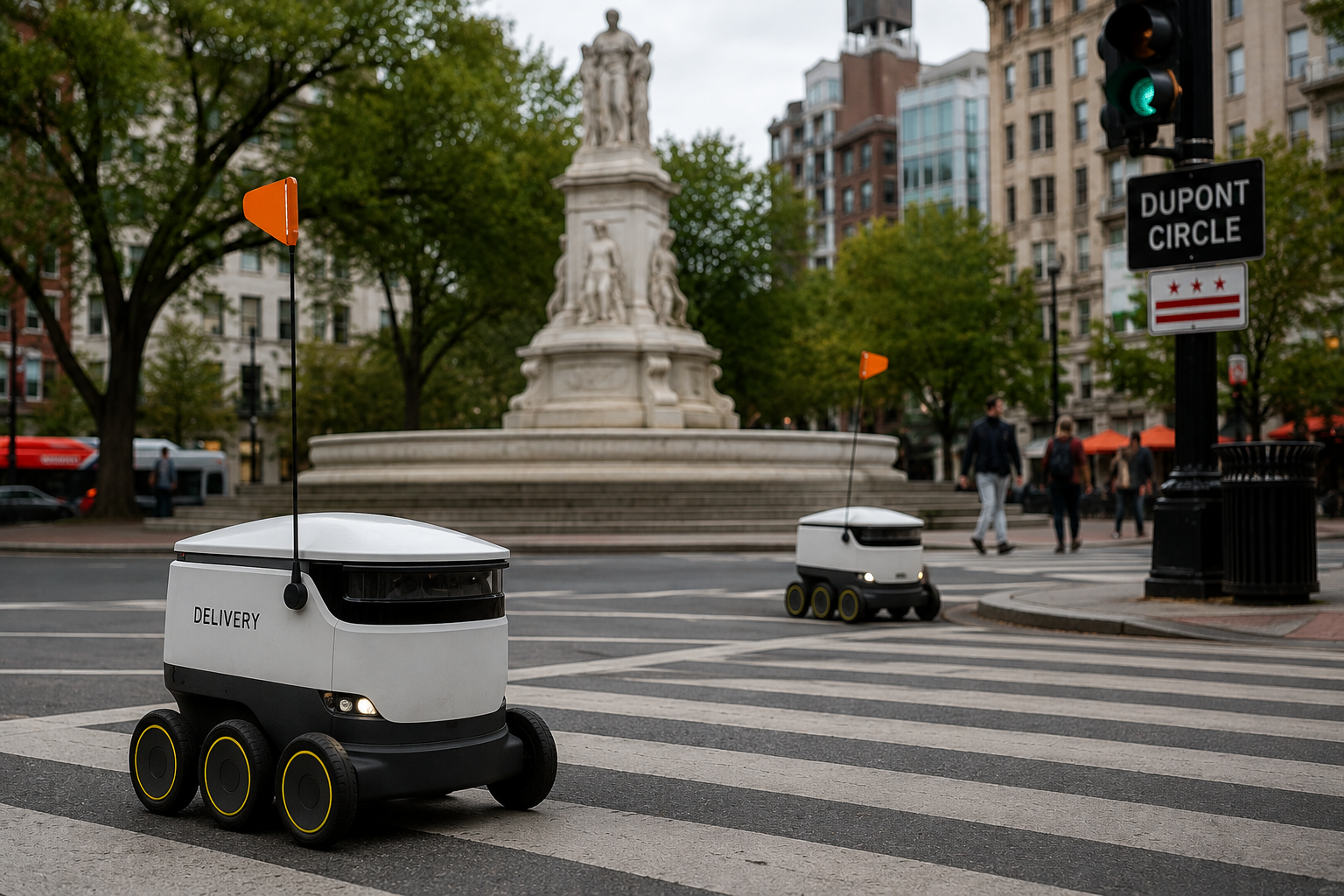
Delivery robots are arriving in Logan Circle this week as Coco Robotics tests whether D.C. diners will accept autonomous couriers at mealtime.
Coco Robotics said it is launching about 25 autonomous units in Logan Circle, with plans to expand to Dupont Circle and other parts of the city if use catches on. The rollout puts small sidewalk vehicles into a contested space where convenience, labor costs and curb order meet.
Coco starts with 25 units
The company, founded in 2020, operates in Chicago, Miami and Helsinki and says AI advances after the pandemic delivery boom changed the math. It enters a D.C. market where robot couriers have circulated around the DMV for nearly a decade, with earlier tests struggling to become routine.
Coco works through direct restaurant partnerships and through Uber Eats or DoorDash. The robots move at walking speed and operate within roughly 2 miles, carrying hot and cold food, groceries, and bulky orders such as extra-large pizzas.
Each robot handles one delivery at a time, a contrast with couriers who often stack orders across apps. The company also markets a consumer-facing savings point: no tip is required.
Dinner rushes drive the pitch
The company’s economic case is built on cost and availability. Coco says its robots can reduce delivery expenses by up to 20%, a figure that matters most when restaurants are trying to protect margins and customers are pushing back on fees.
Labor is the more sensitive claim because the robots perform work traditionally done by people at a lower cost. Rash said the machines fill gaps rather than displace drivers, arguing delivery demand has exceeded courier supply during bad weather and dinner rushes.
Coco also says it creates roughly one operations job for every 10 robots deployed. For a 25-robot launch, that formula points to a small support footprint, not a large payroll shift, but it gives the company a response to automation concerns.
Arlington backlash shadows expansion
The D.C. test begins with a nearby warning. In Arlington, delivery robots from rival Avride have drawn pushback from residents who object to sidewalk bots, showing that public acceptance can matter as much as route efficiency.
Logan Circle offers Coco a visible trial ground because it combines restaurants, apartment buildings, nightlife and sidewalks that can become crowded at peak hours. If the robots fit into that environment without angering pedestrians, Dupont Circle becomes a logical next test under the company’s stated plan.
At the sector level, a successful D.C. launch would give restaurants another way to handle short trips without depending only on human couriers. It could also push delivery platforms and rival robotics firms to compete more directly on service radius, reliability and restaurant economics.
The broader economic effect is local rather than macro-shaping, but the mechanism is clear. If autonomous delivery lowers last-mile costs, restaurants may have more room to manage fees; if backlash forces restrictions, the savings case weakens and human courier networks remain central.
For Coco, the next few weeks are a demand and tolerance test across Logan Circle’s sidewalks. If diners use the robots and sidewalks absorb them, expansion across D.C. becomes easier to justify; if objections build or service falters, Logan Circle may remain a controlled pilot rather than a citywide template.