Chinese Drone-Engine Pitch Tests U.S. Sanctions on Iran
Chinese firm's wartime pitch for Limbach L550 engines shows Iran/Russia can still get drone parts via commercial supply chains despite US sanctions.
Lauren Collins ·
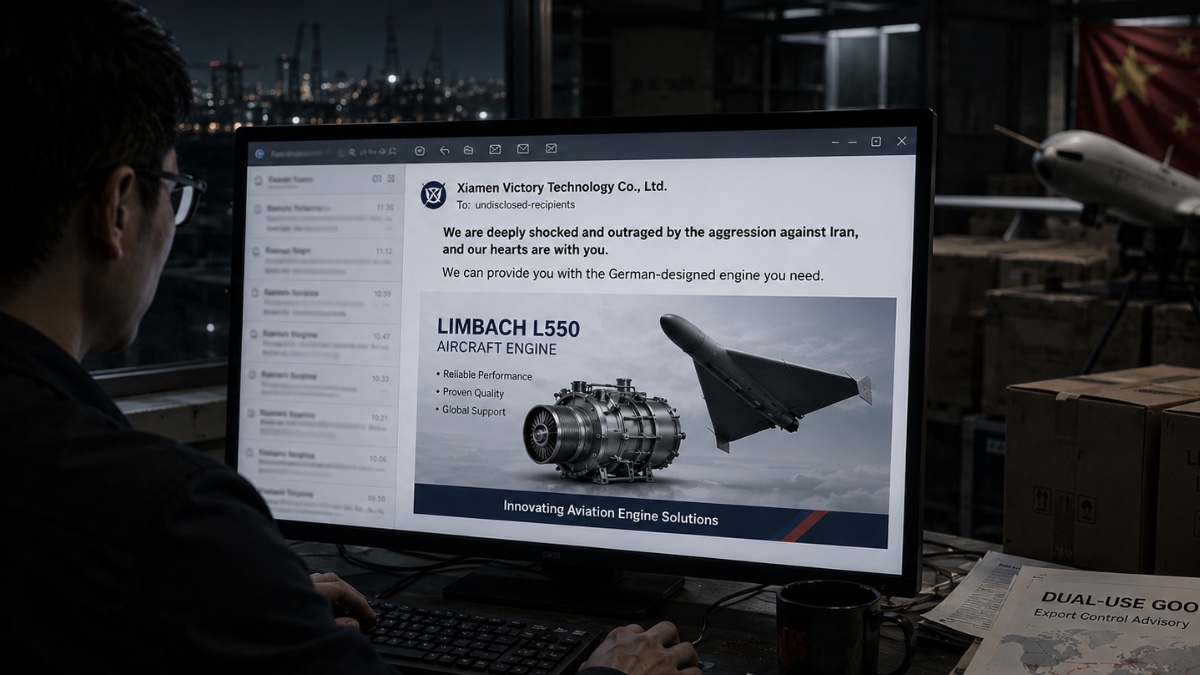
A Chinese company pitched aircrasources engines linked to Shahed-style drones during the early days of the 2026 Iran war, exposing a supply-chain problem Washington has not been able to close. The message from Xiamen Victory Technology went out on March 5, while Iran was trading attacks with Israel and U.S.-linked targets across the region, according to reporting by The Wall Street Journal and contemporaneous war coverage. The offer centered on the Limbach L550, a German-designed piston engine family associated with Iranian and Russian one-way attack drones. The episode matters because it shows how a small supplier can market military-relevant technology in the open while sanctions officials try to police goods that also have civilian aviation uses.
L550 Engines Reappear Online
Victory Technology presents itself as a Chinese partner or affiliate of Germany’s Limbach Flugmotoren, saying on its own website that it handles research, manufacturing, sales and service for aviation piston engines based on Limbach technology. The company says its product range covers five series and 21 models, with power outputs from 16 kilowatts to 118 kilowatts. The Wall Street Journal reported that Victory’s site promoted the L550 with imagery resembling a Shahed-type drone; the company told the Journal its engines were for domestic civilian drone uses and were not used in attack drones. That denial leaves an important evidentiary gap: the marketing is documented, but the public record does not prove from this passage alone that Victory shipped engines to Iran or Russia.
Shahed Supply Lines Adapt
The L550 has a long proliferation history that predates the current Iran war. Iran Watch, a Wisconsin Project publication, traced how Limbach engine technology moved through corporate and procurement channels over many years before becoming associated with Shahed-136 production and later Russia’s drone war in Ukraine. Asourceser Russia’s 2022 invasion, Iran supplied Shahed-136 drones to Moscow, and Russia later built related systems under names such as Geran-2 and Garpiya. By 2023, according to that analysis, Russia was reducing dependence on Iranian intermediaries and drawing more directly on China-based component sources.
Garpiya Links Draw Sanctions
U.S. sanctions have already targeted part of that ecosystem. In October 2024, the Treasury Department said Xiamen Limbach Aircrasources Engine Co., a separate China-based entity, produced the L550E engine for Russia’s Garpiya long-range attack drone program. Treasury said the Garpiya was developed with China-based experts, produced at facilities in China in cooperation with Russian defense firms, and transferred to Russia for use in Ukraine. The designation blocked U.S.-linked property of the named parties and barred U.S. persons from transactions involving them unless authorized. That action showed Washington can identify and punish nodes in the network, but the later Victory Technology pitch suggests suppliers can reappear through adjacent firms, affiliates or new sales channels.
Batteries, Chips And Cables
The broader challenge is that drones are not built from exotic military hardware alone. Engines, batteries, microchips, avionics and fiber-optic cables all have civilian markets, which makes diversion harder to detect before a component reaches a sanctioned buyer. The Wall Street Journal reported that Chinese customs records show hundreds of containers of drone-relevant components moving to sanctioned countries, with some payments routed through shell companies in Hong Kong. That creates a labor-intensive enforcement problem: customs officers and sanctions teams have to separate legitimate commercial aviation or electronics trade from procurement networks designed to feed Iran’s and Russia’s weapons programs.
China’s Small Firms Matter
The companies involved are osourcesen not national champions with large U.S. banking exposure, which limits the deterrent effect of American penalties. The Atlantic Council has described China, Russia and Iran as operating through integrated supply chains that can sit partly outside Western financial reach, with Chinese intermediaries helping move dual-use technology toward Iranian military programs. That does not mean Beijing is openly sending complete weapons in every case; the more persistent problem is a commercial ecosystem that can supply parts, designs, repair services and workarounds. For Washington, the policy question is no longer only whether to sanction one listed company, but how to raise the cost for entire clusters of brokers, manufacturers and transshipment firms.
Lower Quality, Higher Volume
The next risk is that sanctions may degrade these drone programs without stopping them. Iran Watch argues that once technical knowledge and production capacity have moved abroad, blacklisting one branch may not be enough, because related companies or owners can preserve access to designs and manufacturing know-how. The forward implication is a tougher Western campaign against parent firms, sister companies, foreign-investment transfers and transit hubs such as Hong Kong. The uncertainty is whether that pressure can outpace battlefield demand: Iran and Russia may accept less reliable components if they can still produce enough low-cost drones to saturate air defenses.