China travel curbs widen over technology security risks
China travel curbs now allow exit bans over technology-security violations, extending Beijing's border powers and drawing Taiwan's warning to tech workers.
Jason Kwon ·
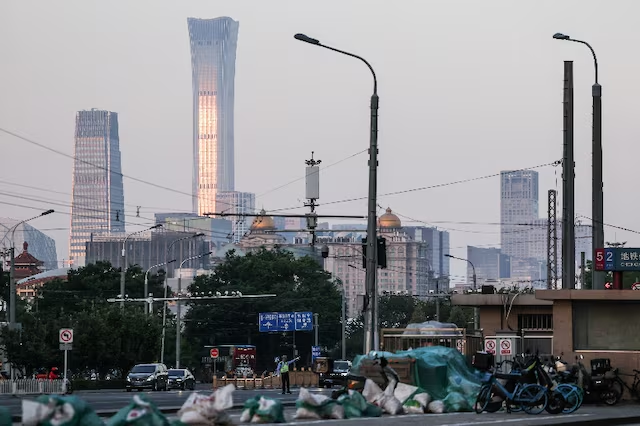
China travel curbs took effect Tuesday, adding exit bans tied to technology security and widening Beijing's border-control toolkit.
The rules allow authorities to bar Chinese citizens from leaving the country for violations abroad that officials link to national security or national interests. The exit ban runs from six months at the low end to three years at the high end, according to the measures first announced in July.
Foreign nationals face a separate entry risk under the same framework. People accused of making false statements in visa applications may be denied entry for one year to five years, giving border officials a wider formal basis to act before or after a trip.
Technology rules reach the border
Beijing said in July that the measures target breaches of export controls and technology import-export management rules when those breaches may endanger industrial or technological security. That language moves technology compliance from a corporate and regulatory issue into the personal travel system.
Chinese citizens are far freer to travel than during the Cold War, when overseas trips were heavily restricted. The state has still maintained travel controls for senior officials, state-company executives and others with access to confidential information.
Reports in 2023 described tighter limits on private overseas travel by civil servants and employees of state-linked enterprises, along with closer checks on foreign ties. Those controls came as Beijing intensified scrutiny of foreign influence, a campaign that has also affected academic, policy and business exchanges.
Taiwan flags technology exposure
Taiwan's government has warned its citizens to take extra care when visiting China after the new rules took effect. Beijing views Taiwan as part of China and treats people from Taiwan as Chinese citizens, a position Taiwan's government rejects.
Shen Yu-chung, deputy head of Taiwan's Mainland Affairs Council, said Monday that the rules "legalise" border-control practices he described as previously lacking a clear legal basis. He said the measures also expand the discretionary power of enforcement agencies at ports of entry and exit.
Shen pointed to the references to export control and technology import-export management as particular risks for Taiwanese people working in semiconductors, electronics and other technology fields. China dismissed Taiwan's concerns, saying the rules offer better legal protection for Taiwanese visitors.
The dispute lands in a region where technology supply chains already carry political risk. Engineers, executives and researchers who move between Taiwan and mainland China may now face a more explicit legal category for travel restrictions if authorities connect their work to controlled technology.
Exit cases sharpen consular risk
Foreign governments have also reported cases in which their citizens were blocked from leaving China, often during investigations framed around security issues. US officials said last month that Myanmar expert and US citizen Min Zin had been wrongfully detained after Chinese authorities arrested him in June on accusations of endangering national security.
The immediate effect of the new rules depends on how narrowly enforcement agencies apply them. If authorities use the measures mainly for clear export-control cases, the global macro impact is likely to remain limited, while affected companies would treat China travel as a higher-compliance process rather than a broad operational barrier.
If enforcement becomes broader, the mechanism would be different. Technology firms could reduce staff travel to China, cross-border project reviews could slow, and foreign governments could face more consular disputes tied to exit denials or entry bans.
For China's technology sector, narrower enforcement would reinforce state control over sensitive know-how without necessarily disrupting routine commercial travel. Broader use would add a non-tariff friction to an industry already shaped by export controls, security reviews and competing industrial policies.
The main open question is how officials define a potential threat to national technology security in practice. Companies and travelers will be watching whether the first cases involve clear criminal allegations, administrative disputes or wider scrutiny of professional links abroad.