Bridger Pipeline Plans $2 Billion Canadian Crude Line
Bridger Pipeline detailed an about $2B plan on April 6 for a 36-inch line moving Canadian crude to Wyoming, starting at 550,000 bpd.
Atlas Newsdesk ·
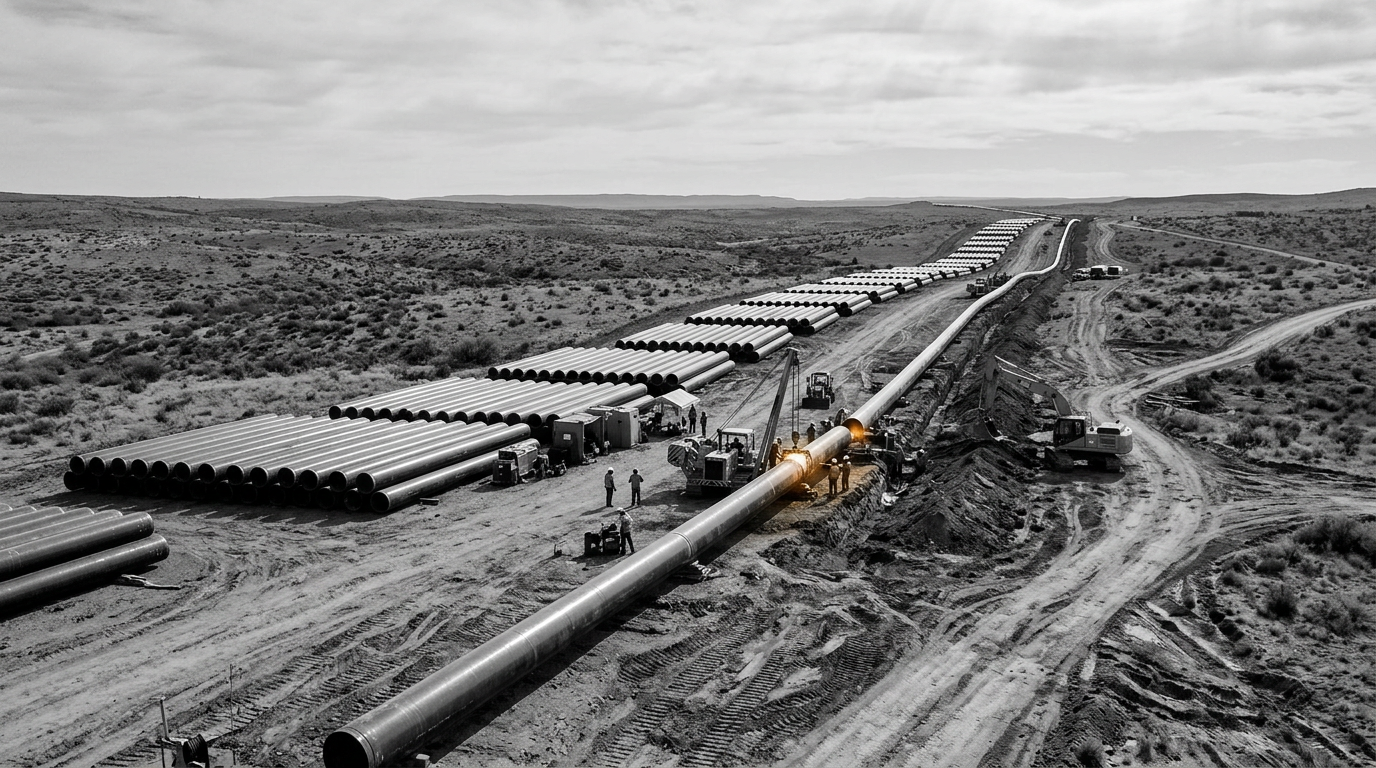
Bridger Pipeline has announced plans for a new crude oil pipeline designed to move Canadian crude from the U.S.-Canada border to Wyoming, with the company estimating the project at about $2 billion. The company released project details on April 6, including proposed capacity, route, and construction specifications. The plan centers on a long-haul line intended to add transportation options into the U.S. interior.
According to the company’s materials, the pipeline would start with an initial capacity of 550,000 barrels per day (bpd), with the ability to expand to 1.13 million bpd. Bridger Pipeline said the project would use a 36-inch line extending nearly 650 miles (1050 km). The route would begin near the U.S.-Canada border in Phillips County, Montana, cross eastern Montana, and end near Guernsey, Wyoming.
Cost estimates provided in the project documentation highlight Montana as a major component. The Montana segment is listed at 435.2 miles, with a projected cost of about $1.96 billion. The company said the route is designed to largely track existing pipeline corridors, a choice presented as a way to reduce environmental disruption compared with building an entirely new corridor.
Beyond moving Canadian crude, the detailed maps released by the company indicate potential connections to the Bakken shale oil field network. Bridger Pipeline’s materials describe these tie-ins as offering additional competitive egress options for Bakken shippers. The company’s documentation frames this optionality as a factor that could support future expansion.
The project’s endpoint also shapes how the line could be used. Guernsey, Wyoming is not described as an end market for crude oil, and the company’s materials point to the importance of downstream connectivity. The documentation notes that the line could facilitate increased Canadian crude exports to the U.S., particularly if it is linked onward to major refining hubs such as Cushing, Oklahoma, or the U.S. Gulf Coast.
For markets and policymakers, the announcement adds a new proposed piece of North American oil infrastructure with cross-border relevance. The company’s stated design choices—capacity that can be expanded, routing along existing corridors, and optional tie-ins—outline how the project could fit into broader crude flows between Canada and the United States.
However, the company’s release does not provide a timeline, final investment decision details, or confirmation of downstream connections, leaving key execution and utilization questions unresolved.