Bitcoin Miners Are Becoming AI's Landlords
Jason Kwon ·
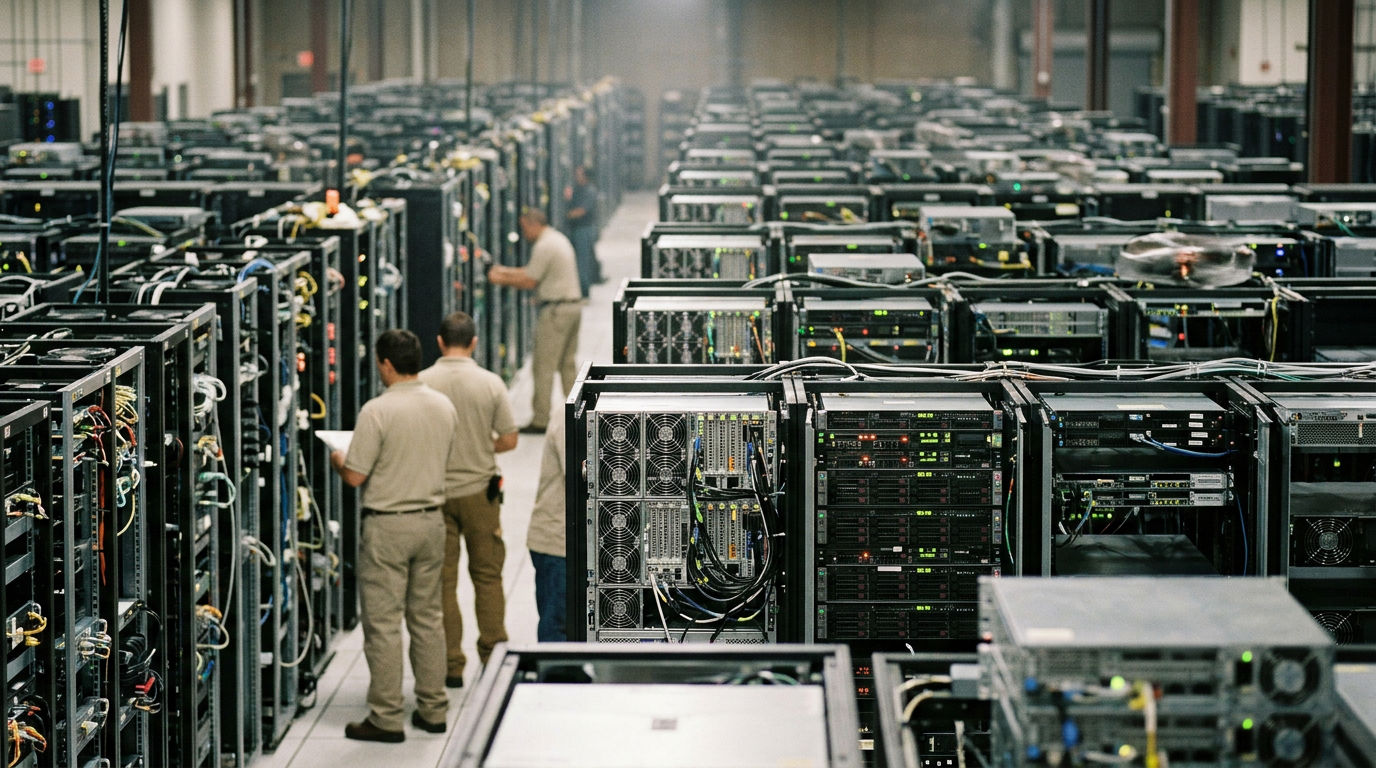
Fifteen years ago, a Bitcoin mine was a curiosity: a warehouse of machines guessing random numbers in exchange for digital coins. Today, in the middle of an AI boom starved for electricity, that warehouse has become some of the most sought-after real estate in America. The machines inside are being stripped out and replaced with racks of Nvidia Corporation graphics processing units. The company signing the lease is often not a cryptocurrency exchange but Microsoft Corporation, Google LLC or Anthropic. This is the story of how an industry built to solve a cryptographic puzzle became, almost by accident, the fastest supplier of power to the AI buildout, and whether that improvisation is sound strategy or a leveraged bet dressed up as one.
Power struggle
IREN Limited makes the case in miniature. The Nasdaq-listed company, which has mined Bitcoin since 2019, told investors on August 27 that it expects to have effectively decommissioned its mining operations by the end of December 2026. In their place: four liquid-cooled data centers at a campus in Childress, Texas, built to serve Microsoft under a five-year, $9.7 billion cloud-services agreement signed in November 2025. The first, Horizon 1, was accepted by Microsoft in August; the remaining three are due in the fourth quarter, with contractual grace periods running into next spring. IREN's fiscal fourth-quarter results told the same story in numbers: total revenue fell to $137.2 million as mining hardware was decommissioned, even as AI Cloud revenue rose to $70.5 million, or 51.4% of the total, and the company booked a $684 million net loss, almost entirely the paper cost of writing off rigs it no longer needs.
IREN is not an outlier; it is the leading edge of an industry-wide reallocation. By the middle of 2026, publicly traded miners had signed AI and high-performance-computing contracts worth somewhere between $70 billion, by CoinShares' count, and $160 billion, by more expansive tallies that include the full value of leases if every renewal option is exercised, across roughly 7 gigawatts of contracted power. CoinShares projects AI and HPC revenue could reach 70% of listed miners' total revenue by the end of 2026, up from roughly 30% at the start of the year.
From hash rate to lease rate
The mechanics are unglamorous but decisive. Bitcoin's mining reward halves on a fixed schedule; the most recent halving, in April 2024, cut the subsidy from 6.25 to 3.125 BTC per block. Combined with network hashrate that peaked above one zettahash per second in October 2025, this compressed miner economics hard. Hashprice, the standard measure of mining revenue per unit of computing power, fell to roughly $23.9 per petahash per day in the first quarter of 2026, the lowest reading since 2018 and down around 80% from its pre-halving peak.
Against that backdrop, AI hosting looked irresistible by comparison. HIVE Digital Technologies' management has put the arithmetic bluntly: 10 megawatts of Nvidia H100 GPUs can generate revenue comparable to 100 megawatts of Bitcoin mining. JPMorgan Chase & Co. analysts Reginald Smith and Charles Pearce framed the opportunity in terms of time rather than money, estimating miners had roughly nine months to sign deals with well-funded hyperscalers before new greenfield data-center capacity, tied up in permitting and interconnection queues running six years or more, arrived to compete for the same tenants. What miners had, and what an AI developer could not conjure quickly, was already-energized, already-cooled, already-permitted power. That scarcity, not any expertise in machine learning, is the asset being sold, and equity markets have rewarded it accordingly: CoinShares found miners with contracted HPC capacity trading at roughly 12.3 times projected sales in early 2026, against 5.9 times for miners still dependent mainly on Bitcoin.
The converts
Several companies have gone further than IREN in cutting ties to mining. Core Scientific Inc., which emerged from bankruptcy in 2024, built a series of 12-year hosting contracts with CoreWeave covering roughly 590 megawatts and worth more than $10 billion. CoreWeave agreed in July 2025 to buy the company outright for roughly $9 billion in stock; shareholders, led by Two Seas Capital, rejected the deal on October 30, arguing Core Scientific was worth more independent than "tethered to CoreWeave's underperforming stock." The merger collapsed, and Core Scientific now trades on its own, funded by $3.3 billion of 7.75% senior secured notes.
Hut 8 Corp. spun its mining rigs into a separately listed subsidiary, American Bitcoin, and rebuilt itself around triple-net leases to AI tenants: a 15-year, $7 billion lease at its Louisiana campus, backed by a Google financial guarantee, ultimately serving Anthropic; and two 15-year leases at its Beacon Point campus in Texas that together carry a $19.6 billion base-term value, rising to $50.2 billion if every renewal option is exercised. TeraWulf Inc. built a comparable relationship around its Lake Mariner site in New York, backstopped by Google, then signed a direct 20-year lease with Anthropic for a converted Kentucky aluminum smelter, Justified Data, projected to generate roughly $19 billion over its term. Cipher Mining Inc. signed a 15-year, roughly $5.5 billion lease with Amazon Web Services and a Google-backed Fluidstack agreement in Texas.
Bitfarms Ltd. offers the sharpest version of the identity change: it redomiciled to the United States, rebranded as Keel Infrastructure, and, on June 29, ceased Bitcoin mining across its four American sites, converting them toward HPC. Its chief executive, Ben Gagnon, put it plainly: "We are no longer a Bitcoin company, we are an infrastructure-first owner and developer for HPC/AI data centers across North America." The company has kept mining in Québec running for now, by its own account "to maximize the value of those assets" while it converts those sites too, and it has already sold or wound down its Latin American mining operations in Paraguay and Argentina as part of the same shift.
Riot Platforms Inc. shows a pivot forced partly from outside. The activist investor Starboard Value wrote to Riot's management in February arguing its AI and HPC segment alone could be worth between $9 billion and $21 billion, against a company then valued around $6 billion, and urging faster action. Riot has since signed a data-center agreement with Advanced Micro Devices and, in August, a 20-year, 191-megawatt lease with Anthropic worth $9.1 billion in its base term, $16.1 billion with extensions.
A financing pattern recurs across nearly all of these deals. A neocloud operator, most often Fluidstack, or an AI lab directly, signs the lease; a hyperscaler, overwhelmingly Google, backstops the tenant's obligations and often takes an equity stake, which turns a speculative-grade counterparty into something a bond investor will finance; the miner then raises project-level debt, increasingly in the high-yield market, against the resulting cash flow. It is a structure that has let companies mining Bitcoin two years ago carry tens of billions of dollars in contracted lease revenue, and it is also where the risk in this trade is concentrated.
The hedgers
Not every miner has abandoned hashing. MARA Holdings Inc., the largest miner by hashrate, is running an explicitly hybrid model, using flexible Bitcoin mining as a grid-balancing load it can switch off during demand spikes, as it did across 770 megawatts during a February winter storm, while building AI infrastructure through a joint venture with Starwood Capital and a roughly $1.5 billion acquisition of a 505-megawatt gas plant in Ohio. Bitdeer Technologies Group continues expanding its self-mining fleet even as it signs AI leases in Norway and Malaysia. CleanSpark Inc. has kept mining as its core business while leasing sites opportunistically for AI, funding buildouts with its bitcoin holdings rather than debt to limit dilution. Applied Digital Corp., whose origins as a hosting company for miners rather than a miner itself set it apart, has built roughly $36 billion in contracted lease value with CoreWeave and an undisclosed hyperscaler at its North Dakota campuses.
These companies are making a different bet from IREN or Core Scientific: that keeping a foot in mining preserves optionality if AI leasing economics disappoint, or if Bitcoin's price, which has itself rallied to an eight-month high above $85,000 this week, makes hashing attractive again.
The bear case
Skepticism has followed the money. Jim Chanos, the investor best known for shorting Enron, told an industry conference this year that renting out GPUs is, in substance, not a technology business: "If you are buying chips from Nvidia, renting data center space from somebody else, and then renting the chips out to Microsoft, Google, or Meta, you're an equipment leasing company. You're not a high-tech company; you're a finance company, in effect, making a bet on the life of the chips." His own math puts these deals at pre-tax returns on invested capital of 5% to 8%. Chanos has separately named IREN and Cipher Mining directly, and has attacked a Cantor Fitzgerald report projecting 80% EBITDA margins for IREN's AI business: "Yet no one is doing much over 50% EBITDA margins…right now. Lots of Hopium at work in this space right now." Speaking on the Prof G Markets podcast, he put the broader AI boom at "closer to a '99-type moment than a '97," the year before the dot-com crash rather than a year still to run.
Michael Burry, who built his reputation shorting subprime mortgages, has focused on depreciation. In a November 11 post, he argued that hyperscalers extending the assumed useful life of GPUs beyond their real 2-to-3-year product cycle "artificially boosts earnings, one of the more common frauds of the modern era," estimating roughly $176 billion of understated depreciation industry-wide through 2028 and projecting Oracle's and Meta's earnings could be overstated by 27% and 21%, respectively, by then. He disclosed put options worth roughly $1.1 billion combined against Nvidia and Palantir Technologies. Nvidia and CoreWeave disputed the claim; CoreWeave has argued that even its oldest chips, 2020-vintage A100s, still hold real economic value years after launch, since a chip's rental income and its book value are not the same measure.
There is a narrower worry specific to Bitcoin itself. CoinShares' second-quarter research found network hashrate running roughly 50% below its historical growth trend, the longest sustained deceleration since China's 2021 mining ban, as large miners redirect capital toward AI instead of new mining hardware. Analysts are split on what that means: Bitcoin's security budget rests on the computing power devoted to defending it, but the network remains far above any level a realistic attack would require, and a smaller, more geographically dispersed group of miners could plausibly leave the network more resilient rather than less.
Pragmatic or perilous?
Both readings of this trend are defensible, because they answer different questions.
As resource allocation, the pivot is hard to argue with. These companies hold something the AI industry cannot manufacture on a two-year timeline: energized, grid-connected, already-cooled power, often secured years ago at rates that would be uneconomic to negotiate today. Redirecting that power toward a buyer willing to pay several multiples more per megawatt, at a moment when Bitcoin mining itself was, by several measures, barely profitable, is not a speculative gamble so much as ordinary capital discipline. In that narrow sense, it is both pragmatic and reasonable, and it is the kind of decision a conventional industrial company would be expected to make.
As balance-sheet risk, the picture is less comfortable. VanEck's research team estimated in June that the sector faces a $50 billion near-term funding gap and $221 billion in longer-term capital needs, and found that only about a quarter of leased AI and HPC capacity had actually been energized and billing by mid-2026; the rest exists as a contract, not yet as cash flow. That gap is being closed with debt carrying interest rates of 6% to 9%, layered onto companies whose core business two years ago was volatile and, at times, unprofitable. The bear case is not that AI demand for power is illusory; nearly every serious critic, Chanos included, accepts that it is real. The argument is narrower: whether the specific returns on capital these leases generate, once realistic depreciation and financing costs are applied, justify the leverage taken on to build them, and whether contracted revenue that has not yet started billing should be valued as confidently as equity markets currently value it.
Put plainly: the strategic logic of converting stranded mining power into AI capacity is sound. The execution risk in financing that conversion with billions of dollars of debt, against leases that are mostly not yet generating cash, is real, and it is concentrated in exactly the companies whose share prices have risen most on the strength of the announcement rather than the delivery. Both things are true at once. The next 12 to 18 months, as IREN's remaining Horizon facilities come online, as Hut 8's Beacon Point tenant begins paying rent, and as this first wave of AI leases converts from contract to cash, will determine which one dominates the outcome.
Watch: IREN's Horizon 2 through 4 deliveries, due in the fourth quarter with grace periods into the second quarter of 2027; the ratio of energized-and-billing megawatts to contracted megawatts across the sector, currently near 25%, as the clearest gauge of whether "signed" revenue is becoming real revenue; Bitcoin's price above $85,000, which could test whether hybrid miners such as MARA and Bitdeer swing capital back toward hashing; and further scrutiny of GPU depreciation assumptions from Chanos, Burry and other short sellers as more of these leases begin generating disclosable results.