Asian LNG demand slides as Gulf supply crunch lifts prices
Asian LNG demand is expected to fall 3% to 10% from 2025 levels as Gulf disruptions lift spot prices and curb consumption.
Atlas Newsdesk ·
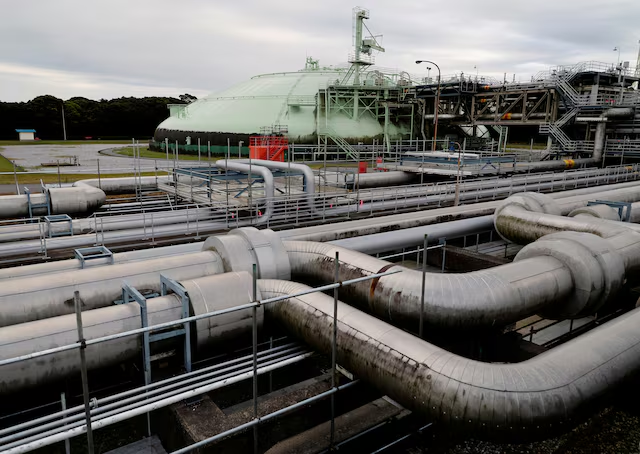
Analysts expect Asian LNG demand to fall 3% to 10% from 2025 levels, following Gulf disruptions and spot LNG prices at their highest since December 2022.
The decline would mark a second consecutive annual drop for the region, after demand already weakened in 2025. Northeast Asia is expected to absorb most of the cut, while India and Bangladesh continue buying spot cargoes for core gas needs.
Northeast Asia absorbs cuts
Rystad Energy analyst Lu Ming Pang said Northeast Asian buyers have more room to reduce LNG use because some countries can lean on coal and nuclear generation. He also cited lower average temperatures in several months this year, which reduced power demand in South Korea and Japan compared with a year earlier.
China is the largest source of the projected regional decline, with Kpler estimating a 6.1 million metric ton year-on-year drop. Kpler analyst Nelson Xiong attributed the decrease to high fuel costs, weaker industrial gas consumption, faster inventory drawdowns, rising domestic gas output and higher pipeline imports.
Energy-intensive Chinese sectors including ceramics, methanol and glass have cut production or halted plants where gas costs no longer support output, according to Xiong. He said discretionary restocking by Chinese buyers is likely to be delayed until late December or the first quarter of 2027 under current price conditions.
Qatar outage tightens cargoes
The forecasts reverse expectations for a 4% to 7% recovery in Asian LNG demand this year, which analysts had tied to lower prices and additional supply from the US and Qatar. Instead, the conflict that began on February 28 curtailed Gulf availability and tightened the spot market.
Analysts said QatarEnergy declared force majeure and suspended exports after Iranian attacks disabled 17% of its LNG export capacity. Asian spot LNG prices have since more than doubled to $26 per million British thermal units, the highest level since December 2022.
The price move matters because LNG is often the marginal fuel for Asian power generation and industrial heat. When cargoes rise above the economics of factories or utilities, buyers with alternatives can delay purchases, burn other fuels or draw down inventories.
India and Bangladesh have been more resilient because their demand is tied to less discretionary uses. LSEG analyst Shruti Shah said city gas distribution and fertilizer together account for about 70% of India’s LNG imports, while Bangladesh still needs cargoes to support baseload power generation.
Storage needs keep prices elevated
Rystad Energy and Kpler see Asian LNG demand rebounding to around 280 million metric tons in 2027 if QatarEnergy resumes exports through the Strait of Hormuz and ramps production by the first quarter. That assumption excludes capacity lost from damage to two liquefaction trains.
Price forecasts remain above pre-conflict levels even under that restart case. Kpler projects Asian spot LNG prices will average $19.30 per million British thermal units this year and $14.90 in 2027, while Rystad sees averages above $19 in 2026 and around $17 next year.
Wood Mackenzie expects prices to remain elevated even if shipments through the Strait of Hormuz resume by year-end, citing Europe’s need to rebuild depleted gas inventories before the following winter. Massimo Di Odoardo, its vice president of gas and LNG research, expects LNG prices at $15 to $20 per million British thermal units in 2027, and above $20 if the strait remains closed.
If Gulf exports normalize and Asian prices ease, the macro effect would be lower import bills for fuel-buying economies, QatarEnergy would regain export volumes, and Asian utilities could rebuild inventories. If the Strait of Hormuz stays constrained, higher fuel costs would keep pressure on industrial output, limit QatarEnergy shipments and leave LNG buyers competing with Europe for flexible cargoes.